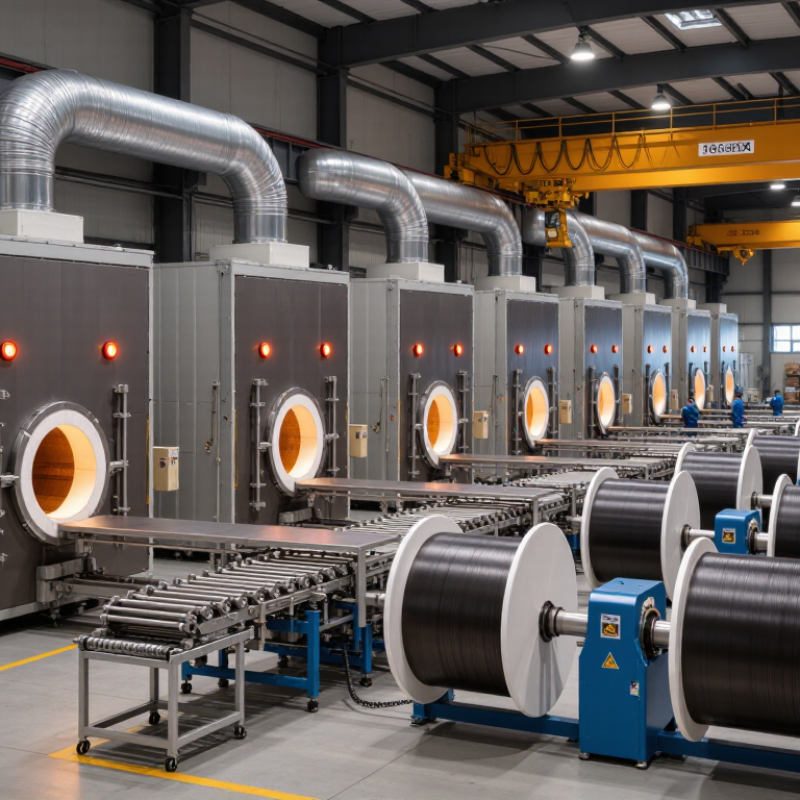
| Final Product Type | Specify whether the line will produce continuous carbon fiber tow, chopped fiber, milled fiber, woven reinforcement, or another intermediate material. | Continuous tow production requires precursor conversion, stabilization, carbonization, surface treatment, sizing, drying, and winding. | Confirm that the factory has designed and commissioned lines for the intended product form and downstream application. |
| Target Application | Identify the end use, such as aerospace structures, pressure vessels, wind-energy components, automotive parts, sporting goods, or industrial composites. | Application requirements determine the required tensile strength, modulus, filament count, surface chemistry, sizing, and consistency. | Ask for documented performance data from materials made on comparable equipment, without relying only on laboratory samples. |
| Precursor Material | Define the precursor chemistry, incoming tow specifications, filament count, linear density, moisture limits, and supply format. | Polyacrylonitrile is the most widely used precursor for structural carbon fiber; pitch is used for selected high-modulus applications. | Verify compatibility between the precursor and tension control, oven design, residence time, and conversion recipe. |
| Tow Size and Filament Count | Select the intended tow size and required number of filaments per bundle. | Common commercial categories include small-tow products below 24,000 filaments and large-tow products at or above 24,000 filaments. | Check whether the line maintains uniform heating, spreading, tension, and sizing across the full tow width and filament count. |
| Annual Production Capacity | State the required output in tonnes per year, operating hours, planned utilization, number of production lines, and expansion target. | A preliminary capacity model should distinguish nameplate capacity from expected saleable output after maintenance, changeovers, and quality losses. | Request mass-balance calculations, line-speed assumptions, yield estimates, and capacity data from a comparable installation. |
| Stabilization Process | Define the number of stabilization zones, temperature profile, residence time, tension strategy, and exhaust requirements. | PAN-based precursor stabilization generally occurs in an oxidizing atmosphere at approximately 200–300°C, depending on the precursor and recipe. | Evaluate temperature uniformity, airflow control, off-gas management, fire protection, and prevention of tow sticking or breakage. |
| Carbonization and Graphitization | Define the required carbonization temperature, optional high-temperature treatment, atmosphere, line speed, and target modulus. | Carbonization commonly uses inert gas at approximately 1,000–1,500°C; optional graphitization may operate above 2,000°C for higher-modulus grades. | Verify furnace temperature uniformity, inert-gas purity, seal performance, energy consumption, emergency shutdown, and electrode or heating-element service life. |
| Surface Treatment and Sizing | Specify the required surface oxidation level, sizing chemistry, sizing add-on percentage, compatibility with the matrix resin, and drying conditions. | Sizing add-on is commonly controlled as a low single-digit percentage of fiber mass, but the correct value depends on the resin system and application. | Confirm bath concentration control, coating uniformity, wastewater treatment, solvent or emission controls, and compatibility testing with the customer’s resin. |
| Mechanical Performance | Set minimum tensile strength, tensile modulus, elongation, density, filament damage rate, and coefficient of variation. | Commercial carbon fiber grades typically target tensile strengths from approximately 3 to 7 GPa and tensile moduli from approximately 200 to 700 GPa, depending on grade. | Require test methods, sampling plans, statistical process capability, calibration records, and acceptance criteria for each property. |
| Line Speed and Tension Control | Define target line speed, allowable tension range, tension zones, tow spreading requirements, and maximum acceptable filament breaks. | Higher line speed can increase output but may reduce conversion uniformity if heating, residence time, and tension control are not properly matched. | Check closed-loop tension control, automatic speed synchronization, break detection, restart procedures, and recipe control. |
| Energy and Utility Demand | List electrical capacity, natural gas or other fuel requirements, inert gas consumption, cooling water, compressed air, ventilation, and wastewater needs. | High-temperature furnaces are major energy consumers; actual demand depends on throughput, insulation, furnace design, temperature profile, and heat recovery. | Request a utility balance with peak and average loads, operating costs, heat-recovery options, and required utility quality specifications. |
| Environmental and Safety Controls | Define requirements for exhaust treatment, volatile organic compounds, hydrogen cyanide risk, hot surfaces, fire protection, inert-gas asphyxiation controls, and emergency response. | Stabilization and carbonization can generate hazardous gases and combustible off-gases; controls must be designed according to local regulations and process chemistry. | Review hazard assessments, interlocks, gas monitoring, ventilation calculations, fire detection, permitting support, and operator safety procedures. |
| Automation and Data Management | Specify the required level of automation, recipe management, alarm history, production tracking, remote diagnostics, and integration with manufacturing systems. | Critical variables normally include zone temperature, tow tension, line speed, gas flow, oxygen level, sizing concentration, and winding parameters. | Confirm data ownership, cybersecurity, audit trails, sensor calibration, control-system redundancy, and availability of spare automation components. |
| Quality Assurance Capability | Define incoming-material inspection, in-process monitoring, final-product testing, traceability, nonconformance handling, and certificate-of-analysis requirements. | Testing may include tensile properties, linear density, sizing content, density, electrical resistivity, surface chemistry, and filament break inspection. | Inspect the factory laboratory, test equipment calibration, standard test methods, measurement uncertainty, and batch-level traceability. |
| Factory Acceptance and Performance Tests | Set measurable acceptance criteria for capacity, yield, product properties, energy consumption, uptime, safety functions, and operator training. | Acceptance tests should use agreed raw materials and production recipes and should distinguish short trial performance from sustained production performance. | Include factory acceptance testing, site acceptance testing, performance guarantees, punch-list closure, documentation delivery, and warranty conditions. |
| Installation and Site Conditions | Define building height, floor loading, line layout, crane access, clean areas, storage, laboratory space, utility rooms, and material flow. | The required footprint varies significantly with line capacity, furnace arrangement, auxiliary equipment, maintenance access, and environmental-control systems. | Request general-arrangement drawings, foundation loads, installation tolerances, shipping dimensions, and a detailed site-preparation responsibility matrix. |
| Lifecycle Support and Spare Parts | Define preventive-maintenance intervals, critical spare parts, local service coverage, training, response time, and expected equipment availability. | Furnace heating elements, insulation, seals, sensors, drives, rollers, pumps, filters, and control components should be assessed as lifecycle items. | Compare spare-parts lead times, maintenance manuals, technician qualifications, remote-support procedures, and total cost of ownership. |