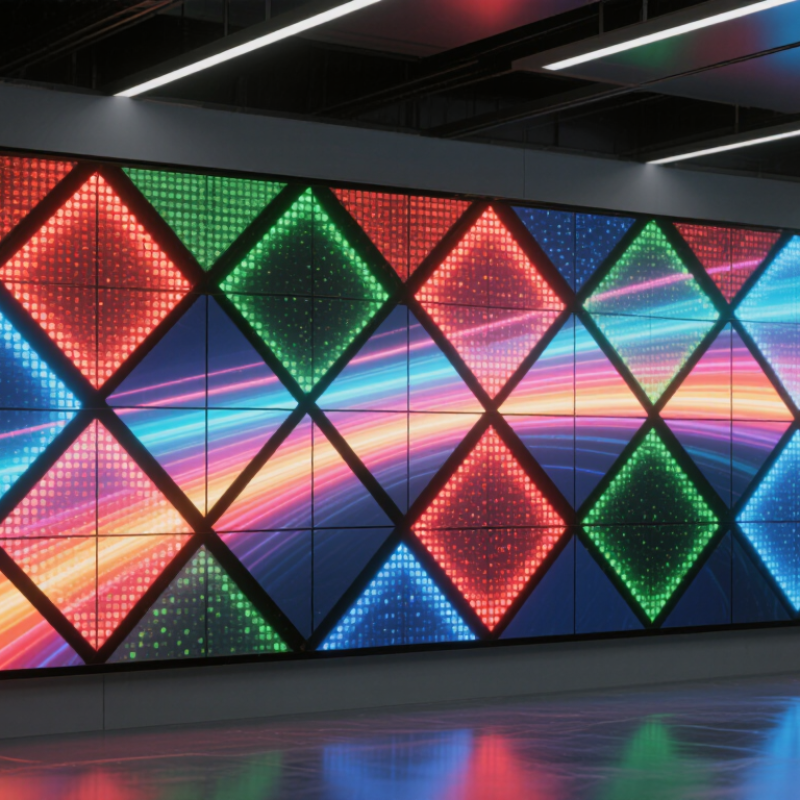
| Display form | A creative LED display assembled in a diamond-shaped layout or from panels installed at angled orientations. | “Diamond” usually describes the display’s shape or arrangement, rather than a separate LED technology. The screen is built from LED modules and a supporting structure. |
| Image formation | Red, green, and blue LEDs combine to produce full-color pixels. | A control system sends image data to the pixels and adjusts their output to create text, graphics, and video. |
| Indoor brightness | Typically about 600–1,500 nits (cd/m²), depending on the installation and viewing conditions. | This range is commonly suitable for indoor environments. The appropriate setting depends on ambient light, viewing distance, and whether the screen faces windows or other bright light sources. |
| Outdoor brightness | Typically 5,000 nits or higher for displays intended to remain visible in bright outdoor conditions. | Higher output helps the image compete with daylight. Actual visibility also depends on screen orientation, direct sunlight, contrast, and the content being shown. |
| Brightness control | Brightness can generally be adjusted through the display controller; some systems support automatic adjustment using an ambient-light sensor. | Setting brightness to suit the environment can improve viewing comfort and avoid using more light output than necessary. |
| Pixel pitch and viewing distance | Pixel pitch is the distance between the centers of neighboring pixels, measured in millimeters. The pitch varies by product and installation. | Smaller pixel pitch can provide a more detailed image at closer viewing distances. The required pitch should be selected for the expected audience distance and content. |
| Viewing angle | Viewing angle varies with the LED package, module design, and display configuration. | For a diamond-shaped installation, consider sightlines from multiple directions because angled faces may appear different in brightness or color from different positions. |
| Outdoor protection | Outdoor suitability depends on the enclosure, sealing, ventilation, and the product’s stated ingress-protection rating. | Brightness alone does not make a display weatherproof. Confirm the rating and installation requirements for exposure to rain, dust, heat, and other site conditions. |
| Calibration and uniformity | Module calibration can help match brightness and color across the display. | Consistent calibration is especially important when multiple modules form angled or geometric surfaces, where differences between sections may be noticeable. |
| Best-fit applications | Examples include indoor feature walls, retail displays, event installations, architectural accents, and outdoor signage designed for daylight viewing. | Choose the display configuration based on the site, ambient light, viewing distance, content, maintenance access, and required environmental protection. |