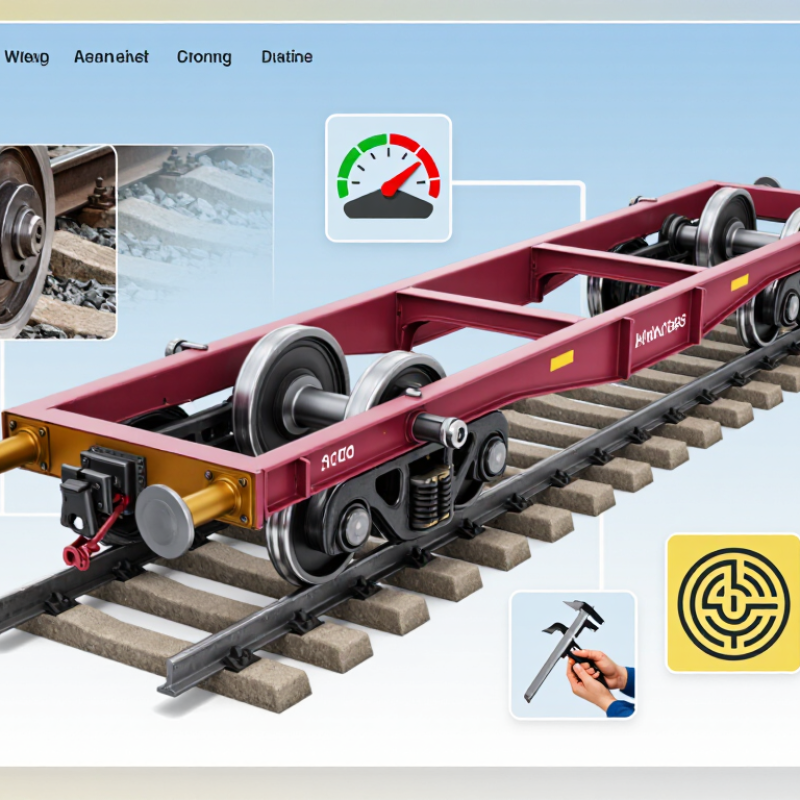
| 1 | Wagon Duty and Operating Route | Identify the wagon type, cargo, empty mass, maximum payload, annual mileage, operating speed, track gauge, climate, and route conditions. Consider whether the wagon will run on domestic or international infrastructure. | Freight wagon design specification, infrastructure manager requirements, gauge profile, route classification, operating temperature range, and maintenance plan. | Define the axle application, service severity, gauge, and operational envelope before selecting dimensions. |
| 2 | Calculate the Required Axle Load | Calculate the maximum static wheelset load from the fully loaded wagon. Include the wagon tare mass, payload, uneven loading allowance, dynamic effects, and the number of wheelsets carrying the load. | Axle load = total loaded wagon mass ÷ number of axles
Apply the applicable dynamic and design safety factors required by the governing railway standard. | Select an axle load category that is not lower than the calculated maximum service load. Common freight applications may use axle loads such as 20 t, 22.5 t, or 25 t, subject to route approval. |
| 3 | Confirm Wheelset and Track Gauge | Match the axle to the required wheelset gauge and wheel arrangement. Verify wheel back-to-back distance, wheel seat spacing, bearing positions, brake disc locations, and clearance to the bogie frame. | Track gauge is the distance between the inner faces of the rails. Standard gauge is 1,435 mm, while other networks use different gauges. Wheelset dimensions must follow the approved vehicle design. | Freeze the axle general arrangement drawing, wheel seat locations, bearing journal positions, and all gauge-related dimensions. |
| 4 | Determine the Axle Geometry | Check wheel seat diameter and length, journal diameter and length, fillet radii, center section diameter, shoulder locations, bearing fits, and required machining allowances. | Dimensions must be compatible with the wheel, bearing, bogie, axlebox, brake system, and available wheelset maintenance equipment. | Choose a proven axle profile with adequate fatigue strength, correct interference fits, and sufficient clearance for assembly and inspection. |
| 5 | Select Axle Material and Steel Grade | Evaluate tensile strength, yield strength, toughness, cleanliness, hardenability, fatigue performance, weldability limitations, and resistance to corrosion-related damage. | Common railway axle specifications include EN 13261 or equivalent national and international standards. Material certification and heat-treatment records are required. | Select a certified railway axle steel grade that satisfies the required mechanical properties, impact toughness, cleanliness, and fatigue performance. |
| 6 | Check Braking and Accessory Interfaces | Confirm whether the axle carries tread brakes, disc brakes, speed sensors, grounding devices, axle-end monitoring equipment, or other mounted components. | Verify brake disc mounting geometry, bolt or shrink-fit requirements, sensor targets, cable routing, axle-end protection, and thermal loads from braking. | Select the axle version and end configuration that accommodate all braking, monitoring, earthing, and maintenance interfaces without reducing fatigue strength. |
| 7 | Perform Strength and Fatigue Verification | Assess vertical bending, lateral loads, torsion, braking forces, press-fit stresses, thermal effects, and stress concentration at fillets and shoulders. | Use the applicable railway axle design method, such as EN 13103-1 or an equivalent approved standard. Consider both static strength and fatigue service cycles. | Approve the axle geometry only when calculated stresses, fatigue safety, and local stress concentrations meet the specified limits. |
| 8 | Define Surface and Manufacturing Requirements | Specify forging quality, heat treatment, straightening limits, machining tolerances, surface roughness, fillet quality, decarburization limits, and protection against corrosion. | Axles are generally manufactured from forged steel and require controlled heat treatment, precision machining, and documented process control. | Create a manufacturing specification covering raw material, forging, heat treatment, machining, dimensional tolerances, and surface condition. |
| 9 | Set Inspection and Non-Destructive Testing | Define checks for chemical composition, mechanical properties, dimensions, runout, surface defects, internal discontinuities, and press-fit surfaces. | Typical controls include ultrasonic testing for internal defects, magnetic particle or equivalent surface inspection, visual examination, dimensional inspection, and hardness testing where specified. | Select an axle supplier and inspection plan capable of providing traceability from steel heat to finished axle and test results. |
| 10 | Verify Wheelset Assembly Compatibility | Confirm wheel bore, axle seat tolerances, required interference, pressing force, wheelset balance, wheel profile, and bearing mounting procedure. | The wheel, axle, and bearing are an integrated wheelset. Pressing, gauging, and inspection must follow the approved assembly procedure. | Release the axle only when it is compatible with the selected wheels and bearings and the complete wheelset can be assembled and inspected correctly. |
| 11 | Check Maintenance and Reprofiling Needs | Consider wheel reprofiling, bearing replacement, ultrasonic inspection intervals, corrosion monitoring, axle journal condition, and limits for re-machining or removal from service. | Maintenance intervals depend on mileage, load spectrum, route conditions, wheel wear, bearing condition, and the vehicle maintenance plan. | Choose an axle design with accessible inspection zones, adequate journal life, clear condemning limits, and documented maintenance instructions. |
| 12 | Confirm Compliance and Documentation | Review design approval, material certificates, heat-treatment records, dimensional reports, non-destructive testing results, fatigue calculations, and traceability documentation. | Depending on the market and vehicle approval route, compliance may involve EN, UIC, national railway regulations, or other recognized technical specifications. | Select the axle configuration that satisfies the complete technical file, approval pathway, route restrictions, and lifecycle maintenance requirements. |