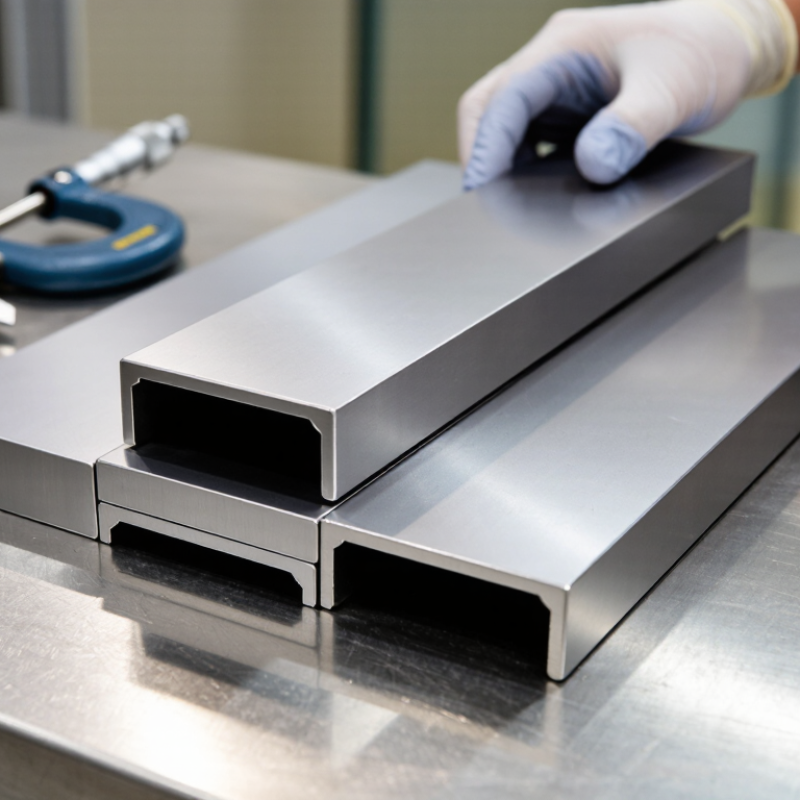
| Material family | Commercially pure niobium plate or sheet, specified to the applicable ASTM B393 material grade. | For applications requiring niobium’s high melting point, corrosion resistance, and superconducting properties. | Confirm the exact ASTM B393 grade, UNS designation, chemical composition, and supply condition on the material certificate. |
| Typical unalloyed grade selection | Grade 1 / Grade 2
Use the specific grade and corresponding UNS designation required by the design or governing specification. | Grade selection should be based on required purity, mechanical properties, forming requirements, and service temperature. | Do not select a grade only by the label “pure niobium”; confirm the grade designation and certified chemistry. |
| Thickness for light fabrication | 0.50–1.00 mm
Common planning sizes: 0.50 mm, 0.75 mm, and 1.00 mm. | Thin covers, diaphragms, liners, laboratory components, and parts requiring relatively easy forming. | Check the minimum bend radius, flatness, surface condition, and whether machining or welding will be performed. |
| Thickness for general plate work | 1.50–5.00 mm
Common planning sizes: 1.50 mm, 2.00 mm, 3.00 mm, and 5.00 mm. | General fabrication, corrosion-resistant components, structural inserts, and machined parts. | Allow for machining loss, dimensional tolerance, edge preparation, and any post-fabrication heat treatment. |
| Thickness for rigid or machined parts | 6.00–12.00 mm or greater, subject to mill capability and order quantity. | Components requiring stiffness, deeper machining, heavy-duty handling, or additional material for finishing. | Confirm availability, thickness tolerance, internal soundness, flatness, and the required inspection level. |
| Small cut-piece dimensions | Approximately 100 × 100 mm to 300 × 300 mm. | Prototype work, laboratory testing, small components, and trial fabrication. | Specify whether dimensions are nominal, finished, or saw-cut dimensions, and state the permitted cutting tolerance. |
| Medium plate dimensions | Approximately 300 × 300 mm to 600 × 600 mm. | Small-batch fabrication and components that require a larger working area. | Confirm the usable area after edge trimming and identify any required rolling or grain-direction information. |
| Large plate dimensions | Approximately 600 × 600 mm to 1,000 × 2,000 mm, depending on thickness and production capability. | Large liners, panels, vacuum or high-temperature components, and parts requiring fewer welded joints. | Check maximum available plate size, flatness, handling limitations, packaging, and transport protection. |
| Surface condition | Specify as-rolled, pickled, chemically cleaned, ground, or polished surface as required. | Choose a cleaned or polished surface for vacuum, chemical, laboratory, or appearance-critical applications. | Define allowable scratches, pits, discoloration, oxide scale, and surface roughness where applicable. |
| Forming requirement | State whether the plate will be bent, deep-drawn, spun, or otherwise cold-formed. | Important when the finished part contains curves, flanges, or tight-radius bends. | Request suitable temper or annealed condition when needed, and confirm forming limits before production. |
| Welding requirement | Identify the welding process, joint design, filler-metal requirement, and shielding-gas purity. | Required for assemblies exposed to high temperature, corrosive media, or vacuum service. | Niobium is highly reactive at elevated temperature; effective inert-gas shielding and clean joint preparation are essential. |
| Dimensional tolerance | Specify thickness, length, width, squareness, flatness, and cutting tolerances separately. | For precision-machined parts or components that must fit within a controlled assembly envelope. | Use the applicable material standard or agreed purchase specification rather than relying on an unspecified “standard tolerance.” |
| Certificate and inspection | Material test report with grade, chemical analysis, mechanical data where applicable, dimensions, heat or lot number, and inspection results. | For traceable production, regulated applications, vacuum equipment, and quality-controlled projects. | State required documentation before order placement; inspection requirements can affect lead time and cost. |