How to Choose the Right Industrial Seal Strip?
Choosing the right Industrial Seal Strip is a performance decision, not a simple purchasing task. A strip may look suitable on a clean sample, yet fail beside heat, oil, vibration, or rain. Field experience shows that small gaps often become large maintenance problems. Door edges harden. Corners pull loose. Compression becomes uneven.
Industry reports support this growing concern. Grand View Research’s Industrial Seals Market report identifies rising demand for reliable sealing products across automotive, construction, and industrial equipment. MarketsandMarkets’ Gaskets and Seals Market analysis also highlights stricter performance expectations, longer service intervals, and broader use of engineered elastomers. These findings are useful, but they are not a universal specification. Actual performance depends on the equipment and environment.
Details matter. EPDM commonly suits outdoor exposure, water, and ozone. Silicone performs well across wide temperature ranges, but it may resist abrasion less effectively. Nitrile rubber is often considered for oil contact, although compound quality changes the result. The strip’s hardness, profile, adhesive system, compression ratio, and installation surface must work together. ISO 2230 provides storage guidance for rubber products, while ASTM methods support material and performance testing. Use these references carefully.
A neat datasheet can still mislead. That is worth remembering. Measure the gap at several points, not only at the widest section. Record temperature, pressure, movement, and chemical exposure before selecting a profile. A dependable choice balances sealing force, recovery, durability, and total maintenance cost. This guide explains how to compare those factors and avoid a seal strip that fits perfectly today, but fails too early.
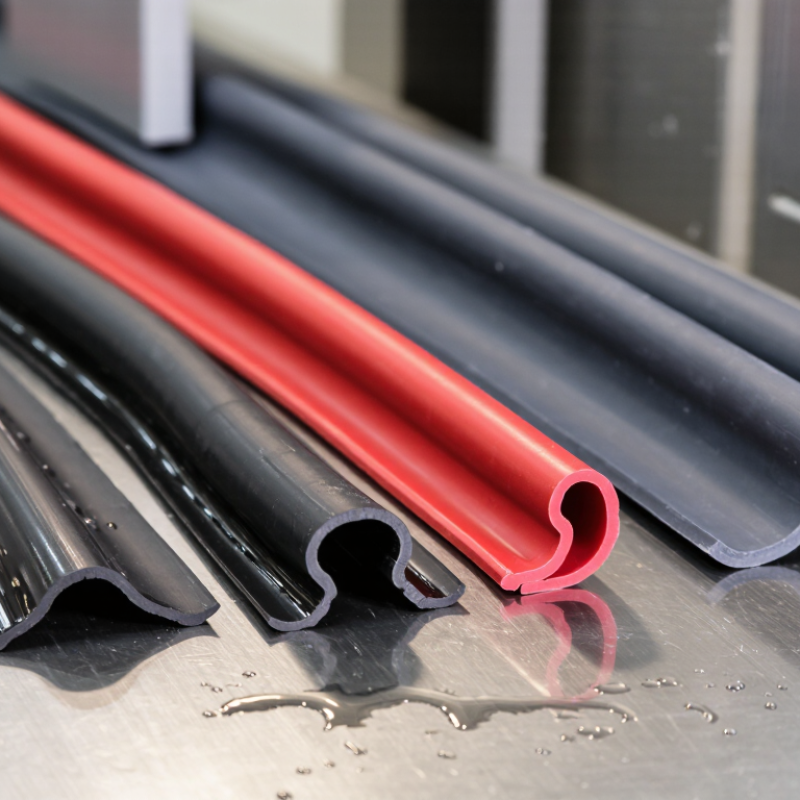
Define Seal Strip Functions Using ISO 3601, ASTM D2000, and EN 13501
Choosing the right industrial seal strip begins with its function, not its shape. ISO 3601 helps define dimensional control, tolerances, and sealing performance for elastomeric sealing elements. Use it when the strip operates like an O-ring or fits a controlled groove. Measure the groove width, compression, temperature range, and movement. A strip that looks suitable may still leak after repeated cycling.
ASTM D2000 supports material selection by classifying rubber compounds through heat, oil, hardness, and aging requirements. Compare the specification with real exposure, such as hot hydraulic fluid, outdoor ozone, or cleaning chemicals.
EN 13501 addresses reaction-to-fire classification, which matters for transport, construction, and equipment near ignition sources. Do not treat fire classification as a complete seal specification. The finished assembly may behave differently from the raw rubber. Testing remains necessary.
Tips: Request batch test reports, hardness results, dimensional records, and aging data. Check compression set after realistic exposure, not only at room temperature. I have seen seals pass initial inspection, then lose recovery after a few weeks. That failure is easy to miss. Confirm installation pressure and surface finish too. Standards provide a reliable framework, but they cannot replace field experience. Choose a compound and profile that match the actual duty cycle, while leaving room for conditions you may have underestimated.
Classify Materials by Temperature, Chemical Resistance, and Compression Set Data
How to Choose the Right Industrial Seal Strip?
Material selection should begin with the real operating temperature, not the advertised maximum. Silicone suits wide temperature swings and remains flexible in cold environments. EPDM performs well with hot water, steam, and weather exposure. NBR is practical for mineral oils and moderate heat. FKM often handles higher temperatures and aggressive chemicals, but it may cost more. These are useful starting points, not final answers.
Chemical resistance must match the actual fluid, concentration, and exposure time. A seal touching diluted cleaner may behave differently in concentrated chemicals. Check laboratory compatibility data, then confirm it with a small trial. I have seen suitable materials fail because the fluid contained an overlooked additive. Compression set data matters just as much. A low compression set usually indicates better recovery after prolonged squeezing. Compare values tested at the same temperature, duration, and compression percentage. Otherwise, the numbers can mislead.
Tips: Record the minimum and maximum temperatures, fluid names, pressure, and sealing gap. Ask for compression set results under conditions close to your application. Inspect a test strip after heat aging. It should not feel permanently flattened or brittle. Do not select by hardness alone. A softer strip may seal uneven surfaces, but it can extrude under pressure. Real installations are rarely perfect. Include tolerance changes, surface damage, and installation mistakes in your review. If data is incomplete, mark the decision as provisional and test longer.
How to Choose the Right Industrial Seal Strip?
Material selection should balance operating temperature, chemical resistance, and compression set. Lower compression set generally indicates better long-term sealing recovery.
Typical engineering values: temperature limits are approximate continuous-service ranges; chemical resistance is a comparative 1–5 rating across common industrial media; compression set values are representative percentages measured around 100°C for 22 hours. Actual performance depends on compound formulation, test method, pressure, and exposure conditions.
Match Seal Profiles to Pressure, Gap, and IP65–IP69K Requirements
How to Choose the Right Industrial Seal Strip?
Match the seal profile to pressure, gap, and the required IP rating. A static seal may need 20–30% compression, but excessive compression can damage soft materials. Pressure direction also matters. Internal pressure can push a seal toward the extrusion gap, causing leakage or permanent deformation. I would not trust a catalog gap value alone. Test the actual flange, fasteners, temperature, and surface finish.
IP ratings describe enclosure protection, not a seal strip’s complete performance. IEC 60529 defines IP65 as dust-tight protection against water jets. IP66 uses more powerful water jets, while IP67 covers temporary immersion. IP68 requires an agreed immersion depth and duration.
For harsh washdown, ISO 20653 specifies IPX9K testing with water near 80°C, roughly 8–10 MPa pressure, and flow around 14–16 liters per minute. That is severe.
Choose a bulb, hollow, or lip profile according to the available gap and closing force. A hollow profile can absorb larger tolerances, but it may collapse under high pressure. A solid profile offers stronger resistance, yet it needs tighter dimensional control. Leave room for thermal expansion. Small gaps become larger after vibration, cycling, or uneven tightening. Test samples after repeated compression, not only when new. Seals can pass a dry inspection and still fail during angled spray.
Verify Sealing Quality Through ASTM D395, ISO 815, and Leak-Test Criteria
How to Choose the Right Industrial Seal Strip?
A reliable seal strip must perform beyond a clean showroom sample. Start by checking ASTM D395 and ISO 815 compression-set results. These tests show how well rubber recovers after long compression. A high compression set can leave a permanent gap. That gap may appear after heat, vibration, or repeated closing. Review the test temperature, compression level, exposure time, and recovery period. Results are not comparable when conditions differ. Use the current standard edition and request complete test records.
Leak testing should match the real assembly. Pressure-decay testing can reveal slow losses in sealed chambers. Bubble testing may locate visible leaks around corners and joints. For critical applications, a tracer-gas method can detect smaller leakage paths. Set acceptance limits before testing. Record pressure, test duration, temperature, fixture design, and strip length. A seal that passes once may still fail after installation. Surface damage, uneven compression, and poor joint alignment often cause unexpected leakage. Field conditions deserve attention.
Tips: Measure the groove and mating surfaces before choosing a profile. Aim for controlled compression, not maximum compression. Test samples after heat aging and repeated compression when service demands it. Inspect corners by hand. They are often the weak point. Do not rely on one number alone. Compression-set data supports selection, but it cannot replace a realistic leak test. I have seen apparently excellent strips fail because the enclosure warped slightly during tightening. That detail is easy to miss.