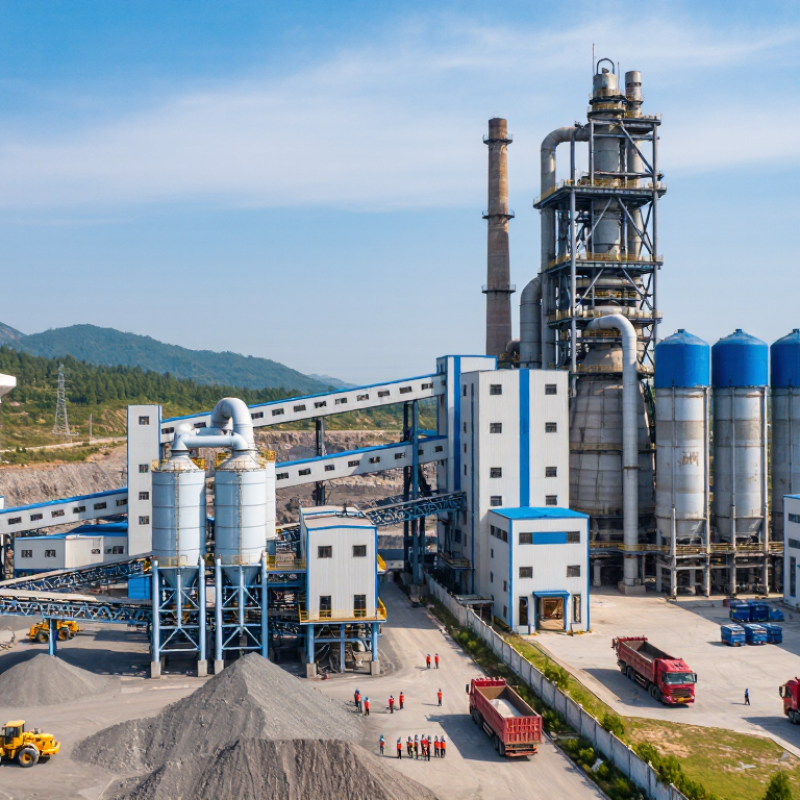
How to Choose the Right Cement Plant for Your Business?

Choosing the right Cement Plant is a major business decision. It affects production capacity, product quality, operating costs, and long-term profitability. A poorly matched facility may leave expensive equipment idle or create costly maintenance problems.

The best choice begins with a clear understanding of your market. Review local demand, planned construction projects, transport distances, fuel availability, and environmental requirements. A plant near reliable limestone reserves can reduce raw material costs. However, location alone does not guarantee success. Power stability, skilled labor, water access, and road conditions also matter.

Capacity should match realistic sales forecasts, not optimistic assumptions. A 5,000-ton daily plant may appear attractive, but unused capacity can weaken cash flow. Examine kiln technology, energy efficiency, automation, dust-control systems, and spare-parts support. Ask suppliers for verified performance data, operating references, and maintenance records. Visit comparable plants when possible. A clean control room means little if production stops every month.

Financial evaluation needs more than the purchase price. Include installation, civil construction, training, fuel consumption, repairs, staffing, and future upgrades. Reliable suppliers should explain technical limits clearly. They should also provide transparent warranties and responsive after-sales service.

No checklist is perfect. Market conditions can change. Experienced managers still make wrong estimates. That is why independent technical reviews, site inspections, and scenario planning are valuable. The right Cement Plant is not always the largest or newest option. It is the facility that fits your resources, market, risk tolerance, and growth plans with measurable evidence.

How to Choose the Right Cement Plant for Your Business?

Define Your Cement Production Requirements

Choosing a cement plant starts with a clear production requirement, not a machine catalogue. Define your expected output in tonnes per day and identify your cement types. Ordinary Portland cement may require different grinding settings than blended cement. Measure it twice. Small differences matter.

Record the strength grades, setting times, and packaging formats your customers require. Then inspect your raw materials carefully. Limestone hardness, moisture, clay content, and particle size affect the whole process. A quarry sample can reveal more than a general laboratory report. In practice, material quality often changes during different seasons. Plan for that variation.

Your energy supply also needs a realistic assessment. Note available electricity, fuel quality, water access, and local environmental requirements. Estimate dust control, noise management, maintenance space, and waste handling before discussing equipment capacity. An oversized plant can create unnecessary costs, while an undersized plant may limit contracts. Our first production estimate was wrong because we ignored weekend demand. That mistake changed our planning method. We now compare normal, peak, and low-demand scenarios.

Consider the skills of your operating team. A complex system is not automatically a better investment if trained technicians are unavailable. Ask suppliers for verifiable performance data, maintenance records, and commissioning support. Check whether spare parts can arrive within your actual logistics conditions. Leave room for future expansion, but avoid paying for capacity you cannot use. Each requirement should connect to a measurable business need.

How to Choose the Right Cement Plant for Your Business?

Define Your Cement Production Requirements

Annual production capacity is a key factor when selecting a cement plant. Smaller facilities can suit regional markets, while larger integrated plants require stronger limestone reserves, logistics infrastructure, and long-term demand. The capacity levels shown represent common planning scenarios for cement production projects.

Capacity is measured in million tonnes of cement per year (Mt/y).

Compare Cement Plant Types and Production Technologies

How to Choose the Right Cement Plant for Your Business?

Compare Cement Plant Types and Production Technologies

Choosing a cement plant starts with comparing production routes, not copying a nearby facility. An integrated plant crushes, grinds, burns, and finishes clinker on one site. It offers tighter process control, but requires substantial capital, land, and reliable limestone supplies. A grinding-only plant buys clinker and focuses on cement milling and blending. This model can reduce construction time, although transport costs may become decisive. Modular units suit phased investment. They may sacrifice efficiency at larger volumes.

Dry-process technology usually uses less heat than wet processing. A preheater and precalciner recover energy from hot exhaust gases before firing. Wet lines can handle sticky, high-moisture raw materials, but water removal consumes considerable fuel. Semi-dry systems sit between these options and deserve a site-specific calculation. Compare kiln capacity, fuel flexibility, grinding power, dust control, and alternative-material compatibility. Ask for measured data, not attractive estimates. Electrical demand often surprises new investors.

During technical reviews, inspect maintenance access, spare-part lead times, laboratory procedures, and operator training. A plant may achieve its rated output only under ideal feed and fuel conditions. Capacity is only paper. Real production can fall during rainy seasons, power fluctuations, or raw-material changes. I would test several operating scenarios before selecting equipment. The cheapest quotation is not always the lowest-cost plant. That distinction is easy to miss. Leave room for correction. A flexible design may protect quality when assumptions prove wrong.

Evaluate Capacity, Location, Infrastructure, and Energy Needs

How to Choose the Right Cement Plant for Your Business?

Capacity should match realistic demand, not optimistic forecasts. The U.S. Geological Survey reported global cement production near 4.1 billion tonnes in 2023. That scale hides major regional differences. A plant designed for 2 million tonnes annually may become inefficient if local demand remains below 60% of that level. Review five-year sales data, public infrastructure plans, and seasonal construction patterns before approving equipment.

Location affects margins every day. Cement is heavy, so transport distance can quickly erase production savings. Assess quarry access, highway quality, rail connections, and customer proximity. Ports may help imported materials, but congestion and storage limitations create delays. Infrastructure matters inside the site, too. Confirm stable water supply, substations, workshops, laboratories, and dust-control systems. Small gaps become expensive during maintenance.

Energy deserves tougher scrutiny. The International Energy Agency estimates cement production creates about 7% of global energy-related carbon dioxide emissions. Compare kilowatt-hours per tonne, thermal fuel consumption, grid reliability, and opportunities for alternative energy. Ask for measured operating data, not only design promises. A short trial can reveal unstable voltage or excessive heat loss. Reports also vary by region, so verify every benchmark locally. I have seen capacity models look impressive while weak roads quietly damage profitability. The uncomfortable question is whether the plant fits your operation, not whether it looks advanced.

Assess Costs, Suppliers, Quality Standards, and Environmental Impact

How to Choose the Right Cement Plant for Your Business?

A cement plant should fit your budget, production goals, and local operating conditions. Purchase price matters, but it rarely shows the full cost. Energy use, maintenance, spare parts, labor, transport, and downtime can change the calculation quickly. I once underestimated installation delays during an early project review. That mistake taught me to request a complete cost schedule, including commissioning and training.

Supplier reliability deserves close attention. Visit operating plants when possible. Ask for maintenance records, delivery timelines, warranty terms, and technical support details. A dependable supplier should explain limitations clearly, not only promise high output. Quality standards must also be measurable. Check cement strength, setting time, chemical composition, testing procedures, and laboratory equipment. Independent inspections can expose gaps that attractive brochures hide.

Tips: Compare at least three detailed quotations. Request energy consumption data from similar installations. Review dust-control systems, wastewater handling, noise levels, and fuel efficiency. Confirm that the plant design supports applicable environmental permits and reporting duties. Ask how emissions are monitored daily. Small leaks and dusty transfer points can become expensive problems. Keep evidence, not promises.

Environmental performance is also a business issue. Efficient kilns may reduce fuel costs and emissions together. However, advanced equipment can require skilled operators and higher upfront spending. The cheapest option may not be the most responsible one. A careful decision balances verified quality, realistic costs, supplier competence, and long-term environmental performance.

Verify Compliance, After-Sales Support, and Long-Term Scalability

Choosing a cement plant is not only a capacity decision. It is a compliance and service decision. The International Energy Agency reports that cement production contributes about 7% of global CO2 emissions. Therefore, verify the plant’s environmental controls before signing. Request emissions test records, dust-filter specifications, energy data, and permits required in your target market. Independent audits are more credible than sales brochures.

After-sales support determines whether production remains stable after commissioning. Ask for a written spare-parts plan, technician response times, training hours, and remote diagnostic coverage. Check whether critical parts are locally stocked. Review previous installation records, not just promised performance. The Global Cement and Concrete Association identifies digital monitoring, efficiency, and lower-carbon production as important industry priorities. A plant that cannot measure fuel use, downtime, and emissions may become expensive to improve later.

Tips: Build a supplier scorecard before comparing prices. Include compliance evidence, warranty terms, maintenance costs, and upgrade options. Visit an operating plant, if possible. Speak with its maintenance team privately. Long-term scalability should be tested with realistic numbers. Can the kiln, grinding system, storage, and power supply expand without rebuilding everything? The IEA’s net-zero pathway requires major efficiency gains and lower-carbon fuels in cement. A scalable design should support those changes. I have seen buyers focus too heavily on initial output. That is understandable, but incomplete. The cheapest plant may not remain cheap.

How to Choose the Right Cement Plant for Your Business? - Verify Compliance, After-Sales Support, and Long-Term Scalability
Evaluation Dimension Recommended Benchmark Data or Documents to Verify Key Evaluation Questions Priority Decision Status
Product Standards and Certification The proposed cement grades should comply with the applicable national or regional standard, such as EN 197-1 for common cements or ASTM C150 for Portland cement. Current product certificates, test reports, declared cement composition, strength-class data, and conformity-assessment records. Which standard applies in the target market? Can the plant consistently produce the required strength class, setting time, soundness, and chemical composition? High Required
Environmental Compliance The project should meet all applicable air-emission, dust-control, noise, wastewater, waste-handling, and environmental-impact requirements before commissioning. Environmental permits, emission-monitoring plans, dust-collector specifications, stack-test results where available, and environmental-impact documentation. What are the permitted emission limits? Are continuous or periodic measurements required? How are kiln dust, bypass dust, and used filter bags handled? High Required
Quality Management System A documented quality-management system aligned with ISO 9001:2015 is recommended for controlled production, testing, nonconformity management, and continual improvement. Valid certification scope, internal-audit records, calibration certificates, laboratory procedures, corrective-action logs, and product traceability records. Does the certification cover cement production and testing? How are raw-material variations and out-of-specification cement managed? High Recommended
Plant Capacity Fit Select a nominal capacity that covers expected demand while allowing for maintenance downtime, seasonal peaks, ramp-up losses, and future demand growth. Independent capacity calculation, mass-balance data, equipment nameplate ratings, production assumptions, and references from comparable operating lines. Is the stated capacity based on clinker production, cement grinding, or finished dispatch? What operating hours, raw-material properties, and product mix are assumed? High Required
Energy Performance Compare guaranteed electricity and thermal-energy consumption on the same basis, including fuel type, moisture content, product mix, and operating conditions. Guaranteed specific power consumption in kWh per tonne of cement, thermal consumption in GJ per tonne of clinker, test conditions, and energy-metering plan. Are the energy figures guaranteed or only estimated? Are grinding, conveying, dust collection, auxiliary systems, and fuel preparation included? High Required
Raw-Material Flexibility The plant should accommodate the expected range of limestone hardness, moisture, chemical composition, and supplementary cementitious materials. Raw-material laboratory analysis, grindability tests, moisture data, chemical-variation limits, equipment design basis, and trial results where applicable. Can the system use local limestone and alternative materials? What happens if moisture, silica, alkalis, or clay content changes? High Required
Automation and Process Control The control system should provide closed-loop process control, alarm management, production records, historian functions, and secure access management. Control-system architecture, instrument list, functional descriptions, cybersecurity procedures, alarm philosophy, and operator-training plan. Can operators trace quality and energy data by batch or time period? Are critical instruments redundant and easy to calibrate? Medium Recommended
Safety and Worker Protection The design should include machine guarding, lockout/tagout provisions, emergency stops, confined-space controls, safe access, and documented risk assessments. Hazard assessments, safety-instrumented functions where applicable, guarding drawings, emergency-response procedures, training records, and inspection schedules. How are kiln, mill, conveyor, silo, and electrical hazards controlled? Are maintenance isolation points clearly identified and accessible? High Required
After-Sales Service The service package should define commissioning support, response times, remote assistance, preventive maintenance, troubleshooting, and spare-parts availability. Service-level agreement, support organization chart, escalation procedure, commissioning schedule, maintenance manuals, and spare-parts list with lead times. Who provides local technical support? What is the guaranteed response time for critical failures? Which spare parts are stocked locally? High Required
Warranty and Performance Guarantees The contract should define measurable guarantees for capacity, product quality, energy consumption, emissions, availability, and remedy procedures. Draft contract, acceptance-test protocol, performance-guarantee table, liquidated-damages terms, warranty duration, and exclusions. How will performance be measured and witnessed? What compensation or corrective action applies if guaranteed values are not achieved? High Required
Spare Parts and Maintainability Critical wear parts and control components should have defined service lives, replacement procedures, and documented procurement lead times. Recommended two-year spare-parts list, bills of materials, wear-life assumptions, interchangeability data, lubrication schedules, and inventory policy. Which components can stop the entire line? Are alternatives available for obsolete electrical, automation, or mechanical parts? High Recommended
Expansion and Modular Scalability The layout should reserve space and utility capacity for additional grinding, storage, packing, loading, waste-heat recovery, or alternative-fuel systems. Master site plan, structural-load allowances, utility-capacity study, expansion tie-in points, equipment layout, and future product roadmap. Can capacity be increased without replacing the main kiln or disrupting current production? Which future upgrades require civil or electrical changes? High Recommended
Local Infrastructure and Logistics The location should provide reliable electricity, fuel, water, transport access, storage areas, and practical routes for incoming raw materials and outgoing cement. Utility-availability letters, power-quality data, road and port assessments, water-balance study, storage calculations, and transport-cost model. Can the site handle peak truck traffic and heavy equipment delivery? What backup systems are required for power, water, and fuel? High Required
Total Cost of Ownership Compare capital cost together with energy, labor, maintenance, consumables, environmental compliance, downtime, financing, and end-of-life costs. Ten-year total-cost model, lifecycle assumptions, maintenance budget, energy-price scenarios, staffing plan, consumables forecast, and downtime assumptions. Which costs are excluded from the purchase price? How sensitive is the project to fuel prices, electricity tariffs, exchange rates, and lower-than-expected utilization? High Required
Training and Knowledge Transfer The supplier should provide structured training for production, laboratory, maintenance, automation, safety, and management personnel. Training matrix, course materials, simulator or classroom plan, competency assessments, operating procedures, and post-start-up support schedule. Is training delivered before commissioning and during ramp-up? Can the operating team independently diagnose common process and equipment faults? Medium Recommended
Supplier Financial and Project Delivery Capability The selected contractor should demonstrate adequate resources, relevant project experience, transparent subcontracting, and a realistic schedule with clear milestones. Audited financial information where available, project references, staffing plan, schedule, risk register, procurement plan, and evidence of completed acceptance tests. Who is responsible for engineering, construction, commissioning, and integration? What are the main schedule risks and mitigation actions? High Required
Digital Monitoring and Future Upgrades The plant should support secure data collection, performance dashboards, condition monitoring, and integration with maintenance or enterprise systems. Data architecture, communication protocols, user-access policy, historian specifications, cybersecurity controls, and upgrade roadmap. Who owns the process data? Can the system integrate with future laboratory, maintenance, energy, or emissions-monitoring applications? Low Optional
Recommended decision rule: Do not approve a cement plant solely on the lowest purchase price. Require documented compliance, independently verifiable performance guarantees, defined after-sales obligations, and a lifecycle-cost comparison before signing the contract.
Find the Right Repair Product for Your Project

Need to find the most appropriate product for the needs of your project? We can help because we have over 70 years of experience servicing the industry with every kind of project, from Do-it-yourself projects to large skyscrapers. Package Pavement has the experience, the knowledge and the products to help every project succeed.

Quikrete Repair Products
Legend
Package Pavement has two convenient locations in Stormville, NY (Dutchess County) and Ravena, NY (Greene County) to serve the Northeastern Region with bagged concrete, blacktop, mortar, and repair products. This map gives a general idea of where we service and the product lines we offer.
Package Pavement Products
Quikrete Products
Spec Mix Products
map

Our Brands Websites