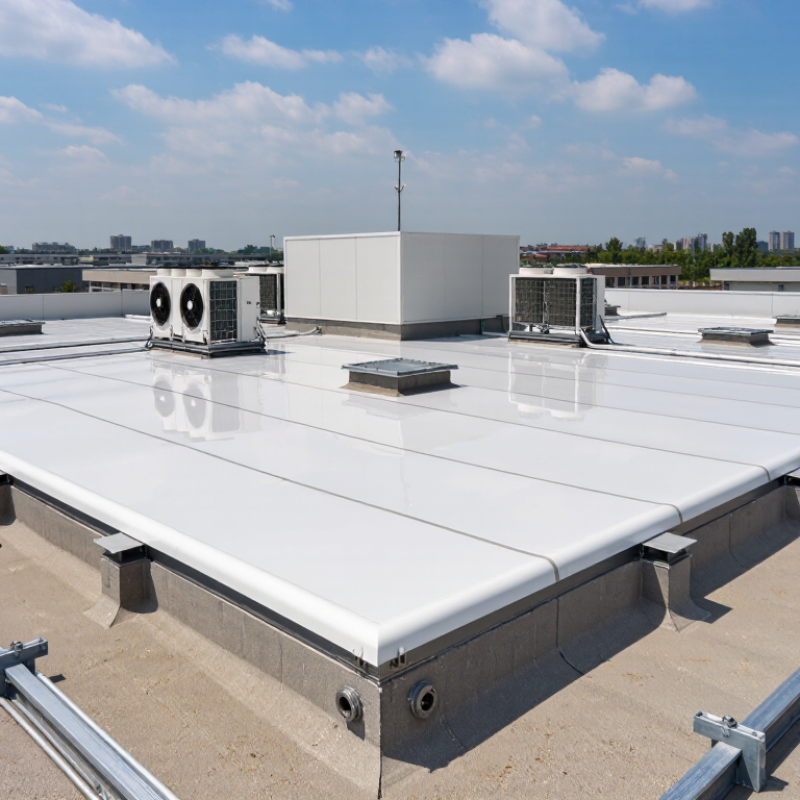
| Material Definition | PVC roofing is a thermoplastic single-ply membrane made primarily from polyvinyl chloride, plasticizers, stabilizers, pigments, and reinforcing materials where required. | The formulation and reinforcement affect flexibility, dimensional stability, weldability, and weathering performance. | Review the published product data sheet and confirm that the membrane is intended for the roof assembly and climate. |
| Applicable Standard | ASTM D4434 is the standard specification for poly(vinyl chloride) sheet roofing. It addresses material classifications and performance requirements for PVC roofing sheets. | A recognized standard provides a consistent basis for comparing membrane properties and specification compliance. | Ask for current, documented ASTM D4434 compliance; do not treat the ASTM reference alone as a complete roof-system approval. |
| Membrane Construction | Common constructions include non-reinforced, scrim-reinforced, and fleece-backed PVC membranes. | Reinforcement improves dimensional stability and resistance to tearing, while fleece backing can provide separation and additional protection over suitable substrates. | Use reinforced sheets for many mechanically attached or high-wind assemblies; select fleece backing when the approved assembly requires added substrate protection. |
| Typical Thickness Range | Commercial PVC roofing membranes are commonly available in approximately 45–90 mil thicknesses, with thicker options used where additional durability is desired. | Thickness can influence puncture resistance, handling, expected serviceability, and installed cost. | Choose thickness according to traffic, maintenance exposure, wind design, hail risk, substrate condition, and the approved assembly—not thickness alone. |
| Seam Technology | PVC seams are generally joined by hot-air welding, creating a fused membrane-to-membrane connection. | Properly welded seams can provide strong, watertight joints and allow seam quality to be checked during installation. | Require trained installers, suitable welding equipment, clean surfaces, correct welding temperatures, and documented seam testing. |
| Solar Reflectance and Heat Control | Light-colored PVC membranes can provide high solar reflectance and reduce roof-surface heat compared with dark roof coverings under similar conditions. | Reflective surfaces may reduce cooling demand and thermal stress, although actual energy savings depend on climate, insulation, HVAC efficiency, and roof design. | Compare independently documented solar reflectance, thermal emittance, and aged-performance data where energy performance is important. |
| Chemical Resistance | PVC membranes generally provide useful resistance to many water-based chemicals, oils, greases, and industrial contaminants, but performance varies by formulation and exposure. | Restaurants, manufacturing areas, waste facilities, and other specialized buildings may expose roofing to chemicals that can damage some membranes. | Obtain a chemical-compatibility review for recurring or concentrated exposure before final material selection. |
| Fire and Code Performance | Fire performance depends on the complete roof assembly, including the membrane, insulation, cover board, deck, attachment method, slope, and penetrations. | A membrane's individual properties do not establish the fire classification of the installed roof system. | Verify the required fire classification, wind uplift rating, and local code approvals for the complete assembly. |
| Wind and Attachment Options | PVC systems may be installed using mechanical attachment, adhered applications, or approved induction-welded attachment methods, depending on the system design. | Attachment method affects wind resistance, installation speed, substrate requirements, penetrations, and repair procedures. | Base the design on project-specific wind calculations and tested or approved assembly data. |
| Expected Service Life | A properly designed, installed, and maintained PVC roof is commonly discussed as providing approximately 20–30 years of service life; actual life may be shorter or longer. | Ultraviolet exposure, weather, ponding water, foot traffic, workmanship, drainage, maintenance, and membrane formulation all affect durability. | Use 20–30 years as a planning range rather than a guarantee, and evaluate project-specific service-life evidence. |
| Ponding Water and Drainage | PVC membranes can be used on low-slope roofs, but positive drainage and properly designed slopes remain important for long-term roof performance. | Persistent ponding can increase dirt accumulation, biological growth, seam stress, and exposure to contaminants. | Correct drainage defects, confirm drain and scupper capacity, and follow the membrane manufacturer's allowable ponding-water requirements. |
| Maintenance Requirements | Routine maintenance includes inspections, drain cleaning, removal of debris, checking flashings and seams, and prompt repair of punctures or damaged accessories. | Preventive maintenance helps identify small defects before they become leaks or widespread system damage. | Schedule inspections at least annually and after severe weather, with more frequent reviews for high-traffic or industrial roofs. |
| Best-Fit Building Applications | Common applications include warehouses, commercial buildings, institutional facilities, retail properties, and low-slope roof renovations. | PVC is especially useful where heat reflection, welded seams, chemical resistance, or lightweight single-ply construction is required. | Match the membrane to the roof deck, insulation, occupancy, climate, maintenance traffic, and expected exposure conditions. |
| Final Selection Checklist | Confirm ASTM D4434 compliance, membrane construction, thickness, reinforcement, seam method, wind uplift rating, fire classification, drainage design, accessory compatibility, installation requirements, and maintenance plan. | Roof performance depends on the complete system rather than on the membrane sheet alone. | Select the option with verified assembly data, qualified installation, suitable accessories, and a realistic 20–30-year lifecycle plan. |