| Best suited to | Increasing biological capacity at an existing plant, especially where adding conventional aeration-basin volume is difficult. | Wastewater with changing flow or biodegradable organic loads, provided toxic or inhibitory compounds are identified and managed. | Improving ammonia removal or adding biological treatment capacity where discharge limits require more consistent performance. |
| Key design inputs | Average and peak flow, influent BOD5/COD, temperature, existing tank dimensions, and downstream clarification capacity. | Flow and load profiles, COD fractionation, pH, temperature, salinity, toxicity, and the effect of production cycles or cleaning discharges. | Influent ammonia, required effluent ammonia, minimum wastewater temperature, alkalinity, dissolved oxygen, and available contact time. |
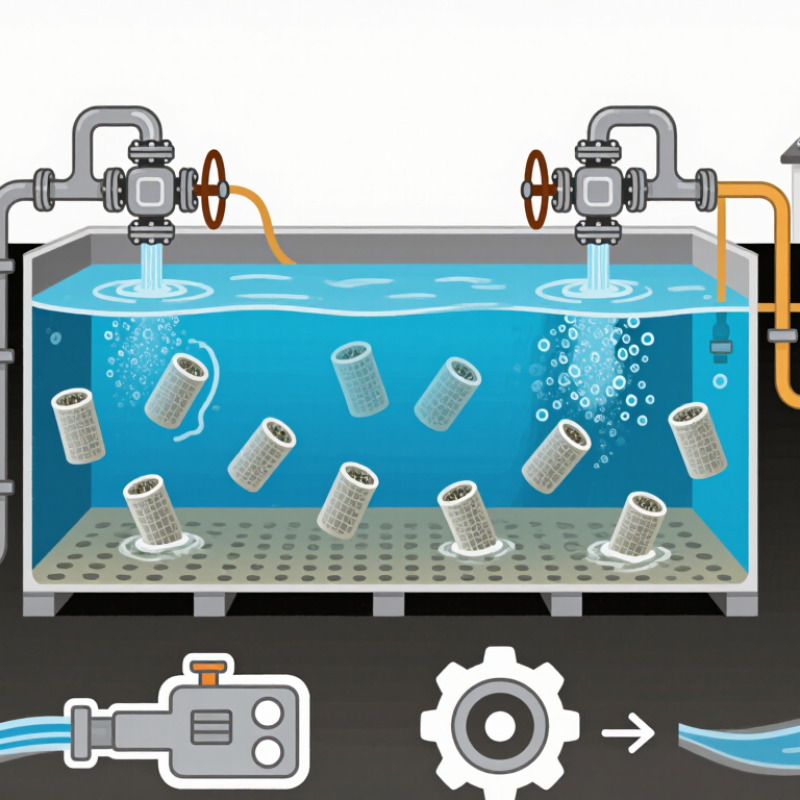
| Media fill and retention | Media fill is commonly selected within roughly 30–60% of reactor volume, subject to media geometry, mixing, screen design, and supplier limits. | Fill fraction is established by the required treatment capacity and hydraulic mixing checks; higher fill is not automatically better. | Reactor sizing must provide sufficient protected biofilm area and contact time at the coldest expected operating conditions. |
| Aeration and mixing | Provide oxygen for carbon removal and enough mixing to keep carriers moving throughout the reactor; verify blower and diffuser capacity. | Design for peak oxygen demand and load swings. Equalization, staged treatment, or load control may be needed for stable operation. | Maintain oxygen and alkalinity for nitrification. Nitrification commonly requires more oxygen and is more temperature-sensitive than carbon removal. |
| Solids separation | Confirm that the existing clarifier or downstream separation process can handle the additional suspended solids and sloughed biofilm. | Allow for variable solids production and consider pretreatment where oil, grit, or high suspended solids could disrupt operation. | Include reliable downstream solids capture; an MBBR reactor alone does not remove suspended solids from the final effluent. |
| Capital cost considerations | Often attractive for a retrofit when existing tanks can be reused; costs include carriers, retention screens, aeration upgrades, and installation. | Cost depends on equalization, pretreatment, corrosion-resistant materials, redundancy, and the range of influent conditions to be covered. | May require additional reactor volume, aeration capacity, alkalinity management, and polishing or filtration to meet the discharge permit. |
| Operating cost drivers | Blower electricity, diffuser maintenance, screen cleaning, carrier loss prevention, and routine effluent monitoring. | Energy use, pH or nutrient adjustment, pretreatment, process monitoring, and management of variable production loads. | Aeration energy, alkalinity addition where needed, temperature-related capacity, and more frequent ammonia monitoring. |
| Compliance checks | Compare expected performance with the site permit for BOD5, TSS, ammonia, and any applicable nutrient limits. | Check permit limits and local pretreatment requirements for parameters such as pH, COD/BOD, TSS, oil and grease, and specific regulated pollutants. | Use permit-specific ammonia and nitrogen limits, sampling requirements, seasonal conditions, and any required effluent polishing as design criteria. |
| Main risks to evaluate | Insufficient clarifier capacity, inadequate aeration, poor carrier movement, or hydraulic short-circuiting. | Shock loads, toxic compounds, pH excursions, temperature changes, and inadequate equalization or pretreatment. | Low temperatures, insufficient alkalinity or oxygen, inadequate biofilm contact time, and relying on biological treatment without solids polishing. |
| Useful selection documents | Recent flow and laboratory data, tank drawings, blower and clarifier capacity checks, and a process performance guarantee tied to defined influent conditions. | Representative sampling across production cycles, treatability testing where uncertainty is high, chemical inventory, and a load-variation assessment. | Seasonal ammonia and temperature data, alkalinity measurements, permit conditions, process calculations, and a commissioning and monitoring plan. |