2026 Top Ion Tester How to Choose the Best One?
Choosing the best Ion Tester in 2026 requires more than comparing prices and screen sizes. The right instrument depends on what you measure, such as water quality, surface charge, or ion activity. These applications need different sensors, measurement ranges, and calibration methods. A tester designed for laboratory samples may perform poorly in field conditions.
In practical testing, reliable results begin with a clear sampling routine. Use clean containers, stable temperatures, and fresh calibration solutions. Small details matter. Check whether the device supports automatic temperature compensation, replaceable electrodes, data logging, and clear error alerts. A readable display also helps when testing beside a tank, production line, or outdoor water source. Look for published accuracy data, repeatability results, warranty terms, and technical support. An ISO/IEC 17025 calibration certificate can add confidence, but it does not replace proper operation.
Price alone can mislead. A higher-cost meter is not always the best choice. Some product listings also present resolution as accuracy, which can create false confidence. That distinction deserves attention. Review manufacturer specifications alongside independent evaluations and user feedback from comparable environments. No Ion Tester is perfect, and even a professional model can produce inconsistent readings when its probe is dirty or poorly stored. This guide will compare key features, practical limitations, and long-term ownership costs. It will also question common buying assumptions, because the most impressive specification may not solve your actual testing problem.
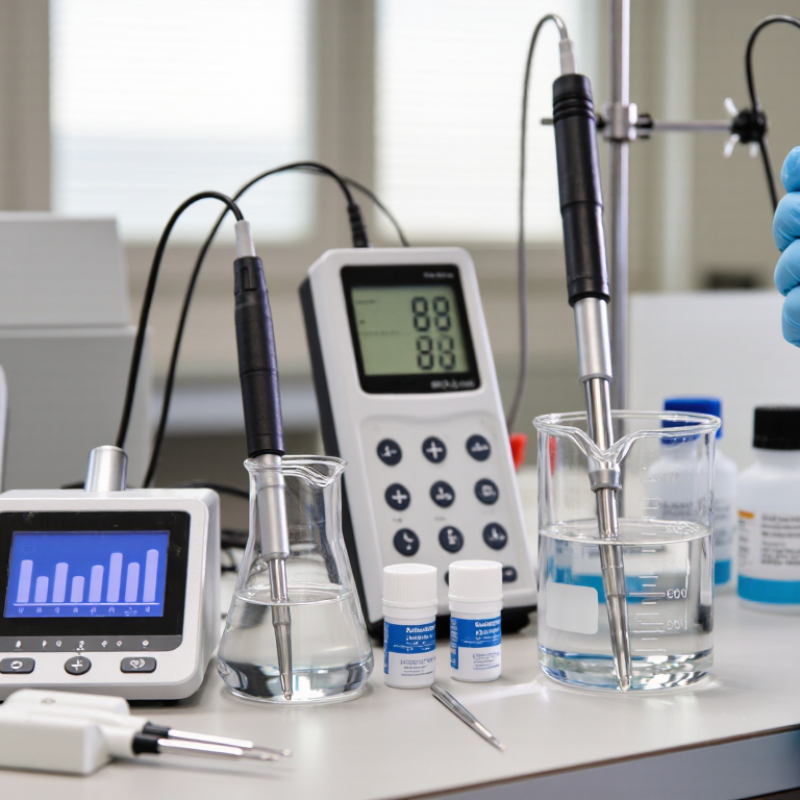
What Is an Ion Tester and How Does It Work?
An ion tester measures charged particles, usually positive and negative ions, in air. It helps evaluate whether an ion-producing device is working consistently. Unlike a general air-quality monitor, it does not mainly track dust, gases, or humidity.
Inside the tester, a collector electrode attracts ions with an opposite charge. The resulting tiny electrical current passes through a sensor circuit. The instrument then displays ion concentration, polarity, or electrical balance. Some models also measure static voltage on nearby surfaces. These functions should not be confused. A static-field meter cannot automatically measure airborne ions.
In practical testing, distance matters greatly. Hold the tester at a fixed position, such as 30 centimeters from the air outlet. Record readings after the display stabilizes. Strong airflow, moisture, temperature, and room ventilation can change results within minutes. I once considered a higher reading proof of better performance, but that assumption was too simple. A reliable comparison needs repeated measurements, clean sensors, and a stated test environment. Calibration records are valuable, especially when readings differ between two instruments. Check the measurement range, resolution, response time, and sensor replacement requirements before choosing a tester. A clear display is useful, but measurement stability matters more. Some inexpensive testers respond slowly. That limitation can be easy to miss.
2026 Top Ion Tester: How to Choose the Best One?
An ion tester measures an ionizer’s discharge performance by tracking how quickly electrostatic voltage falls and by checking whether positive and negative ion output remains balanced.
This physics-based reference curve uses the exponential decay model V(t) = V₀e−t/RC, with an initial charge of ±1,000 V and a time constant of 2 seconds. A suitable ion tester should provide stable voltage readings, clear discharge-time measurements, and reliable positive/negative ion balance results. Actual results depend on airflow, humidity, distance, and ionizer design.
How to Compare Accuracy, Features, and Ease of Use
Choosing a top ion tester in 2026 requires more than reading its accuracy claim. Compare measured offset voltage, discharge time, repeatability, and operating range. ANSI/ESD STM3.1 provides a useful framework for evaluating ionizer performance. A reliable tester should also show calibration status and measurement uncertainty. NIST Technical Note 1297 explains that expanded uncertainty often uses a coverage factor of k=2, representing roughly 95% coverage under suitable conditions. That detail matters on a busy production floor.
Tips: Test at a fixed distance and record temperature, humidity, and airflow. Compare at least three readings. A simple worksheet can expose unstable results. Check whether the display remains clear under bright factory lighting. Also, verify battery life and probe replacement costs. Small practical details often decide daily usability.
Features should support decisions, not create extra work. Data logging, automatic range selection, and exportable results can improve traceability. However, more functions may increase training time. It is easy to overvalue a colorful screen. A tester with fewer controls may produce faster, cleaner inspections. Look for a clear interface, tactile buttons, and a stable probe grip. The instrument should respond consistently when operators change. That is not always guaranteed. Review independent calibration records, service intervals, and conformity with relevant electrostatic-control procedures before purchase.
