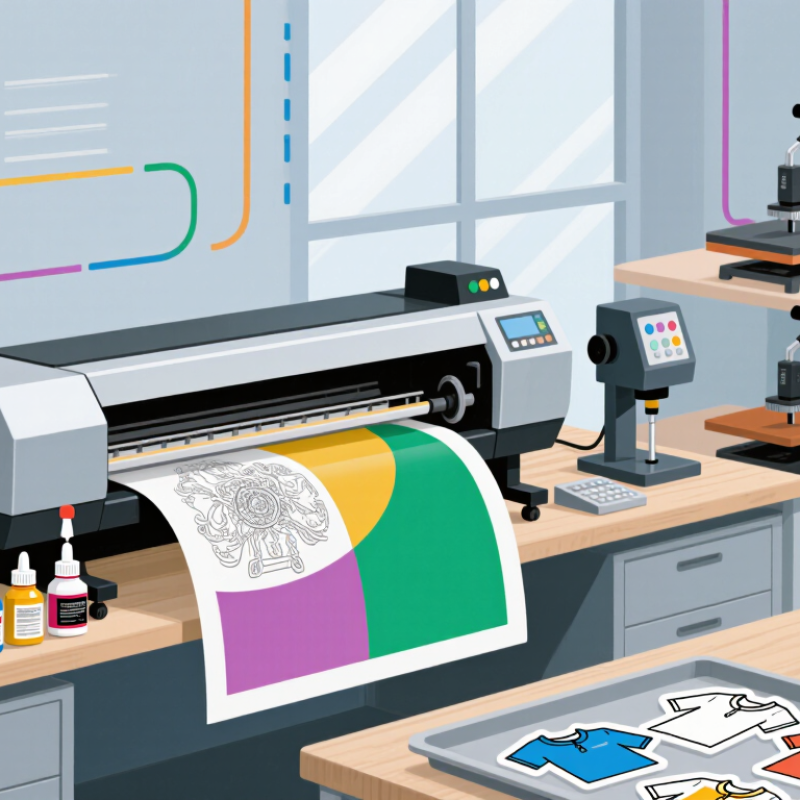
| Order volume | Occasional jobs, samples, or short runs with frequent design changes | A compact direct-to-film (DTF) setup may suit small batches. DTF prints onto coated PET film and typically uses textile pigment inks and hot-melt adhesive powder. | Check the recommended daily workload, maintenance routine, included software, and whether powder application and curing are manual or automated. |
| Steady, repeat production | Recurring garment orders with consistent artwork and predictable schedules | A wider DTF system with a controlled film-feed path and a matched curing workflow can reduce handling between printing and pressing. | Ask for demonstrated throughput using your artwork and film. Confirm whether quoted speed includes white ink, curing, routine cleaning, and loading time. |
| Large-format graphics | Oversized transfers, long runs, or designs that need a wider print area | Choose a printer whose supported media width accommodates the finished artwork, margins, and any multi-up layout. DTF roll film and solvent-printable transfer media are not interchangeable. | Compare usable print width—not just maximum media width—and check roll diameter, core size, feed accuracy, and space for curing equipment. |
| Full-color designs on dark garments | Artwork requiring opaque color on black or other dark fabrics | DTF systems commonly use a white-ink layer beneath color artwork. The transfer film, ink set, powder, and curing profile must be designed to work together. | Print and press a test on the intended fabric. Review white-ink circulation and maintenance requirements, and confirm the transfer follows the film supplier’s instructions. |
| Cut lettering and spot-color graphics | Names, numbers, simple logos, or graphics that need cut contours | A print-and-cut workflow may suit solvent-printable heat-transfer media, while unprinted heat-transfer vinyl is generally cut rather than printed. Film coatings must be specified for the printer’s ink chemistry. | Verify ink and media compatibility, contour-cut accuracy, weeding requirements, and the correct application temperature, pressure, and dwell time. |
| Film compatibility | Reliable feeding, ink adhesion, release, and transfer results | Match the printer to the media’s coating and intended process: DTF PET film for DTF ink workflows, or specifically coated media for the relevant solvent or other supported ink system. | Obtain a written list of supported media types, thicknesses, finishes, and storage conditions. Test release and wash performance using the complete production process. |
| Artwork detail and color consistency | Fine text, gradients, repeat colors, or customer-approved proofs | Print resolution, print modes, ink limits, RIP settings, and media profiles all affect the finished result; the highest stated resolution alone does not determine production quality. | Request sample transfers with your files. Check small text, gradients, registration, and repeatability across multiple prints on the actual film. |
| Finishing and workspace | A safe, consistent workflow from printed film to finished garment | DTF production generally requires adhesive powder application, curing, and a heat press. Other transfer media may require different cutting, peeling, or pressing steps. | Plan for the full equipment footprint, ventilation and workplace safety needs, electrical requirements, consumable storage, and operator training. |
| Total cost of ownership | Predictable costs per usable transfer, not just a low purchase price | Include printer, ink, film, powder or other consumables, curing, pressing, maintenance, rejected prints, and labor in the production-cost estimate. | Request consumable usage estimates for representative artwork and clarify warranty coverage, service availability, replacement-part costs, and maintenance intervals. |