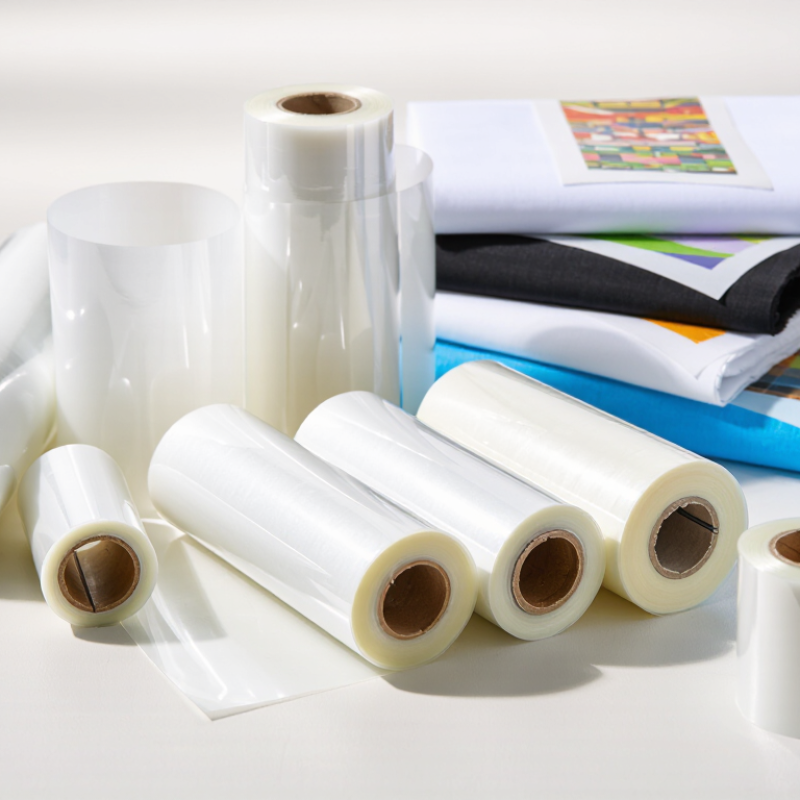
| Base Material | PET film, commonly used for DTF transfer applications | PET provides dimensional stability, a smooth printing surface, and controlled release during heat pressing. | Choose a film specifically engineered for DTF ink, adhesive powder, and heat-press transfer. |
| Film Thickness | Approximately 75–100 microns | Thickness affects handling, stiffness, heat transfer behavior, and resistance to wrinkling. | Around 75–85 microns is often easier to handle; thicker film can offer greater rigidity but may require process adjustment. |
| Surface Finish | Matte, semi-matte, or glossy | Surface finish influences glare, image appearance, film handling, and the visual finish of the transferred design. | Matte film is useful for reduced glare and easier visual inspection; glossy film can provide a brighter appearance. |
| Release Type | Cold peel, warm peel, or hot peel | The release window affects production speed, image quality, and the risk of lifting fine details. | Select the release type that matches the adhesive powder, curing process, and heat-press workflow. Do not mix peel methods without testing. |
| Coating Structure | Single-sided coated or double-sided coated | The printing side must accept water-based pigment ink evenly, while the reverse side should feed smoothly and resist sticking. | Use single-sided coated film for standard workflows; double-sided coated film may improve feeding and handling in some equipment. |
| Ink Compatibility | Water-based DTF pigment ink | Compatible coating helps control ink absorption, dot formation, color density, and drying. | Confirm compatibility with the specific ink system and perform a nozzle, color, drying, and adhesion test before bulk production. |
| White Ink Performance | Uniform coverage with controlled drying | Poor white-ink interaction can cause uneven opacity, pinholes, spreading, or powder adhesion problems. | Look for smooth white layers without excessive pooling or premature drying during printing. |
| Powder Adhesion | Even adhesion to wet printed areas with minimal background contamination | Consistent adhesion affects wash durability, edge definition, hand feel, and transfer completeness. | Test fine details, large solid areas, and transparent spaces. Excess powder on unprinted areas may indicate a film or process mismatch. |
| Available Roll Width | Common widths include approximately 30–60 cm | Width determines print layout, material utilization, nesting efficiency, and compatibility with the printer. | Choose a width that matches the printer's maximum media width while leaving enough margin for reliable feeding. |
| Roll Length | Often supplied in rolls of approximately 50–100 m, depending on width and intended use | Longer rolls reduce changeovers but require stable storage, accurate tension control, and consistent coating quality throughout the roll. | Use shorter rolls for sampling or low-volume work; use longer rolls after confirming reliable printer and powder-shaker performance. |
| Dimensional Stability | Low shrinkage and low stretching during printing and pressing | Stable film helps preserve registration, fine lines, repeated patterns, and accurate image dimensions. | Check for wrinkling, edge curl, and image distortion after curing and pressing. |
| Static Control | Low-static or antistatic handling characteristics | Static can attract dust, disturb powder distribution, and cause feeding or stacking issues. | Prefer film with stable feeding and minimal dust attraction, especially in dry production environments. |
| Heat Resistance | Must tolerate the curing and heat-press temperatures specified for the complete DTF system | Insufficient heat resistance can lead to deformation, sticking, image transfer defects, or difficult peeling. | Follow the film supplier's tested temperature and dwell-time window, then verify results on the target garment. |
| Storage Conditions | Cool, dry, clean environment; protected from moisture, direct sunlight, and pressure | Moisture and heat can affect coating performance, static behavior, curling, and powder adhesion. | Keep rolls sealed until use, allow them to acclimate to the production room, and store them flat or according to the supplier's instructions. |
| Quality-Control Checks | Print test, powder test, curing test, peel test, stretch test, and wash test | A film may print well but still fail during peeling, pressing, stretching, or laundering. | Approve a roll only after checking color appearance, fine detail, release behavior, adhesion, stretch recovery, and wash durability. |