| Loose sand and fine gravel | Unconsolidated deposits that can be drawn into a suction intake; particle size must suit the pump and pipeline. | Plain suction dredge | Often a practical choice where the deposit is loose and does not need mechanical loosening. A cutterhead can be added if the material is partly compacted. | Confirm particle-size limits, pump passage size, slurry concentration, and the risk of pipeline blockage or settling. |
| Compacted or cohesive deposits | Dense sand, clay, or layered material that resists suction and may need to be loosened before pumping. | Cutter suction dredge | A rotating cutterhead loosens the bed so material can be drawn into the suction pipe. Suitability depends on material strength, cutter design, and required production. | Assess deposit hardness, layer thickness, cutter wear, available working area, and the effect of cutting on nearby structures or slopes. |
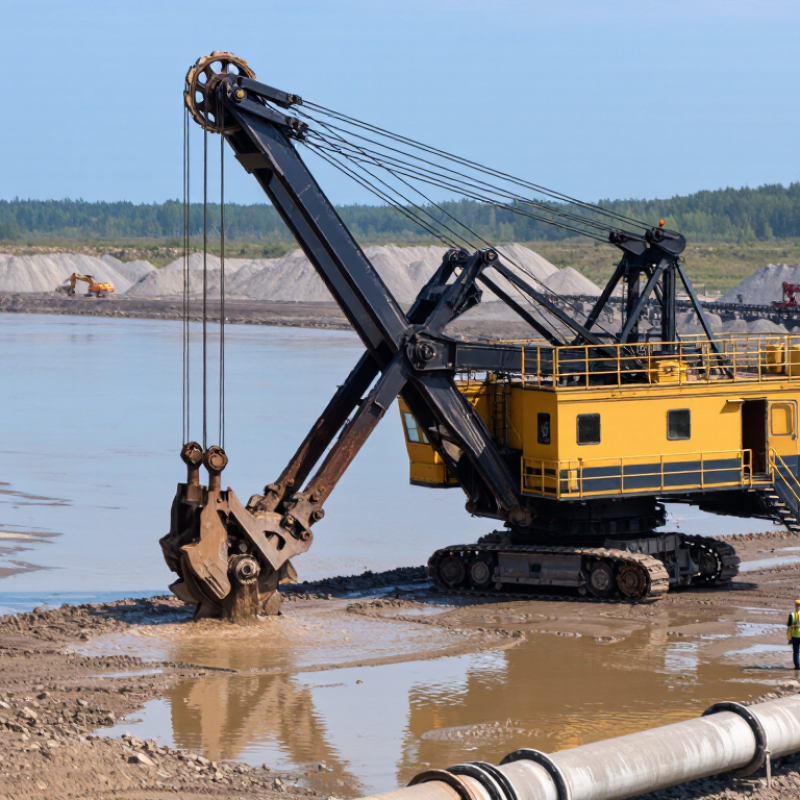
| Coarse or abrasive material | Gravel, cobbles, or abrasive mineral-bearing sediments; oversized particles may exceed a pump’s passage capacity. | Bucket ladder or other mechanical dredge; cutter suction for pumpable sizes | Mechanical excavation can handle material that is difficult to lift by suction. For suction systems, check that the largest particles can pass through the intake, pump, and pipeline. | Determine the particle-size distribution, proportion of oversize material, abrasion potential, screening needs, and disposal or processing method. |
| Water depth and draft | Shallow ponds, variable water levels, deep pits, or restricted access for floating equipment. | Small shallow-draft suction or cutter suction dredge; mechanical dredge where access or depth is limiting | Match the dredge’s operating depth and draft to the lowest expected water level, not just the average depth. These limits vary by design. | Check minimum operating depth, draft, under-keel clearance, access channels, water-level variation, and safe mooring locations. |
| Current, waves, and wind | Still-water ponds, flowing channels, or exposed sites with waves and changing weather. | Stable, appropriately anchored floating dredge; mechanical dredge if floating operations are unsuitable | Higher current and wave exposure can affect positioning, pipeline handling, and safe operating conditions. The required anchoring and operating limits are equipment-specific. | Measure current and water-level variation; review wind and wave exposure, mooring loads, access for support craft, and weather-related shutdown criteria. |
| Discharge distance and elevation | Material must travel through a pipeline to a processing plant, settling area, or stockpile, possibly uphill. | Suction or cutter suction dredge with a pump and pipeline sized for the route | Longer pipelines, elevation gain, bends, and changing slurry properties increase pumping requirements. A booster pump may be needed after hydraulic calculations. | Map pipeline length and elevation profile; account for bends, pipe diameter, slurry density, solids settling, and access for inspection and flushing. |
| Required production and operating schedule | Production targets depend on deposit thickness, sediment properties, operating hours, and interruptions. | Choose the dredge and pump configuration after estimating site-specific production | Do not compare equipment by pump capacity alone. Actual solids production is affected by sediment concentration, excavation rate, downtime, and transport conditions. | Estimate recoverable volume, operating hours, expected solids concentration, maintenance time, and the capacity of downstream screening or processing. |
| Environmental and permitting constraints | Water-quality limits, sensitive habitats, nearby users, or restrictions on turbidity, noise, and discharge. | Any suitable dredge fitted to the site’s control and monitoring requirements | Containment, controlled excavation, and appropriate discharge management may be required. Applicable limits depend on local permits and regulations. | Review permit conditions, turbidity monitoring, discharge location, sediment testing, noise limits, and measures to prevent spills or unintended releases. |