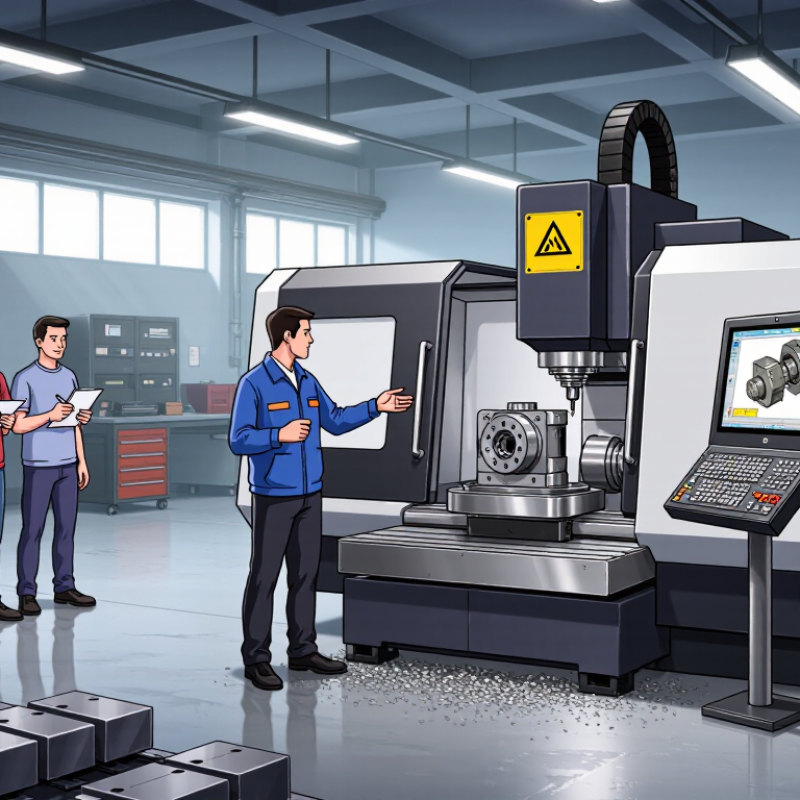
| Beginner | Build a safe foundation for operating and understanding CNC equipment. | Basic mathematics, ability to read simple technical drawings, and willingness to follow machine-safety procedures. | Machine components, coordinate systems, work offsets, tool identification, basic G-code, setup procedures, workholding, cutting-tool safety, and emergency stops. | Instructor-supervised machine demonstrations, simulator exercises, tool and workpiece setup practice, and simple two-dimensional machining tasks. | Trainer with strong safety experience, clear teaching methods, and the ability to explain machine functions without assuming prior CNC knowledge. | Approximately 2–5 days for introductory operation, depending on machine type and practice time. | Can identify major machine controls, load and verify a basic program, set work offsets under supervision, and complete a safe inspection checklist. |
| Intermediate | Develop independent setup, programming, and process-control skills for routine production work. | Basic CNC operation, measurement with calipers and micrometers, technical drawing comprehension, and familiarity with fundamental G-code. | Program structure, canned cycles, tool-length and diameter compensation, feeds and speeds, datum selection, inspection methods, workholding choices, and basic troubleshooting. | Complete setup-to-inspection projects, edit programs safely, measure first-off parts, identify dimensional errors, and optimize a stable cutting process. | Trainer with hands-on production experience, strong metrology knowledge, and the ability to connect programming decisions with part quality and cycle time. | Approximately 1–3 weeks of structured training, including supervised practice and assessment. | Can prepare a setup sheet, prove out a program, produce a conforming part, document measurements, and correct common setup or machining errors. |
| Advanced | Improve complex machining, process reliability, productivity, and technical problem-solving. | Independent CNC setup and programming, competent inspection skills, and experience with production documentation. | Multi-axis concepts, complex workholding, advanced toolpaths, process capability, tolerance control, tool-life management, machining optimization, automation concepts, and root-cause analysis. | Use real or representative production parts, compare alternative toolpaths, analyze process data, perform controlled optimization trials, and validate repeatability. | Trainer with substantial experience in complex machining, process engineering, quality control, and risk-managed program prove-out procedures. | Approximately 2–8 weeks for a focused advanced module, with additional time required for complex multi-axis or production-optimization projects. | Can develop and validate a complex process, justify tooling and cutting parameters, demonstrate repeatable results, and document corrective actions using measurable data. |
| Career Change | Move from a non-machining background into an entry-level CNC operator or setup role. | Basic numeracy, mechanical interest, workplace communication skills, and willingness to learn measurement and safety practices. | Shop-floor safety, blueprint reading, inspection basics, machine operation, tool handling, offsets, production documentation, and standard operating procedures. | Hands-on exercises should progress from measurement and identification tasks to supervised machine operation and basic part production. | Trainer who combines technical instruction with workplace coaching, uses plain language, and provides frequent feedback on safe work habits. | Approximately 4–12 weeks, depending on the learner’s prior mechanical experience and the role requirements. | Can follow documented procedures, inspect a part against a drawing, communicate an abnormal condition, and operate assigned equipment safely under workplace rules. |
| Engineering or Programming | Strengthen CNC programming, manufacturing-process planning, and design-for-machining decisions. | Technical drawing interpretation, manufacturing fundamentals, coordinate geometry, and basic knowledge of CNC machining operations. | CAD/CAM workflow, toolpath verification, post-processing concepts, fixture planning, tolerancing, material behavior, tool selection, cycle-time analysis, and process documentation. | Program representative parts, verify tool motion before cutting, compare machining strategies, and validate finished dimensions through inspection records. | Trainer who understands both shop-floor constraints and digital programming workflows, with experience reviewing programs for safety, manufacturability, and quality. | Approximately 1–4 weeks for a focused programming module, followed by project-based practice. | Can create a documented machining plan, verify toolpaths, explain parameter choices, and produce a part that meets defined dimensional requirements. |