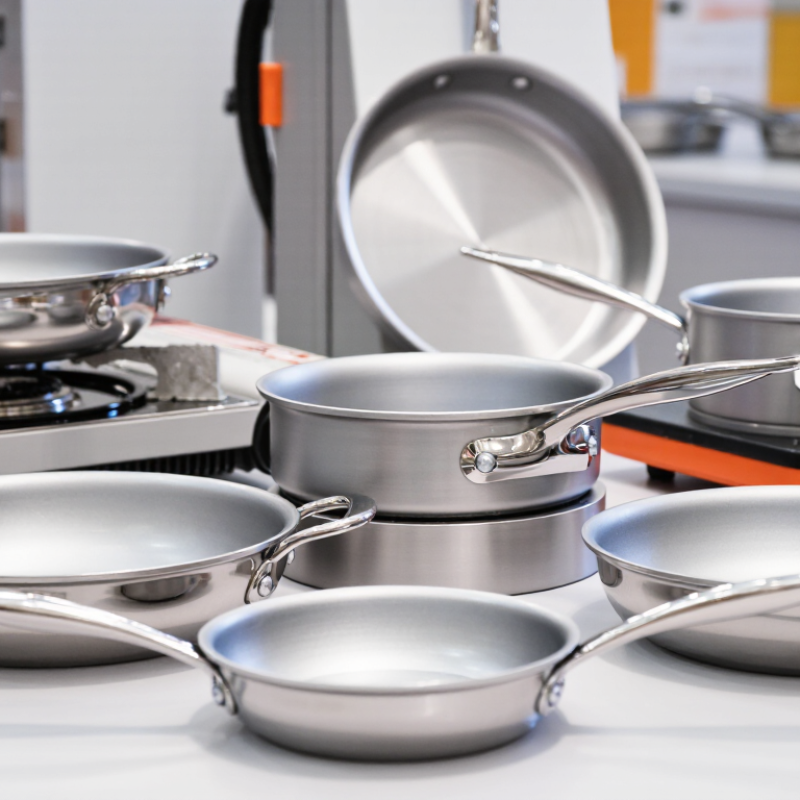
| Unit Pricing | Approximately USD 4–18 per aluminum frying pan for standard wholesale models, depending on diameter, coating, handle, and order volume. | Confirm whether the quotation includes the pan body, non-stick coating, handle, packaging, inspection, and export documentation. | Request tiered pricing for 100, 500, 1,000, and 5,000 units. | Very low prices may indicate thinner aluminum, lower-grade coatings, simplified packaging, or excluded charges. | 20% |
| Minimum Order Quantity | Stock or catalog products may start at approximately 50–300 units; customized products commonly require 500–3,000 units. | Ask whether the MOQ applies per model, size, color, coating, or packaging design. | Choose a supplier with an MOQ that matches forecast demand and available storage capacity. | A high MOQ can increase inventory costs and create excess stock if the product sells slowly. | 15% |
| Aluminum Material | Common cookware bodies use aluminum alloys selected for formability, heat conduction, and corrosion resistance; exact alloy grades vary by design. | Request the declared alloy grade, material thickness, inspection standard, and test documentation. | Use a documented material specification with agreed thickness tolerances and surface requirements. | Unclear material specifications can lead to warping, uneven heating, or inconsistent production batches. | 15% |
| Non-Stick Coating | Coating systems vary by construction and use case. Performance depends on coating layers, application process, curing, and substrate preparation. | Verify food-contact compliance documents, coating type, abrasion testing method, temperature guidance, and batch traceability. | Require a pre-production sample and written acceptance criteria for adhesion, appearance, and release performance. | Unverified coating claims or missing test reports increase food-safety and durability risks. | 15% |
| Product Sizes and Compatibility | Common frying pan diameters include approximately 20 cm, 24 cm, 26 cm, and 28 cm, although available sizes differ by supplier. | Check base diameter, wall height, weight, handle attachment, lid compatibility, and suitability for gas, electric, or induction cooking. | Select sizes that match the target market and clearly define compatible cooktops. | Incorrect base dimensions or unclear compatibility information can cause product returns. | 10% |
| Production Lead Time | Standard stocked items may ship in approximately 7–20 days; customized production commonly takes 30–60 days after approval. | Confirm sample approval time, production time, packaging preparation, inspection time, and holiday-related delays. | Obtain a written production schedule with milestone dates and delay-notification procedures. | Unclear lead times can disrupt promotions, seasonal launches, and retail replenishment. | 10% |
| Shipping and Delivery | Transit times vary by route and method. International ocean freight commonly takes several weeks, while air shipment is faster but more expensive. | Compare EXW, FOB, CIF, and DDP quotations, and confirm carton dimensions, gross weight, port of loading, and insurance responsibility. | Evaluate total landed cost rather than product price alone. | Low product prices may be offset by high freight, customs, handling, or destination charges. | 10% |
| Quality Control | Reliable cookware production typically uses incoming-material checks, in-process inspections, final inspection, and packaging verification. | Ask for the inspection checklist, sampling plan, defect classifications, corrective-action process, and inspection records. | Use an agreed pre-shipment inspection standard and retain approval samples. | Suppliers that cannot explain inspection procedures may deliver inconsistent quality. | 10% |
| Customer Support | Professional export suppliers generally provide a dedicated contact, quotation follow-up, order updates, and after-sales communication. | Measure response speed, technical knowledge, documentation quality, language capability, and issue-resolution process. | Prefer written replies within one business day and documented corrective actions for defects. | Slow or unclear communication often creates delays during sampling, production, and claims handling. | 5% |