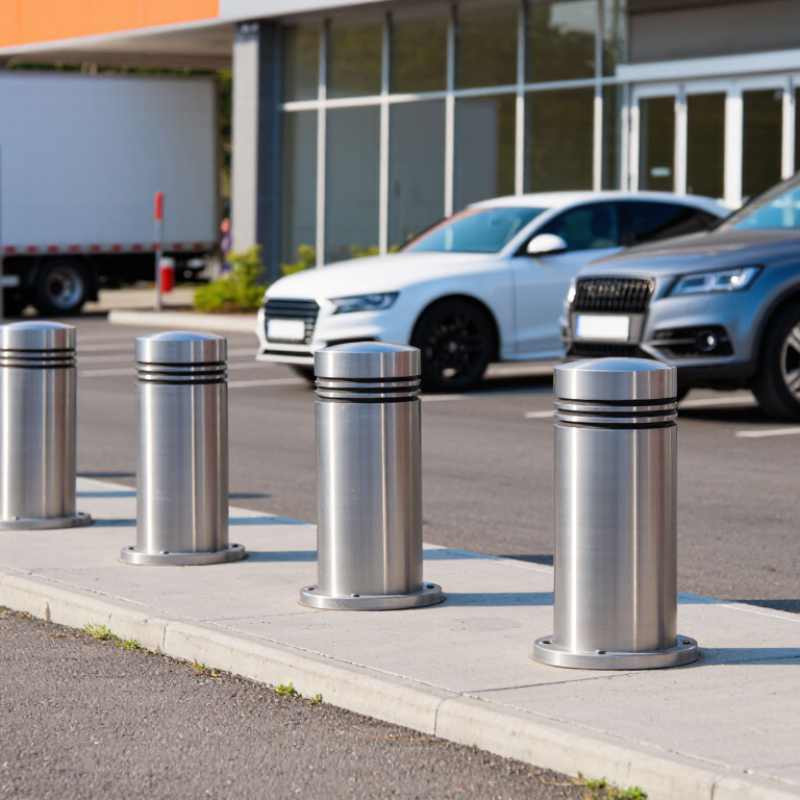
| Intended function | Whether the bollard is for visual guidance, pedestrian separation, vehicle access control, or vehicle impact resistance. | Match the bollard and its foundation to the actual risk. A standard parking bollard should not be assumed to stop a moving vehicle. | If impact resistance is required, specify a tested barrier system and installation appropriate to the site—not just a steel post. |
| Visibility in daylight | Contrast with the surroundings, finish color, and visibility from driver approach angles. | Use a contrasting finish where the post could blend into paving, walls, landscaping, or parked vehicles. Check visibility in the installed setting. | Follow applicable local site, road-authority, or facility specifications for colors and markings. |
| Nighttime visibility | Reflective bands, reflective sheeting, lighting, and the condition of those features over time. | Consider reflective markings where vehicles approach in low light. Keep markings clean and replace damaged or faded material. | For public-road applications, check the relevant road authority requirements and the current MUTCD where applicable in the United States. It does not automatically govern every private parking area. |
| Steel and corrosion protection | Steel grade, coating type, coating coverage, and protection at welds, cut edges, and the base. | Hot-dip galvanizing provides a zinc coating; a compatible topcoat may be considered for added color or protection. Confirm coating repair procedures for installation damage. | ASTM A123/A123M covers zinc coatings applied by hot-dip galvanizing to iron and steel products. It does not by itself guarantee a specific service life in every environment. |
| Coastal or de-icing-salt exposure | Salt exposure, moisture retention, drainage, and the suitability of the steel and coating system. | Specify a corrosion-protection system for the actual exposure. Stainless steel grade 316 generally offers better resistance to chloride exposure than grade 304, but neither choice eliminates the need for suitable design and maintenance. | Ask the supplier for material and coating documentation, and have the specification reviewed for the site’s exposure conditions. |
| Dimensions and placement | Post height, diameter, wall thickness, spacing, setback, and foundation dimensions. | There is no single size suitable for every site. Set dimensions and spacing based on vehicle paths, pedestrian routes, visibility, required protection, and the bollard manufacturer’s installation details. | Check local building, fire-access, accessibility, and site-plan requirements before setting out the bollards. |
| Foundation and installation | Embedment or anchor design, concrete condition, underground utilities, and drainage around the base. | Use the installation method specified for the selected bollard. Confirm that the substrate and foundation can support the intended use; avoid placing posts where water can collect around the base. | For crash-rated systems, installation details are part of the tested system’s performance and should be followed as specified. |
| Fixed, removable, or retractable type | How often access must be opened, who controls it, and the maintenance needed for moving parts. | Choose fixed posts for permanent separation. Consider removable or retractable designs where authorized vehicle access is needed, and plan for locks, keys, drainage, and routine inspection. | Check local emergency-access and site-security requirements before choosing an access-control arrangement. |
| Accessibility and pedestrian clearance | Clear width of accessible routes, detectable placement, and potential obstruction of doors, ramps, or crossings. | Locate bollards so they do not obstruct required routes or create avoidable trip and maneuvering hazards. Review the complete route, not just the post location. | Where applicable, check the ADA Standards and relevant state or local accessibility requirements; confirm the requirements for the specific site and jurisdiction. |
| Impact-rating claims | Test rating, tested configuration, foundation, installation conditions, and the exact product being supplied. | Do not rely on appearance, wall thickness, or a general “heavy-duty” description as proof of crash performance. Request documentation for the complete system and confirm it matches the proposed installation. | ASTM F2656/F2656M is a vehicle-barrier crash-test method and classification specification. Its relevance depends on the project; it is not a general requirement for every parking bollard. |
| Inspection and maintenance | Loose anchors, corrosion, coating damage, faded reflective material, damaged caps, and water ingress. | Set a routine inspection schedule based on exposure and use. Repair coating damage and replace worn visibility features promptly. | Follow the manufacturer’s maintenance instructions and any applicable owner, road-authority, or local requirements. |