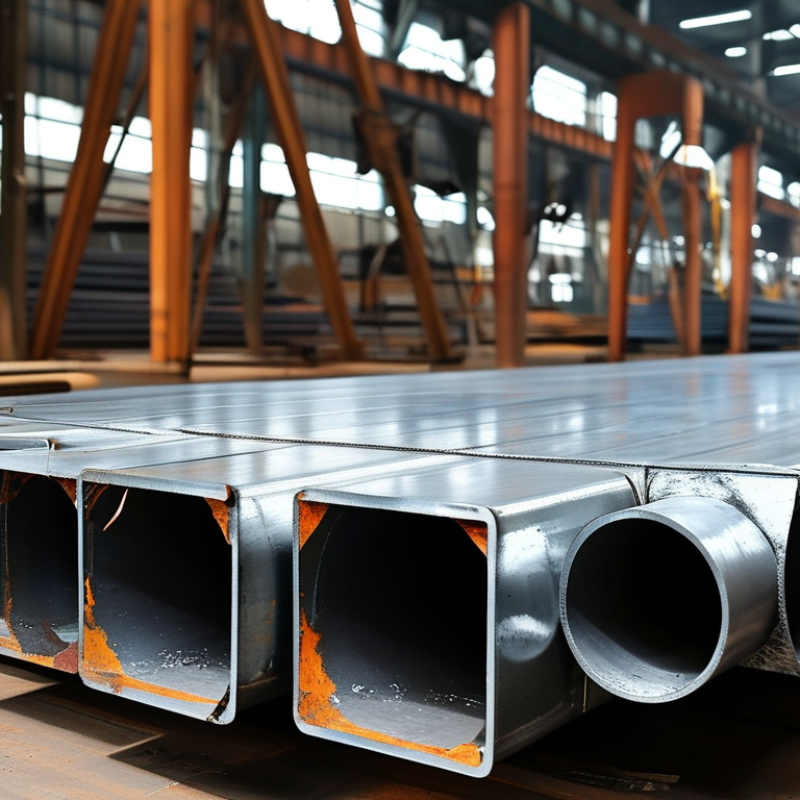
| 1. Product Definition and Applicable Standards |
| Steel hollow-section standard | For structural square hollow sections, commonly specified standards include ASTM A500/A500M or EN 10219-1. The purchase order should identify the exact grade, manufacturing method, dimensions, wall thickness, and applicable edition. | Product datasheet, signed technical offer, standard designation, and dimensional drawing. | Clearly stated | “Mild steel tube” or “equivalent standard” without a defined grade or edition. | 10% |
| Galvanizing standard | Hot-dip galvanized fabricated products may be specified to ASTM A123/A123M, while continuous sheet or strip coatings are commonly specified to ASTM A653/A653M or EN 10346. The coating process must match the product route. | Galvanizing process description, coating standard, coating designation or mass, and inspection procedure. | Process and standard match | Only “galvanized” is stated, with no coating type, standard, or measured coating result. | 10% |
| Steel grade and mechanical properties | Typical structural grades may include ASTM A500 Grade B or C, or EN grades such as S235JRH and S355J2H. Yield strength, tensile strength, and elongation must be confirmed against the selected standard. | Heat number, chemical composition, yield strength, tensile strength, elongation, and applicable standard limits. | Grade-specific results | Generic mechanical values are provided without heat or batch traceability. | 12% |
| 2. Dimensional Tolerances and Workmanship |
| Outside dimension tolerance | Use the tolerance stated in the governing standard. As a practical screening value, many cold-formed structural hollow-section specifications use approximately ±1% of the outside dimension, subject to minimum limits and the selected standard. | Inspection report showing measured side lengths at multiple locations along the pipe. | Within the ordered standard | Supplier reports only nominal dimensions or measures one point per bundle. | 12% |
| Wall-thickness tolerance | Wall thickness should be assessed against the applicable product standard. A practical procurement screen is commonly around ±10%, but the contractual limit must follow the selected standard and thickness range. | Ultrasonic or micrometer readings taken at corners and flat faces, with minimum measured thickness recorded. | Minimum thickness protected | Average thickness is reported while local minimum thickness is omitted. | 12% |
| Squareness, corner radius, and twist | Check cross-sectional squareness, corner radius, twist, and flatness because these affect fit-up, welding, and structural alignment. Limits should be stated in the technical order. | Dimensional inspection plan, calibrated gauges, cross-section measurements, and photographs of bundle condition. | Recorded and controlled | Visible bowing, irregular corners, excessive twist, or no inspection records. | 8% |
| Length and straightness | Confirm whether the order requires fixed lengths or random lengths. Straightness tolerance and cutting tolerance should be specified separately because cutting accuracy does not prove tube straightness. | Cut-length report, straightness readings, bundle labels, and packing list. | Length and straightness documented | Uncontrolled random lengths or undocumented over-length and under-length pieces. | 6% |
| Surface condition | The zinc coating should be continuous and reasonably uniform, without bare areas, peeling, blistering, excessive ash, sharp zinc spikes, or damage that interferes with assembly. | Visual inspection criteria, defect-repair procedure, coating photographs, and nonconformance records. | Uniform and repairable | Heavy white rust, exposed steel, peeling zinc, or unapproved paint-over repairs. | 8% |
| 3. Mill Certificates, Traceability, and Testing |
| Mill test certificate | Request an EN 10204 Type 3.1 certificate or an equivalent heat/batch-specific certificate containing actual test results rather than only standard values. | Certificate showing manufacturer, product designation, heat number, dimensions, grade, chemical analysis, mechanical tests, and authorized approval. | Batch-specific 3.1 certificate | Unsigned certificate, recycled template, missing heat number, or certificate showing only nominal values. | 12% |
| Heat and bundle traceability | Every bundle should be linked to the relevant heat, production lot, galvanizing batch, quantity, and inspection release. | Bundle tags, heat numbers, production records, packing list, and certificate cross-reference. | 100% traceable | Tags are missing, duplicated, illegible, or inconsistent with the certificate. | 8% |
| Mechanical and chemical testing | Depending on the standard, testing may include tensile properties, chemical composition, bend or flattening tests, and weld-related checks. The required test frequency should be agreed before production. | Laboratory reports, test methods, equipment identification, sampling frequency, and acceptance criteria. | Standard-based testing | Supplier provides only a generic quality statement without actual results. | 8% |
| Coating thickness and adhesion verification | Coating thickness should be checked using a calibrated magnetic or eddy-current gauge. Adhesion and visual acceptance should follow the selected galvanizing standard and agreed inspection plan. | Gauge calibration record, measured coating results, sampling plan, and nonconformance report if applicable. | Measured by batch | Coating thickness is estimated from zinc consumption or stated without measurements. | 8% |
| Independent pre-shipment inspection | For high-value or safety-critical orders, use an independent inspection covering dimensions, quantity, certificates, visual condition, packaging, and coating results. | Inspection appointment, signed report, photographs, sampling plan, and release status. | Recommended for large orders | Supplier refuses reasonable third-party inspection or release verification. | 4% |
| 4. Indicative 2026 Pricing and Commercial Factors |
| Indicative galvanized square-pipe price | For standard structural sizes, a practical 2026 budgeting range is approximately US$1,050–1,650 per metric ton on a bulk industrial basis. Actual pricing depends on steel coil cost, zinc usage, dimensions, order volume, destination, and trade terms. | Formal quotation showing grade, dimensions, coating requirement, quantity, delivery term, validity period, and included inspection documents. | Comparable quotation basis | Lowest price excludes galvanizing, testing, packing, inland freight, or export documentation. | 8% |
| Small-order or cut-length premium | Orders below normal mill quantities, mixed sizes, custom cut lengths, or special packaging may add approximately 5%–20% compared with a full-bundle standard-length order. | Minimum order quantity, bundle quantity, cut-length surcharge, and remnant policy. | All surcharges disclosed | Quotation is based on a full truckload but the buyer requires small mixed lots. | 4% |
| Freight, duties, and delivery basis | Compare offers on the same Incoterm and destination basis. Ocean freight, inland transport, customs duties, insurance, and port charges can materially change the delivered cost. | Incoterm, port or delivery location, estimated freight, duty assumptions, lead time, and validity date. | Delivered-cost comparison | FOB, CFR, CIF, and delivered prices are compared as if they were equivalent. | 4% |
| Price validity and adjustment mechanism | Because steel and zinc costs can change, a 2026 quotation should state its validity period and whether price adjustment is allowed before production or shipment. | Quotation validity, payment schedule, raw-material adjustment clause, and cancellation terms. | Clearly defined | Open-ended quotation or unilateral price adjustment after order confirmation. | 4% |
| 5. Recommended Supplier-Selection Rule |
| Minimum technical qualification | Select only offers that meet the specified steel grade, galvanized-coating requirement, dimensional tolerances, traceability, and certificate requirements. | Completed technical compliance matrix and signed deviation list. | No critical deviations | Price is attractive but the supplier cannot prove grade, coating, or minimum wall thickness. | Pass/Fail |
| Weighted commercial score | After technical qualification, score delivered cost, lead time, payment terms, inspection support, warranty, and historical nonconformance performance. Do not rank suppliers by unit price alone. | Normalized quotation comparison and total-cost-of-ownership worksheet. | Highest compliant value | Lowest nominal price produces a higher delivered cost or higher quality risk. | Final ranking |
| Recommended purchase release | Release production only after approval of the technical specification, certificate format, inspection plan, sample or first-article results, packaging, and delivery schedule. | Approved purchase order, inspection and test plan, certificate template, and pre-shipment release checklist. | Documented approval | Production begins from an informal quotation with unresolved technical details. | Gate control |
| Pricing ranges are indicative 2026 budgeting benchmarks in US dollars per metric ton, not a fixed market quotation. Confirm the applicable ASTM or EN edition, coating requirement, dimensions, tolerances, inspection frequency, Incoterm, destination, taxes, and freight before placing an order. |