
How to Choose the Best RFID Tags for Your Business Needs?

In today’s fast-paced business environment, choosing the right RFID tags is crucial. These tags play a key role in streamlining operations, tracking assets, and improving inventory management. With various types and features available, the selection process can be overwhelming. Businesses need to understand their specific requirements to make an informed decision.

The effectiveness of RFID tags depends on several factors. These include tag type, read range, and durability. For instance, some tags are better suited for harsh environments, while others are designed for indoor use. Understanding your operating conditions is essential for optimal performance. Often, companies underestimate the importance of clear requirements. This can lead to costly mistakes.

Moreover, integrating RFID technology poses its own set of challenges. Companies may face issues with compatibility and data management. It is vital to partner with reliable suppliers who offer expert advice. Their experience can guide you in the right direction. Reflecting on your unique needs will help ensure you invest in RFID tags that truly enhance your business operations.

How to Choose the Best RFID Tags for Your Business Needs?

Understanding RFID Technology and Its Applications

RFID technology has transformed many industries. It uses radio waves to identify and track objects. The core component is the RFID tag. These tags can store data about the item they are attached to. They can be passive, active, or semi-passive, each serving different purposes. Passive tags are most common. They do not require a power source and are cost-effective.

Understanding the various applications of RFID is essential for businesses. Retailers use RFID for inventory management. This enhances efficiency and accuracy. In healthcare, RFID tracks medical equipment and pharmaceuticals, improving patient safety. However, not every RFID solution fits all business needs. Assessing the environment and specific requirements is crucial. Businesses must reflect on their unique challenges and weigh the advantages of RFID.

Integration of RFID into existing systems can bring challenges. Compatibility issues may arise. Staff training is often needed to maximize the technology's potential. It's essential to evaluate if the investment aligns with overall business goals. Proper planning and consideration of potential hurdles are vital for a successful implementation.

Evaluating Your Business Requirements for RFID Tags

Evaluating your business requirements for RFID tags is essential. Understanding what you need helps you select the most suitable options. Start by identifying the type of products you manage. Are they large, small, or fragile? Your choice of tags will depend on these characteristics.

Consider the environment where the tags will be used. Factors like temperature, moisture, and exposure to chemicals matter. Some tags perform poorly in harsh conditions. This insight can aid in narrowing down your choices.

Tips: Look for tags that can withstand your specific operational conditions. Test a few options in real scenarios before making a final decision. Involving your team in the evaluation process can unveil diverse perspectives. This approach may prevent overlooking crucial requirements.

Lastly, do not forget to evaluate the read range. Some applications need close proximity, while others may require long-distance reading. Weighing these factors can help you avoid costly mistakes later on. Engage with field experts to discuss unique challenges your business faces. This can guide you to a more informed decision.

Comparing Different Types of RFID Tags Available

Choosing the right RFID tags is crucial for optimizing your business operations. Different types of RFID tags serve various purposes. Passive tags are economical and ideal for inventory management. They don't require a power source, which makes them lightweight and compact. Active tags, on the other hand, have their own battery. They offer greater range and are suitable for tracking high-value items.

When comparing RFID tags, consider the environment where they will be used. For outdoor applications, durable tags resistant to weather conditions are essential. In a warehouse, you need tags that can withstand harsh conditions. How will the tags be attached? Adhesive, looping, or embedding? Each approach has pros and cons.

Tip: Evaluate the read range your operation requires. This can influence the tag type you choose.

Analyze the frequency that suits your needs. Low-frequency tags penetrate materials better. High-frequency tags offer faster read speeds. Ensure you assess your goals thoroughly before purchasing. Making informed decisions can help prevent costly mistakes in the future.

Assessing Durability and Environmental Resistance of Tags

When selecting RFID tags for business needs, durability and environmental resistance are crucial factors. A recent industry report indicates that nearly 30% of businesses experience tag failures due to environmental challenges. This emphasizes the importance of assessing how tags perform in varied conditions.

For example, some tags are designed to withstand extreme temperatures, while others excel in moisture-rich environments. Tags labeled as IP67 or IP68 demonstrate superior water and dust resistance. They are ideal for logistics and outdoor applications. However, not all tags are created equal. A study shows that approximately 40% of low-cost tags fail to meet basic durability standards. This can lead to data loss and increased operational costs.

Consider the materials used in tags. High-quality tags are often made from robust plastics or metals, providing better longevity. Yet, some users may overlook this aspect. In certain cases, businesses must weigh the initial savings against the potential long-term risks. Conducting real-world tests can reveal how well a tag will perform under actual conditions. This practical approach can help avoid costly mistakes in the future.

Durability and Environmental Resistance of RFID Tags

Budgeting for RFID Tag Solutions and Long-term Costs

When budgeting for RFID tag solutions, consider the initial costs and long-term expenses. Choose tags based on durability and performance. Understand the materials involved. Different types come with varying prices. A high-quality tag might cost more upfront but save money later on.

Analyze your business needs carefully. Think about how many tags you will require. Bulk purchases can reduce costs significantly. However, overestimating can lead to wasted resources. Monitor your inventory closely. Tags that fail too soon can become costly over time.

Long-term costs include maintenance and replacements. Consider how often you'll need to replace these tags. Evaluate the technology durability in your specific environment. If tags are frequently damaged, higher-quality options may pay off. Reflect on past experiences. Have cheaper options caused headaches? Investing wisely ensures smoother operations moving forward.

Find the Right Repair Product for Your Project

Need to find the most appropriate product for the needs of your project? We can help because we have over 70 years of experience servicing the industry with every kind of project, from Do-it-yourself projects to large skyscrapers. Package Pavement has the experience, the knowledge and the products to help every project succeed.
Quikrete Repair Products
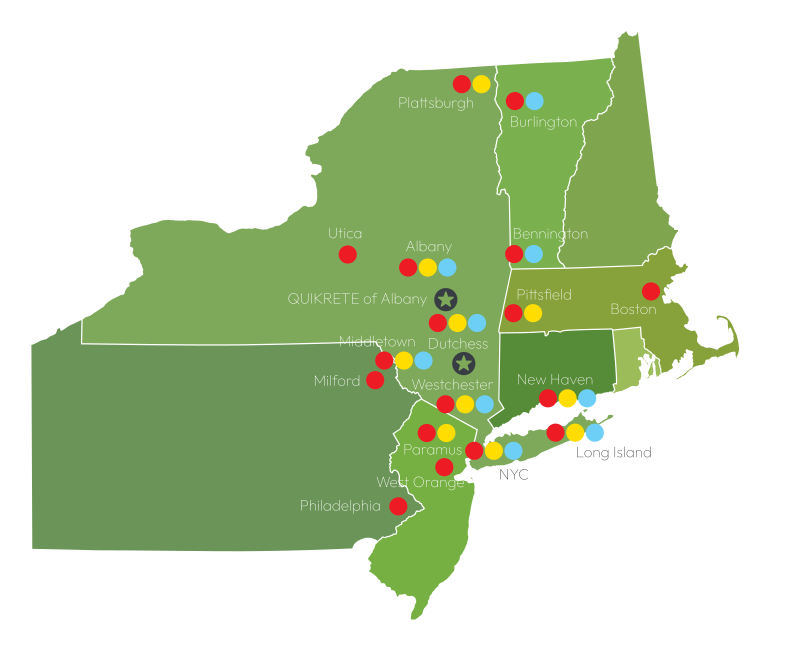
Legend
Package Pavement has two convenient locations in Stormville, NY (Dutchess County) and Ravena, NY (Greene County) to serve the Northeastern Region with bagged concrete, blacktop, mortar, and repair products. This map gives a general idea of where we service and the product lines we offer.
Package Pavement Products
Quikrete Products
Spec Mix Products
map

Our Brands Websites