| C-Frame Pneumatic Press | Compressed air drives a pneumatic cylinder. The cylinder moves a ram and punch downward through a guided stroke, while a die supports the workpiece. | Hole punching, embossing, bending, riveting, crimping, and light assembly work on sheet metal, plastics, leather, and gaskets. | Approximately 0.5–20 tons, depending on cylinder size, air pressure, and machine construction. | Approximately 25–150 mm; adjustable stroke and shut height are common on many models. | Suitable for intermittent or repetitive operations. Cycle speed depends on stroke length, valve size, tooling, and air-supply capacity. | Compact open-front design, easy loading, good visibility, and relatively simple maintenance. | Less resistant to frame deflection than straight-side presses; not ideal for very high loads or highly precise multi-station work. | Choose when accessibility, compact size, and general-purpose punching are more important than maximum rigidity. |
| Straight-Side Pneumatic Press | One or more pneumatic cylinders apply force to a guided ram inside a rigid, enclosed frame. The straight-side structure reduces side movement during pressing. | Higher-accuracy punching, forming, blanking, and operations requiring better alignment between punch and die. | Approximately 5–100 tons in specialized pneumatic or air-over-oil configurations; capacity varies considerably by design. | Approximately 50–250 mm, depending on the required forming depth and tooling. | Provides improved rigidity and repeatability compared with many C-frame designs, but normally requires more floor space. | Better alignment, lower frame deflection, and improved suitability for heavier tooling. | Higher purchase cost, larger footprint, and more demanding installation requirements. | Choose when die alignment, structural stiffness, and consistent production quality are key priorities. |
| Bench-Top Pneumatic Press | A compact pneumatic cylinder operates a small ram mounted on a workbench or dedicated stand. The operator positions each part manually or with a simple fixture. | Small holes, eyelets, labels, gaskets, terminals, rivets, and low-volume assembly operations. | Approximately 0.1–5 tons. | Approximately 10–100 mm. | Best for low- to medium-volume work, prototypes, and flexible product changes. Automatic feeding is usually limited. | Low space requirement, easy relocation, lower initial investment, and convenient manual operation. | Limited force, workpiece size, automation capability, and operator throughput. | Choose when the workpiece is small and the required force is modest. |
| Air-Over-Oil Press | Compressed air moves hydraulic oil through an intensifier or air-oil cylinder. The pneumatic input is converted into higher pressing force and smoother motion. | Deep forming, controlled pressing, punching of tougher materials, assembly, and applications requiring longer dwell or higher force. | Approximately 5–100 tons, depending on the air-oil intensifier and cylinder configuration. | Approximately 50–300 mm. | Slower than a basic direct-air press in many applications, but offers improved force control and a more stable pressing phase. | Higher force density, smoother pressing, better control of the working stroke, and reduced requirement for a large hydraulic power unit. | More complex construction, possible oil leakage, and greater maintenance requirements than a direct pneumatic press. | Choose when direct compressed-air force is insufficient or when controlled pressing is required. |
| Toggle Pneumatic Press | A pneumatic cylinder drives a toggle linkage. Near the end of the stroke, the linkage increases mechanical advantage and can hold force briefly at the bottom position. | Riveting, clinching, crimping, stamping, and operations requiring high end-of-stroke force with a relatively short working zone. | Approximately 0.5–10 tons at the working point, depending on linkage geometry and cylinder size. | Approximately 20–100 mm, with the highest force concentrated near the bottom of the stroke. | Fast approach and strong end-of-stroke action. The available force changes significantly with ram position. | Efficient force multiplication, compact design, and good suitability for repeatable end-of-stroke operations. | Limited force throughout the full stroke; tooling and adjustment must match the toggle geometry. | Choose when the process needs high terminal force rather than uniform force over the complete stroke. |
| Pneumatic Punching Machine with Strip or Coil Feeding | A pneumatic press performs the punching action while a mechanical, servo, or pneumatic feeder advances strip material through the die at a preset pitch. | High-volume production of brackets, terminals, washers, clips, small panels, and repetitive strip components. | Approximately 1–30 tons for many light- and medium-duty applications. | Approximately 20–100 mm; the required stroke depends on the die and material layout. | Improves output consistency and reduces manual handling. Actual speed depends on material thickness, pitch, die design, and feeding system. | Higher productivity, repeatable indexing, reduced labor, and better material utilization when properly configured. | Higher system cost, more setup complexity, and greater sensitivity to strip alignment and material variation. | Choose when the same part is produced repeatedly and automatic material feeding provides a measurable productivity benefit. |
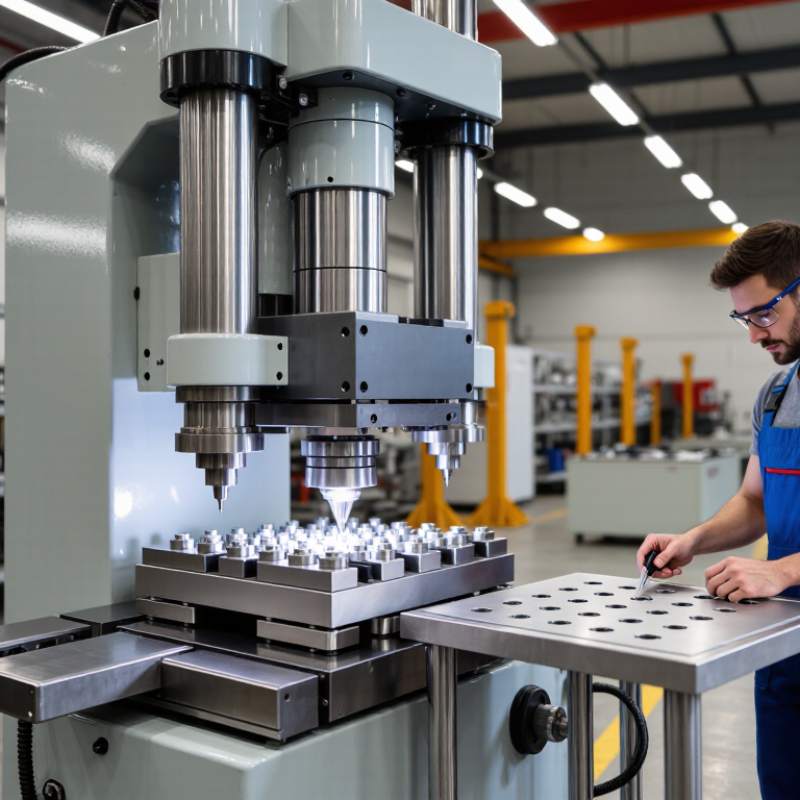
| Multi-Head Pneumatic Punching Machine | Several pneumatic cylinders or punching heads operate simultaneously or in a programmed sequence to perform multiple holes or forming actions in one fixture. | Panels, covers, footwear components, filters, electrical parts, and products requiring several repeated holes. | Approximately 0.2–10 tons per head, depending on the number and size of cylinders. | Approximately 10–100 mm per head. | Can reduce handling time and improve positional consistency, especially when all holes are processed in one clamping operation. | Shorter cycle time, consistent hole spacing, and reduced risk of errors caused by repeated repositioning. | Less flexible for frequent product changes; fixture and control-system design are more complex. | Choose when the product geometry is stable and several operations can be combined into one cycle. |
| Automatic Pneumatic Punching Cell | A pneumatic press is integrated with sensors, a programmable controller, part feeding, workpiece positioning, and optional unloading equipment. | Continuous production lines, safety-critical repeat operations, and applications requiring traceability or minimal manual intervention. | Approximately 1–30 tons for many light- and medium-duty automated cells. | Approximately 20–150 mm. | Offers the highest automation potential among the listed types, but line balance, sensor reliability, and tooling changeover directly affect performance. | Reduced manual labor, improved repeatability, enhanced safety monitoring, and stable production data. | Highest integration cost, more complicated troubleshooting, and greater dependence on correct programming and maintenance. | Choose when production volume, labor reduction, process consistency, and automated quality control justify the investment. |