| Primary Purpose | Stabilize a lightweight camera during flight | The mount counteracts aircraft movement so the camera remains aimed at the target | Produces smoother photographs and video than a rigid camera mount |
| Stabilization Axes | Usually 1–3 axes: pitch, roll, and optional yaw | Each axis uses a motor and control loop to correct rotational movement | Three-axis designs provide better control for changing flight directions and wind conditions |
| Sensing Method | Gyroscope and accelerometer; optional magnetometer | An inertial measurement unit detects angular movement and acceleration | Allows rapid correction before motion becomes visible in the footage |
| Control System | Microcontroller with proportional–integral–derivative control | The controller compares the desired angle with the measured angle and adjusts motor output | Improves holding accuracy while reducing overshoot and unwanted vibration |
| Camera Payload | Common DIY range: approximately 100–500 g | Motor torque must be sufficient to move and hold the camera and mounting hardware | Supports compact action cameras, small digital cameras, or sensors when correctly balanced |
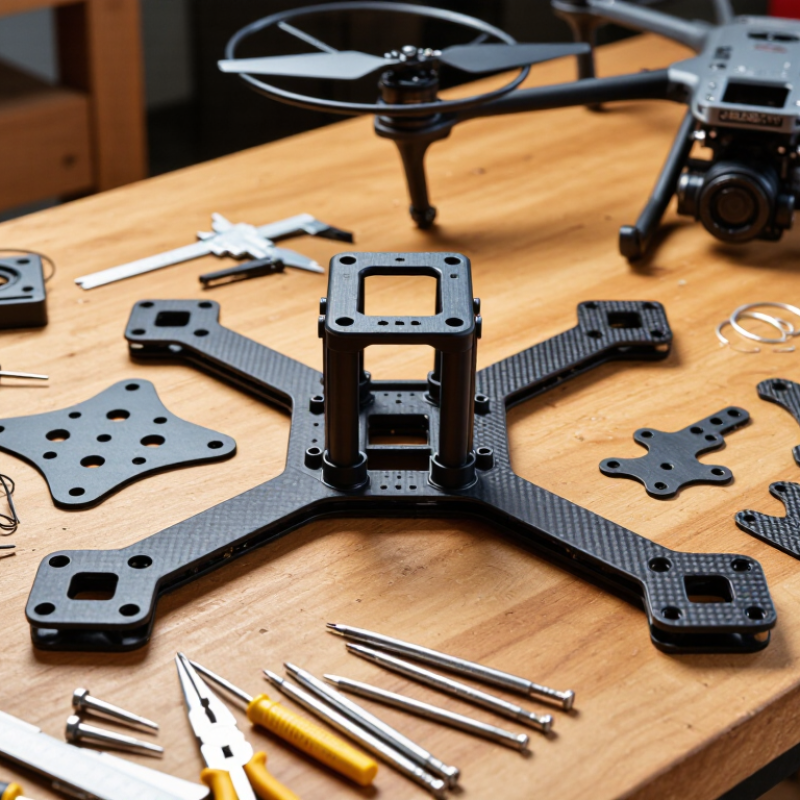
| Mechanical Frame | Aluminum, carbon-fiber plate, 3D-printed polymer, or a mixed structure | The frame supports the camera and isolates it from the drone body | A custom frame can be adapted to the camera shape and available mounting points |
| Motor Type | Small brushless or geared servo motors | Motors apply controlled torque to rotate the camera around each stabilized axis | Enables fast, repeatable corrections without requiring manual adjustment in flight |
| Operating Voltage | Common electronics range: 5–12 V, depending on the motor and controller | A regulated power circuit supplies the voltage required by the controller and motors | Compatible power design helps prevent resets, overheating, and unstable movement |
| Camera Tilt Range | Often about −90° to +30° on the pitch axis | The pitch motor changes the viewing angle from downward-looking to forward-looking positions | Supports ground inspection, landscape imaging, and forward-flight recording |
| Response Speed | Designed for corrections within milliseconds to tens of milliseconds | The sensor-controller-motor loop repeatedly updates the camera position during flight | Faster response reduces blur caused by small, sudden aircraft movements |
| Vibration Isolation | Silicone dampers, rubber balls, foam, or flexible mounts | Soft materials reduce high-frequency vibration transferred from motors and propellers | Helps minimize rolling-shutter artifacts, micro-jitters, and visible image shake |
| Balancing Requirement | Camera center of gravity should be close to each rotation axis | A balanced payload reduces the continuous torque required from the motors | Improves efficiency, reduces motor heat, and increases stabilization accuracy |
| Typical Added Mass | Approximately 80–250 g for a compact DIY assembly | The added mass includes the frame, motors, controller, dampers, and wiring | Lower mass generally preserves flight time and leaves more payload capacity |
| Power Consumption | Varies with payload, motor size, correction frequency, and supply voltage | Motors draw more current when correcting large angles or holding an unbalanced camera | Efficient construction can extend flight time compared with an oversized mount |
| Remote Control Function | Optional pitch command through a radio receiver or flight controller | Pilot input changes the target angle while stabilization remains active | Allows the operator to frame subjects without physically moving the drone |
| Main DIY Advantages | Custom fit, repairability, adjustable settings, and component-level control | The builder can select the frame, sensors, motors, firmware, and mounting geometry | Useful for prototypes, educational projects, specialized cameras, and experimental payloads |
| Key Design Trade-Off | Higher stability may increase mass, cost, power use, and tuning effort | Performance depends on mechanical stiffness, balancing, sensor quality, and controller tuning | A properly tuned lightweight system offers a practical balance between image quality and flight endurance |