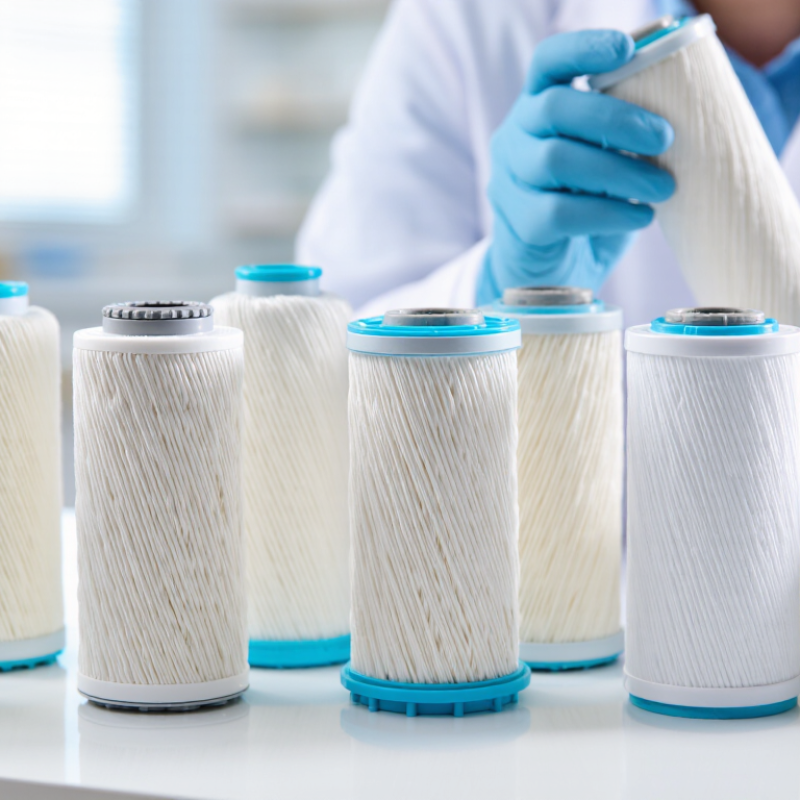
| Polypropylene String | Approximately 1–100 µm, depending on winding density and cartridge design | Up to approximately 80–90°C in many standard designs | Broad chemical resistance; low extractables; good resistance to acids, alkalis, and many aqueous process fluids; does not support biological growth. | Limited resistance to strong oxidizers and some aggressive solvents. Temperature and pressure limits vary by core, adapter, and end-cap materials. | Water treatment, prefiltration, plating solutions, process water, chemicals, and general-purpose industrial liquids. |
| Cotton String | Approximately 1–100 µm | Usually suitable for moderate-temperature service, often up to approximately 60–80°C | Good adsorption of some oils and organic compounds; effective for many general-purpose liquid filtration duties; economical. | Can swell or degrade in water-based or alkaline conditions; may release natural fibers or extractables; poor resistance to microbial growth and strong chemicals. | Oil filtration, fuel-related service, selected solvent applications, and processes where natural-fiber media are acceptable. |
| Polyester String | Approximately 1–100 µm | Often suitable up to approximately 120°C, subject to cartridge construction | Better thermal performance than many natural-fiber options; good mechanical strength; useful resistance to dilute acids and many organic liquids. | Chemical resistance is not universal. Strong alkalis, concentrated acids, and certain solvents may attack the fiber or reduce service life. | Industrial process liquids, oils, coatings, resins, and applications requiring higher temperature capability than cotton. |
| Fiberglass String | Approximately 1–100 µm | Often suitable for approximately 150–260°C, depending on binder, core, and end-cap materials | High temperature resistance; good dimensional stability; strong resistance to many chemicals; suitable for demanding industrial filtration. | May be brittle; loose fibers must be controlled; binder and hardware compatibility can limit maximum temperature and chemical resistance. | High-temperature oils, solvents, hydraulic fluids, chemical processing, and applications requiring low media deformation. |
| Stainless Steel Wire | Commonly approximately 5–100 µm, depending on mesh and winding pattern | Potentially above 300°C when the complete cartridge is designed for high-temperature service | Excellent mechanical strength; reusable in suitable applications; high temperature capability; resistant to media migration when properly constructed. | Higher purchase cost; not resistant to every chemical, especially certain chlorides and strong reducing or oxidizing environments; cleaning validation is required for reuse. | High-temperature liquids, lubricants, hydraulic systems, aggressive industrial service, and applications requiring cleanable metal media. |
| Surface-Wound Construction | Nominal or absolute ratings may be offered; commonly approximately 1–100 µm | Determined primarily by the string, core, and end-cap materials | Controlled pore openings at the media surface; good depth-loading capability; can provide a useful balance between dirt-holding capacity and particle retention. | Actual retention depends on winding tension, string diameter, density, and flow direction. A nominal rating should not be treated as an absolute rating. | General industrial liquid filtration, prefiltration, cooling water, and applications with variable particle sizes. |
| Dense Gradient-Wound Construction | Commonly available from approximately 1–50 µm | Determined by the media, core, end caps, and seal materials | Looser outer winding and progressively tighter inner winding can provide greater dirt-holding capacity while maintaining finer retention near the core. | Pressure drop can rise as the cartridge loads. Performance depends strongly on manufacturing consistency and the stated test method. | Pretreatment before membrane filters, high-solids process liquids, water polishing, and applications requiring extended cartridge life. |
| Coreless or Low-Hardware Design | Depends on the selected string material and winding density | Depends on the media and process conditions | Reduces internal hardware and may reduce extractables or disposal mass; useful where the process requires a predominantly fiber-based cartridge. | May have lower collapse resistance than a reinforced-core design. Differential-pressure limits must be checked carefully. | Low-to-moderate pressure liquid filtration and applications where reduced hardware contact is beneficial. |
| Reinforced-Core Design | Depends on the selected string material and winding density | Limited by the lowest-rated component in the assembly | Higher resistance to collapse, improved dimensional stability, and better suitability for higher differential pressure or viscous liquids. | Adds material cost and potential extractables. Core material must be compatible with the process fluid and operating temperature. | High-flow systems, viscous liquids, elevated differential pressure, and installations subject to hydraulic surges. |
| Standard Open-End Cartridge | Available across most common string-wound ratings | Determined by the complete cartridge assembly | Broad equipment compatibility when the housing uses a standard open-end configuration; easy replacement and wide availability. | Seal configuration and end-cap dimensions must match the housing. Bypass around the seal can occur if the cartridge is incorrectly fitted. | General-purpose cartridge housings and routine industrial liquid filtration. |
| Gasketed, Finned, or Custom-End Construction | Depends on the selected media and winding configuration | Determined by media, gasket, end cap, and housing materials | Can improve sealing, alignment, and resistance to bypass in specialized housings or demanding process installations. | Less interchangeable than standard designs. Gasket elastomer compatibility, compression, and installation orientation must be verified. | Dedicated process housings, sanitary or critical applications, and systems requiring enhanced sealing control. |