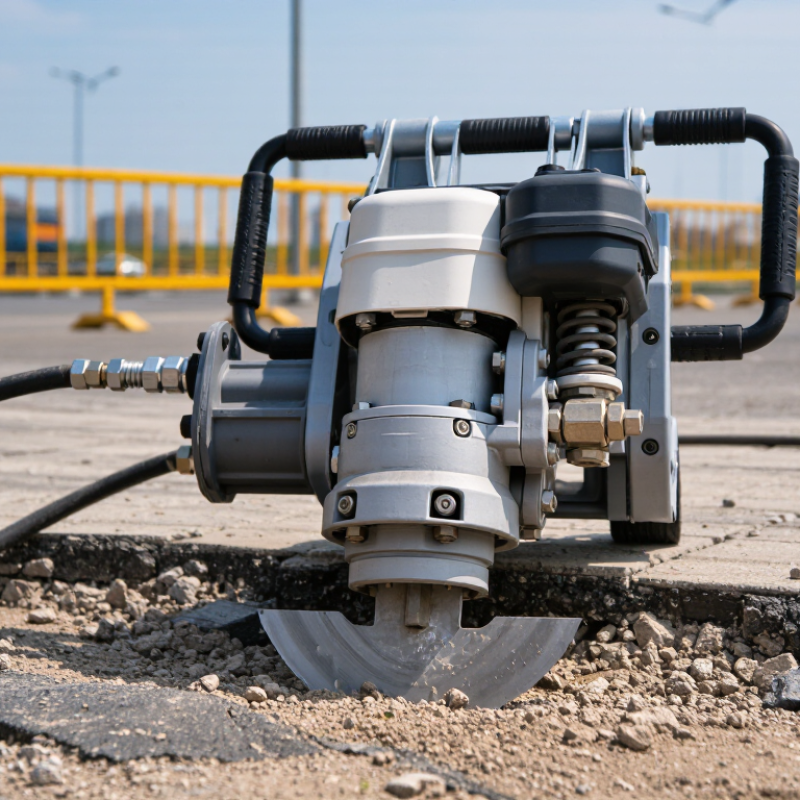
| Product type | Hand-held pneumatic paving breaker for concrete, asphalt and masonry demolition. | The quotation should clearly identify the tool as a TPB-90 class paving breaker and state its intended applications. | Check that all suppliers are quoting the same tool class rather than visually similar light-duty breakers. | Unclear model definition or inconsistent specifications. |
| Tool weight | Approximately 18–20 kg for many TPB-90 listings, excluding hose and tools. | A measured net weight with a defined configuration and a tolerance stated in the technical sheet. | Compare net weight, shipping weight and operating weight separately. | Weight is quoted without accessories or differs substantially from the listed range. |
| Overall length | Common published dimensions are around 500 mm, depending on handle and retainer design. | Length should be measured from the rear housing to the tool retainer, with the measurement method specified. | Confirm that dimensions are not copied from a different breaker size. | Dimension drawings and catalogue data do not match. |
| Impact frequency | Typically about 16–21 Hz, subject to air pressure, hose size and tool condition. | Test data should state operating pressure, hose inside diameter, oil condition and measurement method. | Compare measured performance under identical air-supply conditions. | Frequency is advertised without test conditions. |
| Air consumption | Many listings specify approximately 1.0–1.2 m³/min, but the reference pressure must be confirmed. | The supplier must specify free-air delivery, operating pressure and whether the value is average or maximum consumption. | Select the tool only after checking compressor capacity and simultaneous equipment load. | Air consumption is given only as a vague “low consumption” claim. |
| Recommended air pressure | Common operating specifications are around 0.5–0.63 MPa. | The operating range, maximum allowable pressure and safety instructions should be documented. | Verify compatibility with the local compressor, regulator and air-line system. | No maximum pressure or pressure-test information is provided. |
| Air inlet and hose | TPB-90 class tools commonly use a large pneumatic connection and a hose with approximately 19 mm internal diameter. | Connection thread, hose inside diameter, coupling type and recommended hose length must be stated. | Compare the complete air-line requirement, not only the tool inlet size. | Small hose recommendations may cause pressure drop and reduced performance. |
| Tool shank compatibility | A commonly listed shank size for this class is approximately 30 mm × 19 mm; dimensions vary by design. | A dimensioned shank drawing and compatible chisel list should be supplied. | Check local availability and price of moil points, chisels and cutting tools. | Shank dimensions are omitted or described only as “standard.” |
| Housing and critical materials | The cylinder, piston, valve and retainer are critical load-bearing or wear components. | Request material grades, heat-treatment information and inspection records for critical parts. | Compare documented process controls rather than relying on housing appearance. | No material or heat-treatment information is available. |
| Lubrication system | Pneumatic breakers require regular lubrication with suitable air-tool oil or an approved lubricator system. | The manual should specify lubricant type, lubrication frequency and recommended quantity. | Check whether lubrication instructions are clear for daily site use. | No lubrication schedule or unsuitable lubricant guidance. |
| Vibration and noise information | Vibration and sound levels depend on the test method, material being broken and operating conditions. | Request declared emission values with the applicable test method and uncertainty information. | Compare complete occupational-safety data, not isolated decibel or vibration figures. | Safety values are missing, unrealistic or unsupported by test records. |
| Factory testing | A functional test should confirm starting, impact operation, air tightness and abnormal noise. | Require a pre-shipment inspection report linked to the actual batch or serial number. | Give higher priority to suppliers willing to provide video and measurable test records. | Only visual inspection is performed. |
| Spare-parts support | Common wear parts include pistons, valves, seals, retainers, springs and tool bits. | The supplier should provide a parts list, exploded drawing, part numbers and recommended stock. | Compare availability, lead time and interchangeability of wear parts. | Parts are available only as an undocumented complete assembly. |
| Documentation | A professional supply package should include a manual, packing list, technical sheet and safety instructions. | Documents should match the quoted configuration and shipment contents. | Check consistency of dimensions, pressure, air consumption and accessories across all documents. | Different documents contain conflicting specifications. |
| Warranty and after-sales service | Warranty terms vary by supplier and should be defined in writing before order confirmation. | The agreement should state warranty duration, exclusions, response time and replacement-part responsibility. | Evaluate total ownership cost, not only the initial purchase price. | Verbal warranty promises without written terms. |
| Quotation and landed cost | The final cost includes the tool, bits, hose or couplings, packaging, freight, insurance, duties and local charges. | Request a line-item quotation with trade terms, packaging details and delivery schedule. | Rank offers by comparable delivered cost and included components. | A low unit price excludes essential accessories or after-sales costs. |