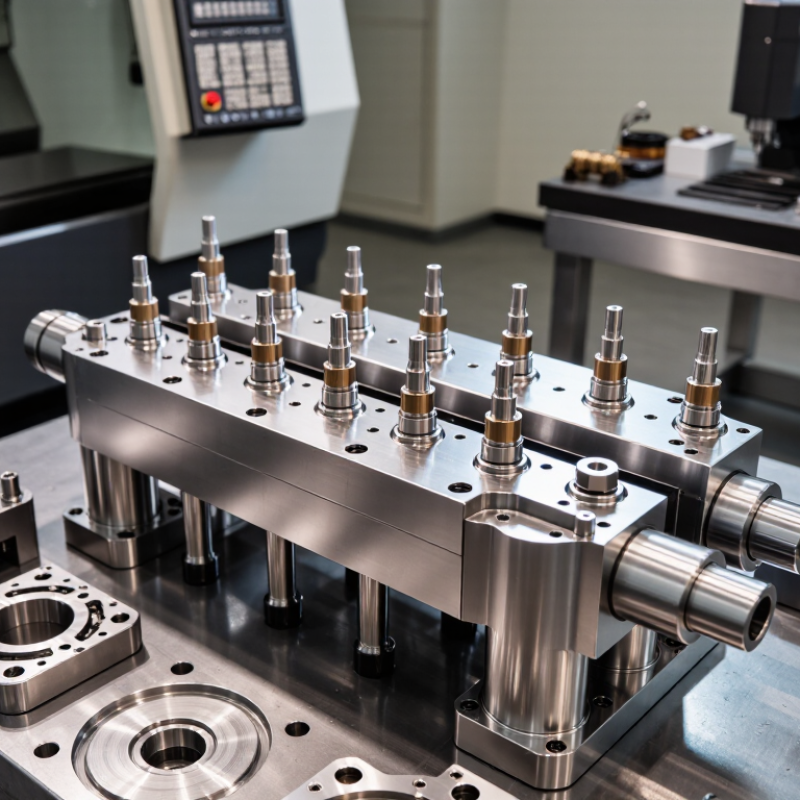
| Design review and process planning | Mold base, cavity and core inserts, manifold, nozzles, gates, heaters, and temperature sensors | Review 3D models and drawings; check component interfaces, material requirements, and machining sequence | Confirm alignment between the hot runner layout and the mold’s parting line, cavities, and cooling layout before cutting material | Drawing and model review; documented interface and tolerance checks |
| Mold base and plate machining | Clamping plates, support plates, cavity plates, and core plates | CNC milling, drilling, boring, tapping, and precision grinding where specified | Maintain plate flatness, pocket locations, guide features, and alignment between mating plates | Coordinate measurement, dimensional inspection, and flatness checks against the drawing |
| Cavity and core machining | Cavity inserts, core inserts, and replaceable mold details | CNC milling, drilling, EDM for suitable features, and surface finishing | Part geometry, shut-off surfaces, draft, surface finish, and insert fit influence part quality and mold assembly | Dimensional inspection; surface-finish checks where specified; trial-fit verification |
| Manifold machining | Hot runner manifold blocks and connecting flow passages | Machining of mounting faces, locating features, fastener holes, and designed melt-channel features | Passage layout and sealing faces must match the hot runner design; avoid unintended restrictions or misalignment in the melt path | Dimensional and positional checks; passage and sealing-surface review against the approved design |
| Nozzle and gate-seat machining | Nozzle pockets, nozzle seats, gate inserts, and tip locations | Precision milling, boring, drilling, and finishing of locating and seating features | Nozzle-to-gate alignment and the specified fit are important for consistent filling and to reduce leakage risk | Location and fit checks; verification of nozzle and gate alignment during assembly |
| Heater and sensor features | Heater bores, thermocouple bores, and cable-routing features | Drilling, boring, and machining of approved access and routing features | Feature locations and clearances must follow the hot runner design so heaters and sensors can be installed and serviced correctly | Bore size and position checks; installation and routing checks during assembly |
| Cooling and auxiliary features | Cooling channels, water connections, and service passages in mold plates and inserts | Drilling, deep-hole drilling where required, tapping, and port machining | Keep cooling features clear of cavities, hot runner components, fasteners, and other passages; confirm circuit connections | Passage-location checks and water-circuit leak or flow checks as specified |
| Heat treatment and finishing | Specified mold plates, inserts, and other heat-treated components | Heat treatment when required by the material and design, followed by finish machining or grinding as needed | Heat treatment can affect dimensions; machining allowances and final finishing should be planned accordingly | Material and heat-treatment records where specified; final dimensional checks after finishing |
| Assembly and hot runner verification | Completed mold and hot runner components | Clean, assemble, install heaters and sensors, connect circuits, and verify component fit | Check sealing interfaces, electrical connections, sensor positions, and clearances before mold trials | Assembly inspection; electrical continuity and insulation checks as applicable; documented trial and leak checks |
| Trial, correction, and final documentation | Assembled mold and molded test parts | Conduct molding trials, assess part and process results, and make approved corrections | Filling balance, gate performance, temperature control, and part appearance depend on the complete mold and process—not machining alone | Trial records, agreed part inspection results, final inspection report, and as-built documentation |