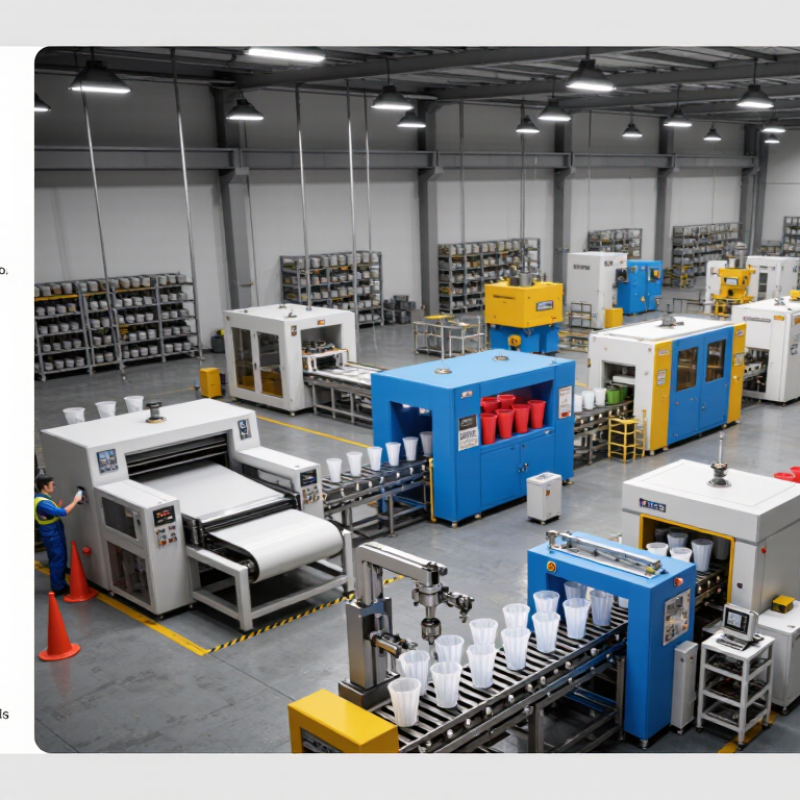
| 1 | Roll-Fed Thermoforming Machine | Feeds a continuous plastic roll, heats the sheet, forms cups in a mold, then trims and discharges them. | PP PS PET PLA | Heating, plug or vacuum forming, cutting, stacking, scrap collection and automatic conveying. | Disposable drinking cups, yogurt cups, dessert containers and portion cups. | Usually suited to continuous, high-volume production. Output depends on mold cavities, cycle speed, cup size and material thickness. | High material utilization and automation. Requires accurate sheet control, mold cooling and regular trimming-tool maintenance. |
| 2 | Sheet-Fed Thermoforming Machine | Uses pre-cut plastic sheets that are loaded individually or by an automatic sheet feeder before heating and forming. | PP PS PET ABS | Sheet loading, heating, vacuum or pressure forming, trimming and part removal. | Short and medium production runs, customized cups, laboratory containers and specialty packaging. | Lower-to-medium output compared with continuous roll-fed systems, with production determined by cavity count and cycle time. | Flexible for different sheet sizes and materials. Sheet handling can increase labor, waste and changeover time. |
| 3 | Inline Extrusion-Thermoforming Line | Extrudes plastic sheet directly from resin and transfers it inline to a thermoforming station. | PP PS PET PLA | Resin feeding, plasticizing, sheet extrusion, thickness control, forming, trimming and stacking. | Large-volume production of thin-wall cups and food-service containers. | Provides continuous sheet supply and consistent material thickness. Line speed is affected by extruder capacity, cup geometry and cooling performance. | Reduces intermediate sheet handling and can lower logistics cost. Requires higher initial investment and coordinated process control. |
| 4 | Vacuum Thermoforming Machine | Heated sheet is drawn against a mold by vacuum pressure to reproduce the cup shape. | PS PET PVC PP | Sheet heating, vacuum forming, mold cooling, trimming and product release. | Simple drinking cups, nursery cups, trays and containers with moderate forming depth. | Suitable for relatively simple shapes and economical tooling. Wall-thickness distribution may be less uniform in deep or complex cups. | Simple tooling and lower forming pressure. Detailed features and deep-draw designs may require plug assistance or pressure forming. |
| 5 | Pressure Thermoforming Machine | Uses compressed air above the heated sheet, often together with vacuum, to press the material into the mold. | PS PET PP PLA | Precision heating, pressure-assisted forming, detailed surface reproduction, trimming and stacking. | Thin-wall cups, branded-shape packaging, ribbed cups and containers requiring sharper details. | Produces better definition and more consistent walls than basic vacuum forming. Needs an air compressor, sealed tooling and careful pressure control. | Good for lightweight designs and precise features. Operating energy, tooling and maintenance requirements are generally higher. |
| 6 | Injection Molding Machine | Melts plastic pellets and injects the melt into a closed cup mold, where it cools and solidifies. | PP PS PE Tritan-type copolyesters | Plasticizing, injection, holding pressure, cooling, mold opening and automatic ejection. | Reusable cups, rigid promotional cups, laboratory cups and cups with integrated handles or complex details. | Suitable for repeatable dimensions, thicker walls and complex shapes. Cycle time depends on wall thickness, cooling and mold cavities. | Excellent dimensional accuracy and design flexibility. Mold costs, cooling demand and injection pressure are typically higher than thermoforming. |
| 7 | Injection-Compression Molding Machine | A measured plastic charge is placed or injected into a partially open mold, then compressed as the mold closes. | PP PET PS | Metered melt delivery, mold compression, controlled cooling, demolding and automated handling. | Thin-wall cups, food containers and products requiring low residual stress and good weight control. | Can reduce injection pressure and improve material distribution in thin-wall products. Performance depends strongly on mold design and compression timing. | Useful for lightweight precision parts. The system is more specialized and requires accurate synchronization between injection and mold movement. |
| 8 | Compression Molding Machine | Preheated plastic material or a measured melt charge is placed into a mold and shaped by direct compression. | PP Bioresins Thermoset compounds | Material dosing, preheating, mold compression, cooling, demolding and optional decoration handling. | Selected reusable cups, lightweight food-service cups and products made from heat-sensitive or specialized compounds. | Offers controlled material distribution and can support low-stress thin-wall parts. Production rate and material compatibility depend on the compound and mold design. | May provide lower melt flow requirements than conventional injection molding. Requires consistent dosing and carefully controlled mold temperature. |
| 9 | Stretch-Blow Molding Machine | A preform is reheated, stretched and blown against a mold to create a hollow container or cup-like vessel. | PET PP Copolyesters | Preform heating, axial stretching, air blowing, mold cooling and product ejection. | Lightweight reusable drinkware, clear specialty cups and containers needing high clarity or orientation strength. | Best suited to hollow designs with suitable height-to-diameter ratios. Output depends on cavities, heating efficiency and blowing cycle. | Can deliver strong, lightweight and transparent products. It is less suitable for very open, shallow cup geometries or wide flanges. |
| 10 | Integrated Cup Trimming, Stacking and Packing Line | Receives formed cups and performs secondary operations rather than forming the cup itself. | PP PS PET PLA | Rim trimming, edge inspection, counting, stacking, conveying, bagging and carton packing. | High-volume disposable cups produced by thermoforming or injection molding. | Automation level can range from semi-automatic handling to fully integrated inspection and packaging. Capacity must match the upstream forming machine. | Improves hygiene, counting accuracy and labor efficiency. Incorrect synchronization can cause jams, cup deformation or unstable stacks. |