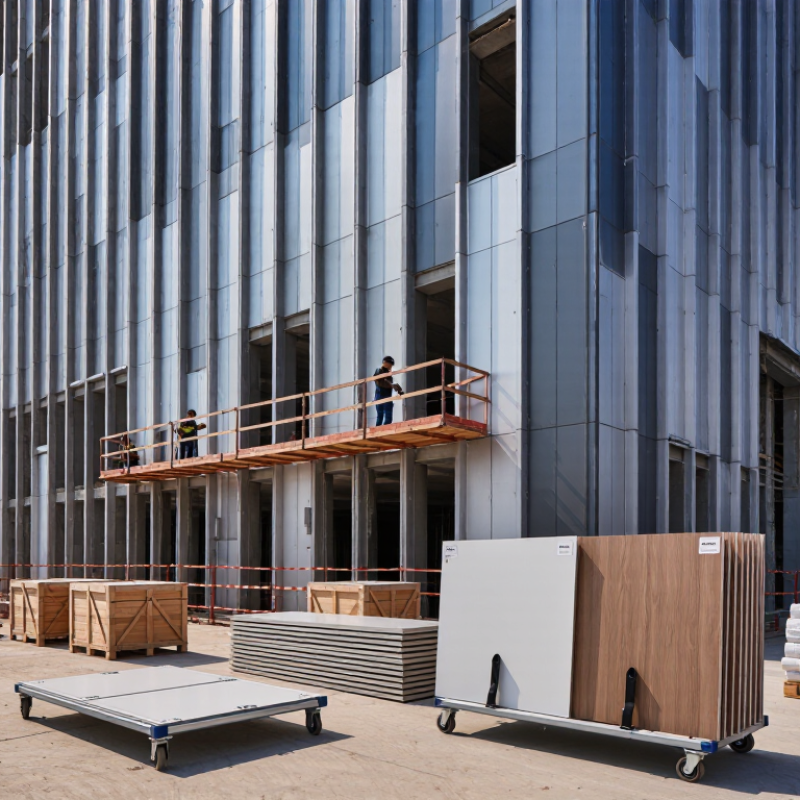
| Product Definition | An aluminum composite panel is a flat sandwich panel made from two aluminum sheets bonded to a central core. | Commonly used for building façades, canopies, signage, partitions, column covers, and interior decoration. | The exporter should clearly state the panel structure, core material, aluminum thickness, coating system, and intended application. |
| Panel Construction | The panel normally consists of an aluminum top sheet, a polymeric or mineral-filled core, and an aluminum back sheet. | Typical overall thicknesses include 3 mm, 4 mm, and 6 mm, depending on the application and local regulations. | Accurate construction data helps buyers compare products on a like-for-like basis rather than comparing price alone. |
| Aluminum Skin Thickness | Aluminum face sheets are commonly specified by thickness, with approximately 0.20 mm to 0.50 mm frequently used in architectural panels. | Thicker skins are generally preferred for demanding façade work, deeper routing, larger panels, and improved dent resistance. | The exporter should provide measured thickness tolerances and distinguish aluminum skin thickness from total panel thickness. |
| Core Types | - Polyethylene or polymer core: commonly selected for general signage and lower-risk applications.
- Fire-retardant mineral-filled core: designed to improve fire performance.
- Mineral core with very limited combustibility: used where stricter fire requirements apply.
| Core selection should be based on the building code, project height, occupancy type, façade design, and required fire classification. | A reliable exporter should not recommend one core for every project and should provide product-specific fire-test evidence. |
| Surface Coating | Common surface finishes include fluoropolymer-based coatings, polyester coatings, anodized finishes, brushed effects, solid colors, and wood or stone patterns. | Coating choice depends on ultraviolet exposure, coastal conditions, cleaning requirements, color stability, and design intent. | The exporter should disclose the coating type, nominal coating thickness, color reference, gloss level, and warranty conditions where applicable. |
| Standard Panel Sizes | Manufacturers commonly offer panel widths around 1,220 mm, with lengths such as 2,440 mm or longer custom lengths available in many markets. | Final dimensions should be confirmed against the cutting plan, container loading method, installation system, and local handling limitations. | Accurate dimensional planning can reduce offcuts, shipping volume, installation time, and total project cost. |
| Dimensional Tolerances | Panel length, width, thickness, squareness, flatness, and surface quality should be controlled according to the applicable product specification or standard. | Buyers should request a tolerance sheet rather than relying only on nominal dimensions. | Consistent tolerances are important for CNC routing, folding, cassette systems, joint alignment, and façade appearance. |
| Fire-Performance Evidence | Fire performance is evaluated through recognized national or international test systems. EN 13501-1 and ASTM E84 are examples of commonly referenced systems, but their classifications are not interchangeable. | The required classification must match the destination country's building regulations and the specific end use. | An exporter should provide current reports identifying the tested product construction, thickness, core, test method, and issuing laboratory. |
| Mechanical and Bond Performance | Relevant evaluations may include peel strength, bending behavior, impact resistance, coating adhesion, and resistance to environmental exposure. | ASTM D1781 is one example of a peel-resistance test method used for certain bonded sandwich constructions; the applicable method depends on the project specification. | Test results help buyers assess delamination risk, fabrication performance, and long-term service suitability. |
| Weather Resistance | Outdoor durability is influenced by coating chemistry, aluminum alloy and temper, pretreatment, ultraviolet exposure, humidity, salt, temperature changes, and installation details. | Coastal, tropical, desert, and high-altitude projects may require different coating and quality-control considerations. | The exporter should provide relevant weathering or corrosion-test information and avoid unsupported claims about service life. |
| Quality-Control Documents | Useful documents may include a technical data sheet, certificate of analysis, inspection report, coating information, packing list, and product-specific test reports. | Documents should identify the product configuration, batch or production reference, quantity, dimensions, and inspection criteria. | Complete documentation supports customs clearance, project approval, incoming inspection, and claims management. |
| Exporter Manufacturing Capability | A capable exporter should be able to explain core preparation, lamination, coating or finishing, trimming, inspection, packing, and traceability procedures. | Buyers may request production photos, sample panels, factory audit information, and a defined inspection plan. | Transparent manufacturing information reduces the risk of receiving panels that differ from the approved sample. |
| Sample Approval | Color, gloss, texture, flatness, edge quality, protective film, and core appearance should be checked before mass production. | For large projects, the approved reference sample should include the exact panel thickness, aluminum skin thickness, finish, and core type. | Written sample approval creates a clear quality benchmark for production and shipment inspection. |
| Packaging for Export | Panels are commonly protected with surface film and packed in reinforced wooden cases, pallets, or other export-suitable packaging. | Packaging should protect against abrasion, moisture, edge damage, shifting, and excessive stacking pressure during multimodal transport. | Packaging quality directly affects the percentage of usable panels received at the destination. |
| Shipping and Trade Terms | International quotations may use Incoterms such as EXW, FOB, CIF, or DAP. Each term allocates different costs, risks, and responsibilities. | The quotation should state the named place or port, currency, validity period, lead time, packing basis, and whether freight is included. | Clear trade terms prevent unexpected logistics charges and misunderstandings about responsibility for damage or insurance. |
| Container-Loading Planning | Loading capacity depends on panel dimensions, thickness, packing method, allowable stacking, gross weight, and the shipping route. | Buyers should request a packing list with package dimensions, net weight, gross weight, and total volume before shipment. | Accurate loading data supports freight comparison and helps prevent overloading or inefficient use of container space. |
| Compliance with Destination Market | Building materials may be subject to local fire, structural, environmental, labeling, chemical, and documentation requirements. | Compliance must be checked against the destination country and the actual application, especially for external façades and high-rise buildings. | The lowest-price product may not be usable if it lacks the approvals or test evidence required by the importing market. |
| Warranty and Claims Process | A professional supply agreement should define warranty scope, exclusions, inspection timing, evidence requirements, and remedies for nonconforming goods. | Claims should be supported by photographs, package references, quantities affected, delivery records, and inspection results. | A clear after-sales process is an important indicator of exporter reliability, particularly for large or repeat orders. |
| Total Cost of Ownership | Total project cost includes panel price, freight, duties, fabrication, installation, maintenance, waste, replacement risk, and compliance testing. | Buyers should compare equivalent specifications, including core, aluminum thickness, coating, dimensions, packaging, and delivery terms. | A technically suitable panel with dependable documentation may provide better value than a cheaper panel with higher project risk. |