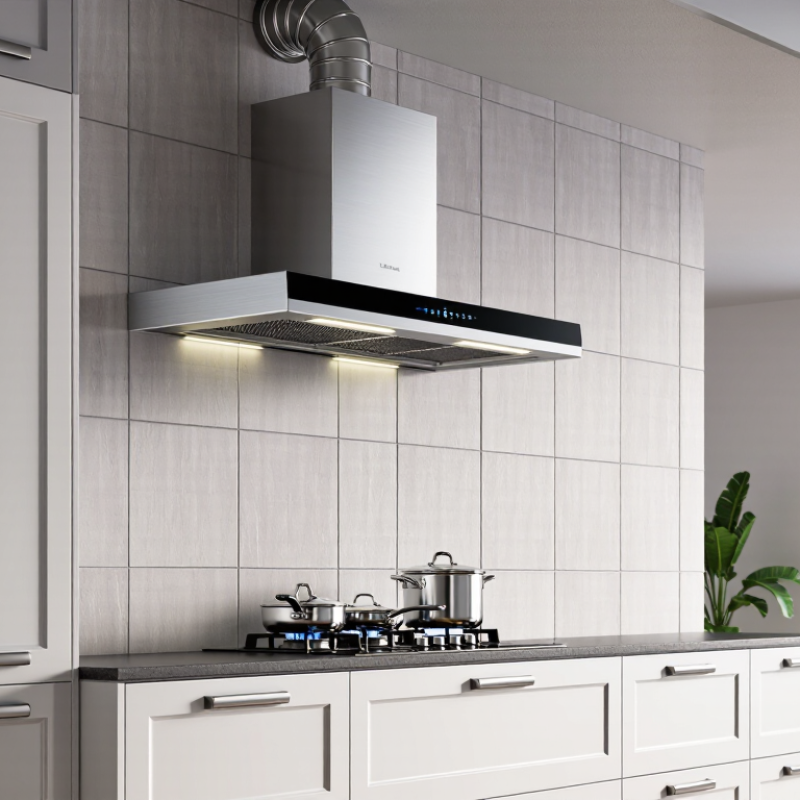
| Product type | Wall-mounted chimney hood | Mounted above a cooktop; typically uses a visible canopy and a vertical decorative flue. | Check hood width, installation height, duct route, and kitchen-cabinet clearance. |
| Product type | Under-cabinet hood | Compact unit fitted beneath a cabinet; may be ducted outdoors or used with recirculation filters. | Confirm cabinet dimensions, outlet position, and whether compatible charcoal filters are available. |
| Product type | Island hood | Ceiling-suspended design for cooktops located away from a wall; requires secure overhead mounting. | Review ceiling support, duct access, electrical connection, and installation instructions. |
| Product type | Insert or built-in hood | Ventilation unit concealed within a custom cabinet or hood enclosure. | Compare the internal cutout, service access, control location, and required enclosure depth. |
| Product type | Downdraft ventilation unit | Air intake rises from or sits beside the cooking surface and draws fumes downward or sideways. | Check compatibility with the cooktop and base cabinet, plus the space needed for ducting. |
| Core component | Motor and drive system | AC or electronically controlled motor drives the fan; speed control and motor design affect airflow and sound. | Assess operating speeds, electrical ratings, noise data, serviceability, and replacement-part availability. |
| Core component | Fan wheel or blower | Moves air through the hood and duct; centrifugal blower designs are commonly used in household ventilation products. | Compare airflow performance under stated test conditions, not just the maximum advertised figure. |
| Core component | Grease filter | Often a removable metal mesh or baffle assembly that captures grease droplets from cooking exhaust. | Check filter dimensions, cleaning instructions, dishwasher guidance, and replacement availability. |
| Core component | Charcoal or activated-carbon filter | Used in many recirculating configurations to reduce some cooking odors; it does not replace outdoor exhaust for moisture removal. | Confirm the correct filter type and recommended replacement interval for the specific hood model. |
| Core component | Housing, canopy, and flue | Common constructions include formed stainless steel, coated sheet metal, and glass panels, depending on design. | Review material thickness, finish consistency, edge quality, corrosion protection, and packaging safeguards. |
| Core component | Controls, lighting, and wiring | May include mechanical buttons or electronic touch controls, LED lighting, wiring harnesses, and a control board. | Verify voltage and frequency compatibility, control functions, wiring protection, and electrical documentation. |
| Core component | Duct connector, damper, and ductwork | Connects the hood to an exhaust route; duct shape, diameter, length, and bends influence system resistance. | Match the outlet size and installation route; use smooth, appropriately sized ducting where permitted by local codes. |
| Upstream supply | Steel and metal-processing suppliers | Provide sheet metal and related inputs for housings, filters, brackets, and decorative parts. | Supplier qualification commonly considers material specifications, surface quality, traceability, and delivery consistency. |
| Upstream supply | Electrical and electronic component suppliers | Supply motors, capacitors where applicable, switches, control boards, LEDs, connectors, and wiring. | Assess component ratings, documentation, change control, and continuity of supply. |
| Manufacturing process | Fabrication, finishing, and assembly | Typical operations include sheet-metal forming, welding or fastening, surface finishing, wiring, and final assembly. | Evaluate process controls, workmanship standards, production capacity, and the handling of customized specifications. |
| Quality and compliance | Inspection and product verification | Relevant checks can include electrical safety, functional operation, airflow, noise, controls, finish, and packaging. | Request test methods and reports applicable to the destination market; requirements vary by jurisdiction and product configuration. |
| Outbound supply chain | Packaging, logistics, and distribution | Finished units move through export packing, freight, import handling, warehousing, and retail or project distribution. | Confirm carton protection, shipping dimensions, spare-parts support, delivery terms, and after-sales arrangements. |