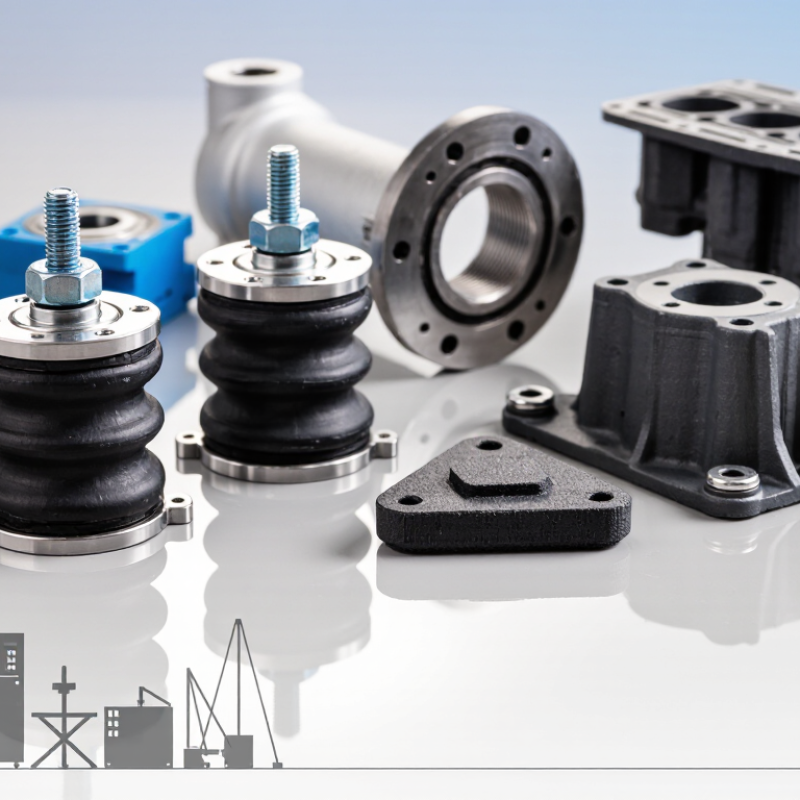
| Product Type and Design Fit | Whether the supplier can provide the correct mount architecture for the load, motion, temperature, and vibration profile. | Rubber-metal mounts, bonded bushings, spring mounts, wire-rope isolators, and custom assemblies should be selected according to static load, dynamic load, natural frequency, stroke, and installation direction. | Product drawings, load-deflection curves, dynamic stiffness data, CAD files, installation instructions, and design calculations. | 15% | __/10 |
| Load Capacity and Deflection | Accuracy of rated load, working load range, compression or shear deflection, and safety margin. | The working load should be specified by direction and operating condition. A documented design safety factor is preferable to using the catalog maximum as the continuous operating load. | Compression and shear test reports, load-deflection charts, finite-element analysis where relevant, and clearly defined static and dynamic ratings. | 12% | __/10 |
| Isolation Performance | Natural frequency, transmissibility, damping, resonance behavior, and performance across the operating frequency range. | For a passive isolator, effective isolation normally begins when the excitation frequency is sufficiently above the system natural frequency; the exact result depends on damping, preload, and the complete mounted system. | Dynamic stiffness or transmissibility curves, frequency-sweep data, test fixture description, preload conditions, and measurement uncertainty. | 15% | __/10 |
| Material Selection | Elastomer type, hardness, metal grade, corrosion protection, and compatibility with the operating environment. | Common elastomers include natural rubber, EPDM, neoprene, nitrile rubber, silicone, and fluorocarbon rubber. Selection should consider temperature, oil, ozone, UV, coolant, salt spray, and chemical exposure. | Material datasheets, compound identification, hardness specification, batch traceability, restricted-substance declarations, and compatibility test results. | 12% | __/10 |
| Temperature Capability | Continuous and intermittent temperature limits, thermal aging, and performance retention after exposure. | Typical elastomer temperature ranges vary substantially by compound. The supplier should state both continuous-use and short-term limits instead of quoting one generic temperature number. | Thermal aging reports, temperature-cycle test results, compound specification, post-aging hardness and tensile data, and application-specific validation. | 8% | __/10 |
| Mechanical and Environmental Durability | Fatigue life, creep, compression set, ozone resistance, corrosion resistance, and failure mode control. | Testing should reproduce the actual load direction, amplitude, frequency, temperature, and environmental exposure. A universal cycle-life claim without test conditions is not sufficient for comparison. | Fatigue test reports, compression-set results, ozone or weathering tests, salt-spray results for metal parts, and documented failure analysis. | 12% | __/10 |
| Dimensional and Process Control | Control of critical dimensions, bonding quality, rubber hardness, concentricity, surface finish, and batch consistency. | Critical tolerances should be defined on the drawing and verified with calibrated inspection equipment. Rubber-to-metal bonding should be controlled through surface preparation, adhesive process, cure conditions, and visual inspection. | Control plans, process flow charts, inspection records, capability studies, calibration certificates, and sample parts from more than one production batch. | 10% | __/10 |
| Quality Management | Formal quality system, document control, corrective action, nonconformance handling, and traceability. | ISO 9001 certification is a useful baseline. Automotive applications may additionally require IATF 16949, while environmental management can be supported by ISO 14001. | Current certificates issued by an accredited certification body, audit scope, process audit results, corrective-action records, and lot-level traceability examples. | 8% | __/10 |
| Compliance and Export Readiness | Ability to meet destination-market substance restrictions, packaging rules, labeling, and technical-documentation requirements. | For many global markets, buyers may request RoHS and REACH declarations. The applicable requirements depend on the product, destination, industry, and customer specification. | Supplier declarations, laboratory test reports where required, safety data information, packaging specifications, country-of-origin documents, and export references with sensitive information removed. | 6% | __/10 |
| Testing Capability | In-house and independent laboratory capacity for static, dynamic, environmental, dimensional, and material testing. | A capable supplier should be able to define test method, sample size, conditioning, acceptance criteria, and equipment calibration status for each validation activity. | Equipment list, calibration records, test-method references such as ISO or ASTM standards, raw data samples, and third-party laboratory reports when applicable. | 5% | __/10 |
| Tooling and Customization | Engineering support, mold design, prototype speed, change control, and ownership of customer-specific tooling. | A clear development process should cover design review, prototype approval, production-part approval, engineering-change notification, and retention of tooling records. | Development schedule, prototype samples, drawing-revision control, tooling agreement, sample approval process, and documented engineering-change procedure. | 5% | __/10 |
| Supply Reliability and Commercial Risk | Production capacity, lead time, minimum order quantity, continuity planning, packaging, logistics, and communication quality. | Lead time should be separated into tooling, prototype, first production, and repeat-order stages. Supplier claims should be checked against capacity evidence and recent delivery performance. | Capacity statement, production schedule, business-continuity plan, packaging validation, shipment records with confidential details removed, and written escalation contacts. | 7% | __/10 |