| Fuel Compatibility | Natural gas, biogas, landfill gas, coal-bed methane, and other approved gaseous fuels, subject to engine configuration and gas quality. | Fuel composition, methane number, pressure, moisture, hydrogen sulfide, and siloxane content must be verified before selection. | Correct fuel matching improves reliability, combustion stability, maintenance intervals, and operating cost control. |
| Power Range | Solutions may cover small standby units below 100 kW, commercial systems from approximately 100 kW to 1 MW, and larger modular power plants above 1 MW. | Final output depends on engine rating, ambient conditions, fuel quality, duty cycle, and site altitude. | A broad product range allows the supplier to match residential, commercial, industrial, agricultural, and utility applications. |
| Operating Mode | Standby, prime, continuous, peak-shaving, microgrid, combined heat and power, and parallel-operation configurations. | ISO 8528 provides internationally recognized classifications and performance concepts for engine-driven generator sets. | Selecting the correct duty rating prevents overheating, premature wear, and inadequate performance under continuous loads. |
| Electrical Output | Common configurations include 50 Hz or 60 Hz systems, three-phase output, and site-specific voltage options such as 380/400 V or 415 V. | Voltage, frequency, phase, power factor, short-circuit performance, and grid-connection requirements must be confirmed in the technical specification. | Electrical compatibility is essential for safe connection to local grids, transfer switches, distribution systems, and sensitive equipment. |
| Fuel Efficiency | Electrical efficiency commonly varies by engine size, load, fuel type, and operating conditions; larger, well-loaded gas engines generally achieve higher efficiency than small units. | Efficiency should be evaluated using documented test conditions, including gas calorific value, load percentage, ambient temperature, and altitude. | Transparent efficiency data provides a more accurate basis for calculating lifetime fuel consumption and operating expenses. |
| Combined Heat and Power | CHP systems can recover engine jacket-water and exhaust heat for hot water, heating, drying, or industrial processes. | Overall CHP utilization can be substantially higher than electrical efficiency alone when recovered heat is used effectively. | Heat recovery can reduce total energy waste and improve project economics where there is a consistent thermal load. |
| Emissions Compliance | Configurations may be designed for applicable local limits on nitrogen oxides, carbon monoxide, unburned hydrocarbons, methane, and formaldehyde. | Requirements vary by country and project; buyers should review local environmental permits and applicable stationary-engine regulations. | Emission compliance affects approval time, after-treatment design, operating restrictions, and total project cost. |
| Safety Engineering | Gas-leak detection, automatic fuel shutoff, emergency stop, ventilation, fire protection interfaces, overspeed protection, and high-temperature alarms. | Safety design should comply with applicable electrical, gas-installation, fire, and workplace-safety regulations at the installation site. | A documented safety system reduces risks to personnel, equipment, buildings, and surrounding communities. |
| Control and Monitoring | Digital controllers with automatic start/stop, load sharing, synchronization, alarms, event logs, remote monitoring, and communication interfaces. | Common communication options include Modbus-based integration and other site-specific supervisory-control interfaces. | Advanced monitoring supports predictive maintenance, faster fault diagnosis, and integration with microgrid or building-management systems. |
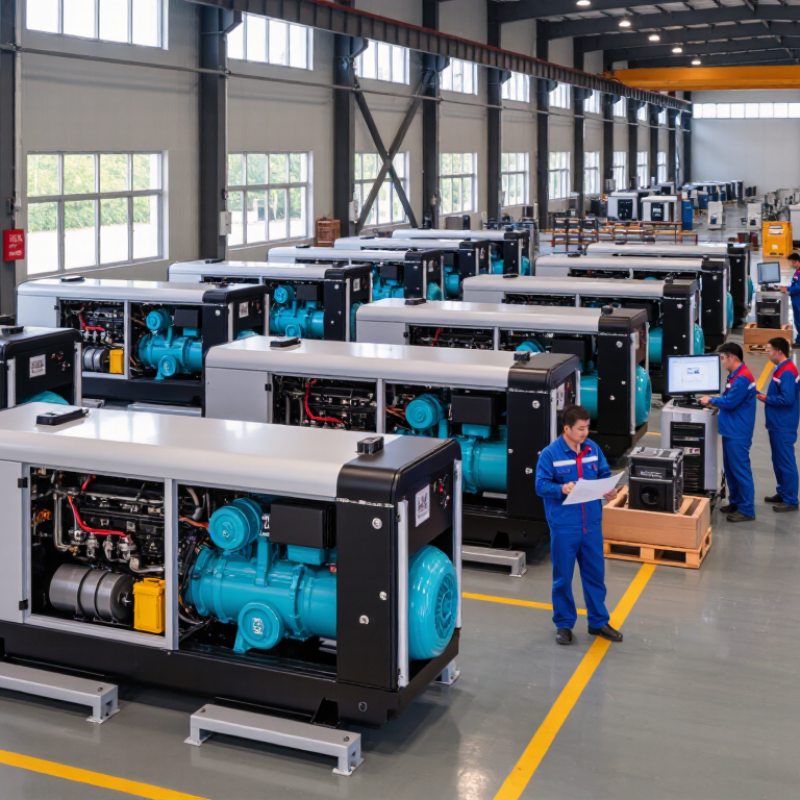
| Factory Testing | Documented inspection and testing of rated output, voltage regulation, frequency stability, protection functions, alarms, noise, and load response. | Testing procedures should be defined in the purchase specification and aligned with the applicable generator-set standards. | Factory acceptance testing helps identify assembly or control problems before shipment and commissioning. |
| Certification and Documentation | Quality-management records, technical datasheets, wiring diagrams, installation manuals, operation manuals, spare-parts lists, and conformity documents where required. | ISO 9001 relates to quality-management systems; additional certifications depend on destination market and equipment configuration. | Complete documentation simplifies customs clearance, installation, operator training, maintenance, and regulatory review. |
| Customization Capability | Options may include containerized or open-frame packages, acoustic enclosures, radiator or remote cooling, automatic transfer systems, synchronization panels, and CHP modules. | Customization should be based on site load profile, climate, altitude, noise limits, fuel conditions, and local electrical requirements. | A properly engineered package reduces installation modifications and improves performance in challenging environments. |
| After-Sales Support | Commissioning guidance, operator training, preventive-maintenance schedules, troubleshooting support, warranty procedures, and spare-parts planning. | Service coverage and response time should be clearly stated in the commercial and technical contract. | Reliable support reduces downtime and protects the generator’s availability throughout its service life. |
| Total Cost of Ownership | Evaluation includes purchase price, gas consumption, oil and filter costs, scheduled maintenance, spare parts, installation, emissions equipment, downtime, and disposal. | A lifecycle comparison should use the expected annual operating hours, average load, fuel price, maintenance plan, and project lifetime. | The lowest initial price does not necessarily provide the lowest long-term cost or the highest availability. |