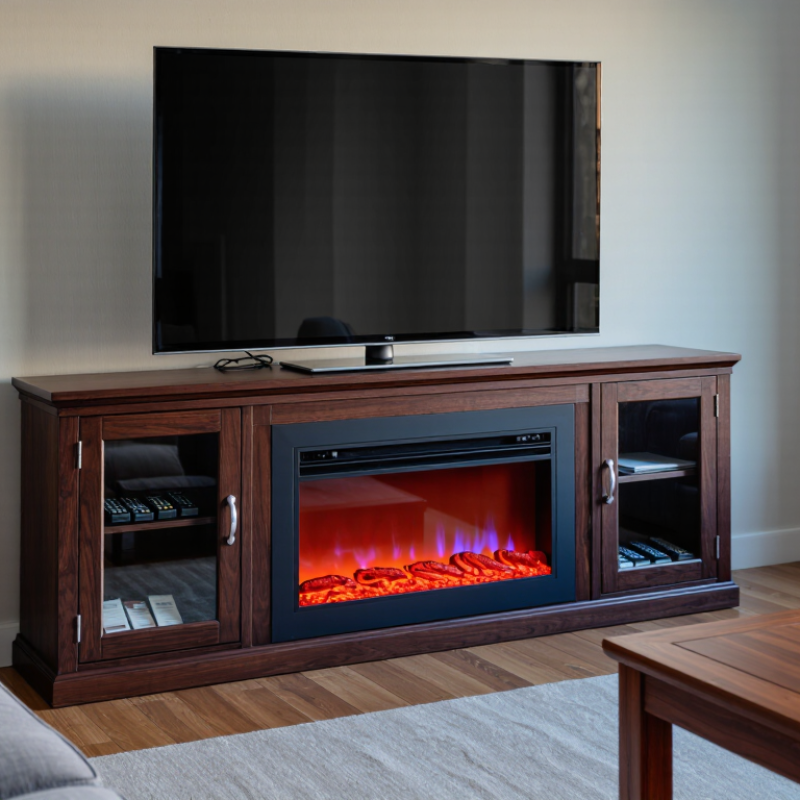
| Product safety and certification | Confirm that the fireplace insert and finished console meet the safety requirements for the destination market. Requirements depend on the product design and market. | Certificate and test report for the exact model; issuing body; model number; certification-directory listing; and product label photographs. | Check that the documents cover the quoted model and electrical configuration. Do not treat a component certificate as certification of the finished product. | Model-specific documentation can be independently checked with the relevant certification body. For the U.S. market, UL 2021 and CSA C22.2 No. 46 are examples of electric-heater safety standards to verify as applicable. |
| Electrical configuration | Match voltage, frequency, plug, rated power, controls, and any heating settings to the destination market and the buyer’s product requirements. | Electrical rating label, wiring diagram, product specification sheet, and sample test results. | Compare the rated input and supplied plug against the destination-market specification. For example, U.S. household supply is generally 120 V at 60 Hz; the product must be designed and approved for its intended use. | Specifications are consistent across the quotation, sample, rating label, manual, and certification documents. |
| Heating performance | Review heater output, operating modes, thermostat or timer functions, flame-effect operation, and any stated room-size guidance. | Rated heater output, test method, operating manual, sample demonstration, and any substantiation for performance claims. | Compare outputs using the same units and test conditions. Treat room-size estimates as guidance, not a guarantee, because results vary with insulation, ceiling height, and climate. | Claims are clearly defined, supported by test information, and consistent with the product’s rated electrical input. |
| Console construction and load capacity | Assess dimensions, materials, panel thickness, joinery, stability, finish, and the stated supported load for the top surface and shelves. | Dimensioned drawings, bill of materials, load-test method and results, assembly instructions, and a production sample. | Compare equivalent dimensions and construction. Ask how the load rating was tested and whether it applies to a distributed load or a point load. | Drawings, sample construction, and documented test results agree; assembly instructions include clear stability and load-use guidance. |
| Composite-wood compliance | If applicable, check formaldehyde-emission compliance for regulated composite-wood components in the destination market. | Applicable test or compliance records, component details, supplier declarations, and required product or packaging labels. | For U.S.-bound products containing regulated hardwood plywood, medium-density fiberboard, or particleboard, verify applicable TSCA Title VI requirements for those materials. | Records identify the relevant material and production source and can be linked to the components used in the quoted product. |
| Quality control and consistency | Review incoming-material checks, in-process inspections, final inspections, defect handling, and change control. | Quality-control plan, inspection checklist, recent anonymized inspection records, and written procedures for approving product changes. | Compare inspection coverage and acceptance criteria, not just the existence of a quality certificate. Confirm how production changes are communicated and approved. | Documented checks cover both the furniture console and the electrical insert, with traceable records and a defined corrective-action process. |
| Packaging and shipping protection | Check protection for glass, cabinet corners, the heater insert, and hardware; also review carton dimensions and shipping configuration. | Packaging specifications, carton photographs, packing list, and drop or transit-test results where available. | Compare packaging against the shipping method and handling risks. Request a packed sample or review packaging during a sample inspection. | Packaging is designed for the agreed transport route, protects fragile components, and has been checked using a documented method. |
| Production capacity and lead time | Check whether the supplier can meet the required order quantity, production schedule, and repeat-order timing. | Production schedule, stated monthly capacity, current lead-time estimate, and a breakdown of sample, production, and shipping timelines. | Compare lead times on the same basis and clarify when the production clock starts, including approval of samples, artwork, and payment terms. | Capacity and timelines are specific to the requested model and quantity, with key milestones and delay-notification procedures in writing. |
| Commercial terms and total cost | Review unit price, tooling or sample charges, minimum order quantity, payment terms, packaging costs, and quoted delivery terms. | Itemized quotation with currency, validity period, order quantity, included accessories, packaging details, and delivery-term location. | Compare like-for-like specifications and delivery terms. Separate product price from freight, duties, taxes, inspection, and other costs not included in the quotation. | The quote clearly identifies inclusions, exclusions, assumptions, and charges that may change with quantity or specification. |
| After-sales support and warranty | Clarify warranty coverage for the heater, controls, electrical components, and furniture structure, including remedies and claim procedures. | Written warranty terms, spare-parts list, claim process, response-time commitment, and proposed remedy for confirmed defects. | Compare coverage period and exclusions separately for electrical and furniture components. Confirm who pays for replacement parts and shipping. | Terms are written, model-specific, practical to use, and supported by an identified process for spare parts and warranty claims. |
| Communication and document control | Assess response clarity, technical knowledge, version control, and ability to keep specifications consistent during sampling and production. | Written specification, approved sample record, document revision history, and responses to technical questions. | Use the same question set for each supplier and record response time, completeness, and whether answers are supported by documents. | Answers are specific and consistent; approved specifications and changes are recorded before production. |