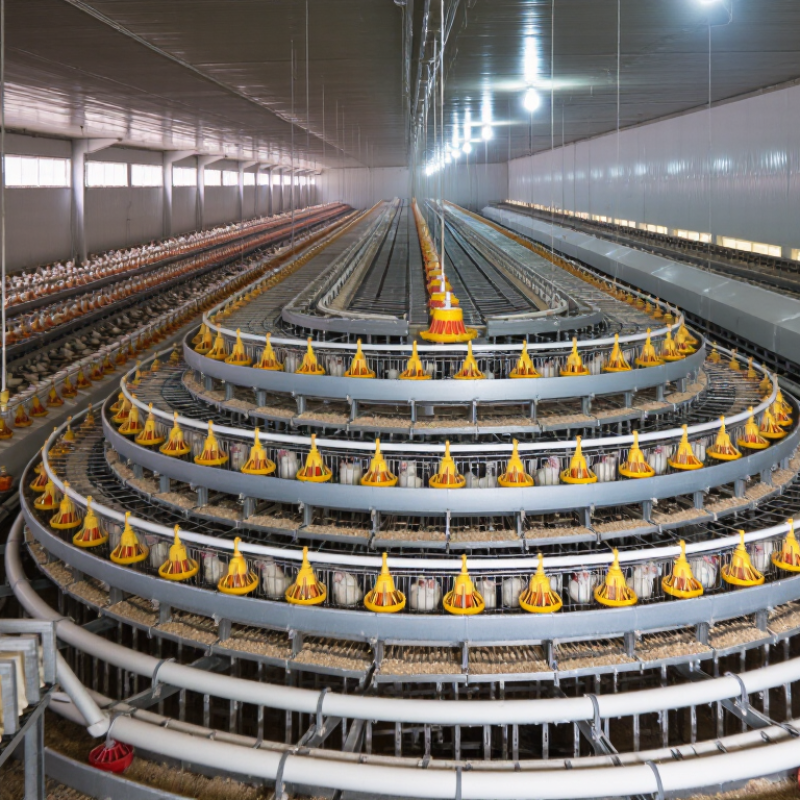
| Conventional battery cage | Small groups of hens housed in adjacent wire enclosures; stocking allowances and permitted use vary by jurisdiction. | Provides a compact housing layout with integrated feeding and watering. | Check local animal-welfare requirements. Conventional cages are prohibited in some jurisdictions. |
| Enriched colony cage | Group housing with features such as perches, nests, and scratching areas. Under EU rules, the minimum space is 750 cm² per hen, including at least 600 cm² of usable area. | Adds behavioral features while retaining a caged housing format. | Confirm applicable standards, usable-area definitions, group size, and required fittings before specifying equipment. |
| Non-cage aviary system | Multi-level indoor housing with floor space, perches, nests, and litter areas. | Allows hens to move between levels and use different areas of the house. | Plan for bird movement, litter management, access to resources, and manure handling. |
| Cage tier arrangement | Single-tier or multi-tier layouts; the number of tiers depends on building height, equipment design, and access requirements. | Uses the available building footprint to organize housing rows. | Allow sufficient clearance for inspection, maintenance, ventilation, and manure removal. |
| Feeding system | Commonly a feed trough supplied by a chain or other distribution mechanism. | Delivers feed along the housing row. | Match trough access and feed delivery capacity to flock size and the selected housing design. |
| Drinking system | Nipple drinkers, often fitted with drip cups, are commonly used in modern poultry housing. | Provides controlled access to drinking water. | Check water pressure, drinker placement, flow rate, and routine maintenance needs. |
| Egg collection | Egg belts can transfer eggs from nest or cage areas to a collection point. | Reduces manual handling and supports organized egg movement. | Consider belt alignment, transfer points, cleaning access, and the planned collection capacity. |
| Manure removal | Manure belts or other removal arrangements may be installed beneath or behind housing rows. | Moves manure out of the housing area for handling or storage. | Choose a removal schedule and storage plan suitable for the flock, building, and local rules. |
| Ventilation and climate control | Typically combines air inlets, fans, and environmental controls designed for the poultry house. | Helps manage temperature, humidity, and air quality. | System capacity must be designed for house dimensions, climate, bird numbers, and operating conditions. |
| Installation and capacity planning | Based on house dimensions, usable floor area, system layout, and the applicable stocking standard. | Ensures that equipment and building services work together as a complete system. | Have the final layout reviewed against local regulations and the equipment specifications before installation. |