| Core Material | Non-combustible mineral wool or rock wool designed for sandwich panels | Confirm the core composition, fiber orientation, organic binder content, and intended application | High | Technical datasheet, material declaration, and production inspection record |
| Core Density | Common commercial range: approximately 80–150 kg/m³; the required value depends on fire, acoustic, and structural performance | Compare the declared density with the tested panel configuration rather than evaluating density alone | High | Batch test reports, density tolerance, and sampling procedure |
| Panel Thickness | Common options include approximately 50, 75, 100, 120, 150, and 200 mm | Select thickness according to thermal, fire, acoustic, and structural calculations | High | Dimensional tolerance data and cross-sectional drawings |
| Thermal Conductivity | Rock wool products commonly declare design or reference values around 0.035–0.045 W/m·K, depending on density and test conditions | Compare values tested under the same temperature, moisture, and calculation method | High | Laboratory report identifying test temperature and declared value |
| Fire Classification | Mineral wool cores may achieve high reaction-to-fire classifications, but the complete panel classification depends on facings, adhesives, joints, and configuration | Evaluate the complete assembled panel, not only the rock wool core | Critical | Valid fire-test report, classification report, and tested assembly details |
| Fire Resistance | Resistance periods such as 30, 60, 90, or 120 minutes may be available, but results are configuration-specific | Check the tested thickness, span, joint design, support condition, and load requirement | Critical | Fire-resistance report issued by a competent accredited laboratory |
| Acoustic Performance | Performance varies significantly with thickness, joint design, facings, and installation; laboratory ratings should be used instead of generic claims | Compare weighted sound reduction results for the exact panel and joint system | High | Acoustic test report, frequency data, and installation details |
| Steel Facing | Common facing thicknesses are approximately 0.40–0.80 mm, depending on application and structural requirements | Verify actual thickness, coating type, coating mass, yield strength, and corrosion-protection requirements | High | Mill certificate, coating certificate, and incoming-material inspection records |
| Panel Width and Length | Effective widths commonly fall around 950–1,200 mm; production lengths are often made to order within transport and handling limits | Confirm effective cover width, maximum practical length, tolerances, and cutting accuracy | High | Approved shop drawings and dimensional inspection report |
| Joint and Water-Tightness Design | Tongue-and-groove or concealed-fixing systems are commonly used; sealing quality is installation-dependent | Review joint geometry, sealant compatibility, fastener arrangement, and drainage provisions | Critical | Section drawings, installation manual, and water-resistance test evidence where required |
| Dimensional Tolerance | Tolerance requirements should be defined according to the applicable product standard and approved drawings | Use a written tolerance schedule covering thickness, width, length, squareness, and surface flatness | High | Quality-control plan and pre-shipment inspection records |
| Applicable Standards | Relevant requirements may be based on EN, ASTM, ISO, or local building standards, depending on the destination market | Require the supplier to identify the exact standard edition and test method used | Critical | Standard compliance statement and traceable third-party test reports |
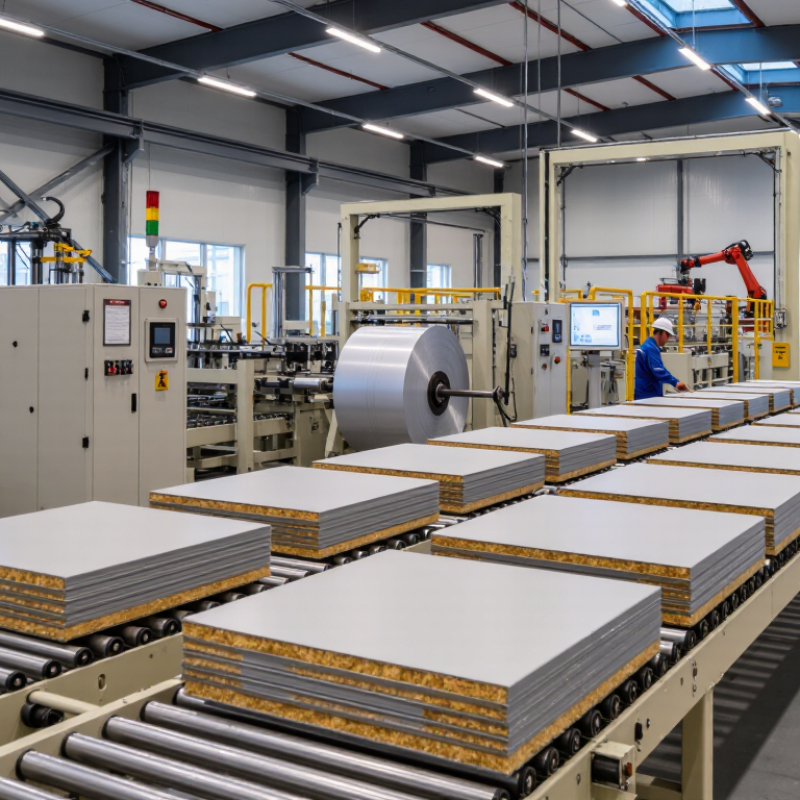
| Production Capacity | Capacity varies widely by line size, product type, and shift arrangement; published capacity should not be treated as guaranteed available capacity | Evaluate confirmed monthly capacity against the project schedule and peak-season demand | High | Production schedule, line photos or audit records, and capacity confirmation |
| Lead Time | A practical purchasing benchmark is approximately 2–6 weeks after design approval, subject to quantity, customization, and raw-material availability | Separate design approval, production, inspection, and shipping time in the schedule | High | Written production schedule and delivery commitment |
| Minimum Order Quantity | MOQ is project-specific and may depend on thickness, color, coating, profile, and production setup | Compare MOQ with the project quantity and identify charges for small or mixed orders | Medium | Formal quotation showing MOQ, setup charges, and mixed-load conditions |
| Quality-Control System | A reliable process should cover incoming materials, lamination or bonding, dimensional checks, appearance, packaging, and final release | Audit the process and confirm whether inspection results are traceable to batch numbers | Critical | Inspection and test plan, sample reports, corrective-action records, and traceability procedure |
| Packaging and Container Loading | Panels require moisture protection, edge protection, stable stacking, and loading methods that minimize compression and surface damage | Review packaging materials, stack height, lifting instructions, and container-loading photos | High | Packing specification, loading plan, and damage-claim procedure |
| Technical Support | Support should include drawings, installation details, cutting guidance, fastener recommendations, and response to technical queries | Assess response time and the quality of documents supplied during the quotation stage | High | Sample technical package and named project contact |
| Total Landed Cost | The delivered cost includes panels, accessories, packaging, inland transport, ocean freight, insurance, duties, and local handling | Compare offers using the same thickness, steel specification, Incoterm, quantity, and destination | Critical | Itemized quotation and clearly stated Incoterm, exclusions, and validity period |
| Warranty and Claims Handling | Warranty terms should define coverage, exclusions, storage requirements, installation conditions, and claim-response procedures | Compare the written warranty rather than relying on verbal promises | High | Signed warranty document, claims process, and replacement or remedy terms |