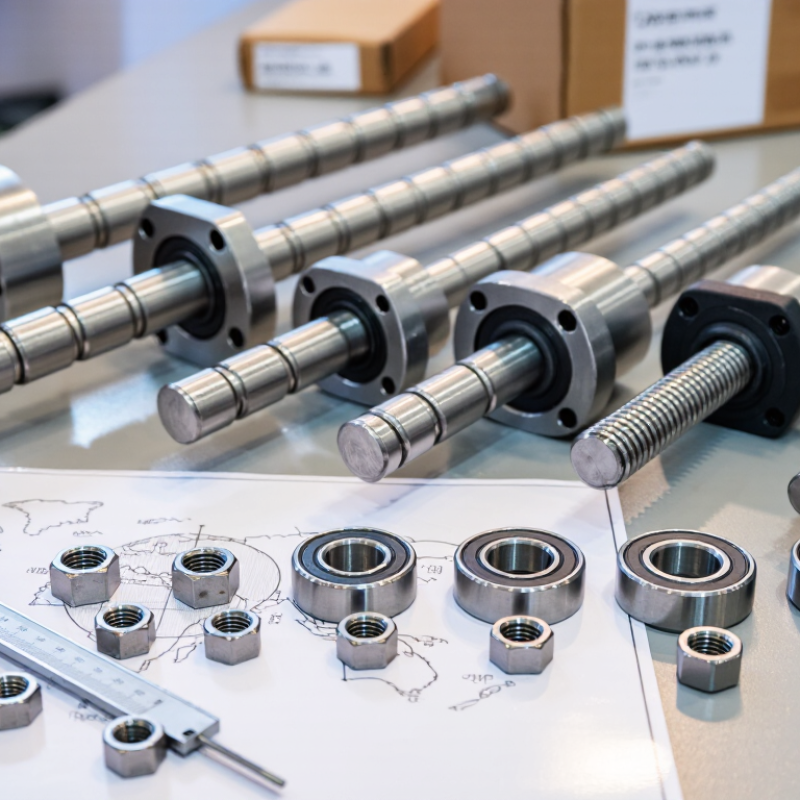
| 1 | Ground Ball Screw | 8–80 mm | 2–20 mm per revolution | Approximately 90–95% | Very low; preload can reduce backlash to near zero | Commonly C3–C5; approximately 8–23 μm/300 mm lead deviation, depending on grade | High load capacity and high positioning speed; suitable for demanding duty cycles | Hardened alloy steel shaft; bearing steel balls; optional corrosion-resistant versions | ISO 3408; accuracy and preload class must be specified | CNC machine tools, precision stages, inspection equipment, robotics | Confirm preload, lubrication, straightness, end machining, inspection report, and transport protection |
| 2 | Rolled Ball Screw | 8–80 mm | 2–40 mm per revolution | Approximately 85–95% | Low to moderate; preload and nut design determine the final value | Commonly C5–C7; approximately 23–50 μm/300 mm lead deviation, depending on grade | High speed and good repeatability; generally more economical than ground designs | Hardened alloy steel; stainless options for selected sizes and environments | ISO 3408; supplier should state lead accuracy and dynamic load rating | Automation equipment, electric actuators, packaging machinery, general CNC systems | Compare rated life, nut return system, allowable speed, noise level, and replacement availability |
| 3 | Miniature Ball Screw | 4–16 mm | 0.5–10 mm per revolution | Approximately 85–93% | Low when preloaded; sensitive to contamination and installation error | Typically C5–C7, subject to supplier specification | Moderate load capacity with high precision in compact assemblies | Precision alloy steel; stainless steel options may be available | ISO 3408 principles; miniature dimensions and tolerances are often supplier-defined | Medical devices, laboratory instruments, optical equipment, compact robots | Check minimum dynamic load rating, ball circulation design, cleanliness, and customized end machining |
| 4 | Metric Trapezoidal Lead Screw | 6–100 mm | 1–20 mm per revolution | Approximately 30–60% | Moderate; clearance is normally required for reliable operation | Typically medium precision; exact tolerance depends on screw and nut grade | High static load capability; low to moderate speed; may be self-locking at low lead angles | Carbon steel, alloy steel, stainless steel, bronze, or engineering polymer nuts | ISO 2904 and ISO 2905; common forms include Tr8×1.5 and Tr12×3 | Lifting mechanisms, linear slides, fixtures, valves, and general automation | Metric compatibility, nut material, lubrication interval, wear allowance, and corrosion protection are critical |
| 5 | Acme Threaded Lead Screw | 0.25–4 in | 2–20 threads per inch; multi-start options available | Approximately 30–60% | Moderate; adjustable nuts can compensate for wear | Medium precision; tolerance class and backlash should be stated on the drawing | Good load capacity and durability; moderate speed; may provide self-locking behavior | Steel, stainless steel, bronze, and polymer nut materials | ASME B1.5; inch dimensions should not be mixed with metric nut components | Industrial actuators, machine slides, jacks, clamps, and legacy equipment | Verify inch thread form, starts, pitch diameter, nut fit, duty cycle, and regional availability |
| 6 | Square-Thread Power Screw | 10–100 mm or 0.5–4 in | Application-specific; commonly 2–12 mm per revolution | Approximately 45–75% | Low theoretical sliding loss, but backlash depends on nut clearance and wear | Design-specific; no universal dimensional accuracy class | High axial load efficiency; usually slower and more difficult to manufacture | Steel shaft with bronze, brass, or polymer nut | Usually drawing-controlled; thread geometry, clearance, and inspection method must be defined | Heavy-duty jacks, presses, laboratory mechanisms, and custom machinery | Best for custom designs; require detailed technical drawings and supplier quality control |
| 7 | Planetary Roller Screw | 5–120 mm | 1–20 mm per revolution | Approximately 80–90% | Very low with preloaded configurations | High precision; exact lead accuracy is supplier- and design-specific | Extremely high load density, shock resistance, and acceleration capability | Hardened alloy steel; specialized roller and nut components | Supplier-specific geometry; specify rated life, preload, load rating, and inspection requirements | Aerospace systems, heavy-duty actuators, industrial presses, and high-force automation | Higher purchase cost and tighter assembly requirements; confirm service capability and spare-part continuity |