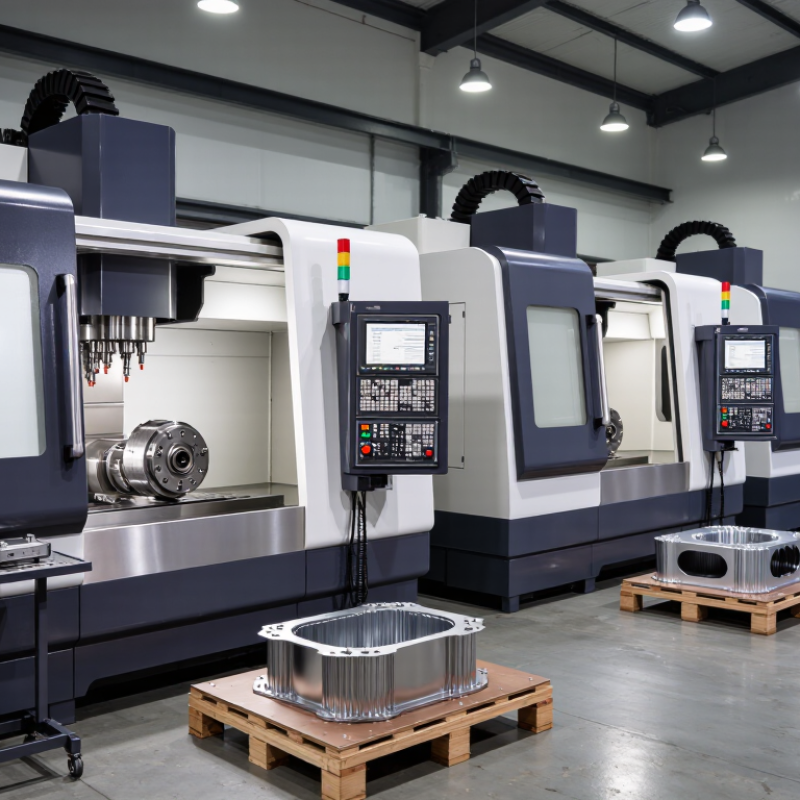
| Vertical machining center (VMC) | Usually 3 linear axes; optional rotary table or trunnion for additional axes | Prismatic parts, plates, molds, fixtures, and general-purpose milling | Broad availability, straightforward workholding, and access to the workpiece from above | Axis travel, table size and load rating, spindle taper, tool capacity, chip evacuation, and verified positioning performance |
| Horizontal machining center (HMC) | Typically 3 linear axes with a rotary pallet or indexing table | Box-shaped components and production work requiring machining on multiple sides | Horizontal spindle orientation can support chip removal; pallet systems can reduce workpiece changeover time | Pallet dimensions and load, indexing accuracy, pallet-change arrangement, spindle specifications, and automation compatibility |
| Five-axis machining center | Three linear axes plus two rotary axes; simultaneous or indexed operation depends on the machine | Complex surfaces, impellers, aerospace components, medical parts, and multi-face machining | Can reach multiple part faces in fewer setups and machine complex geometries with suitable CAM programming | Rotary-axis travel and load, work envelope, collision limits, calibration method, thermal behavior, and five-axis test results |
| Gantry or bridge-type machining center | Commonly 3 linear axes, with optional rotary axes or attachment heads | Large molds, dies, panels, and oversized components | Large working envelope and support for heavy or wide workpieces | Effective travel, table capacity, machine footprint, structural stiffness, head configuration, and accuracy across the full travel range |
| High-speed machining center | Often 3-axis or 5-axis; configuration depends on the intended material and process | Aluminum components, electrodes, precision mold work, and fine-detail machining | High spindle speed and responsive motion can suit small tools and light cutting, when matched to the application | Spindle speed and power curves, tool-holder system, balance requirements, cooling, vibration behavior, and surface-finish test parts |
| CNC drilling and tapping center | Usually 3 linear axes; rotary-axis options depend on the model | Small parts with repeated drilling, tapping, and light milling operations | Designed for short-cycle operations and frequent tool changes in suitable production environments | Tool-change time under stated conditions, spindle torque, tapping capability, worktable capacity, and cycle-time validation on sample parts |
| CNC mill-turn center | Turning axes with driven-tool capability; axis count and configuration vary | Components that require both turning and milling operations | Can combine operations on one machine and reduce transfers between separate turning and milling equipment | Turning capacity, driven-tool power, axis synchronization, bar or part-handling options, and demonstrated cycle time |