10 Best Carbon Fiber Components for Global Buyers?
Global buyers are looking beyond glossy surfaces when selecting Carbon Fiber Components. They need measurable performance, stable supply, and dependable technical support. A lightweight bracket may look simple, yet its fiber direction controls strength, stiffness, and failure behavior. A poorly aligned laminate can crack near a bolt hole. That detail matters.
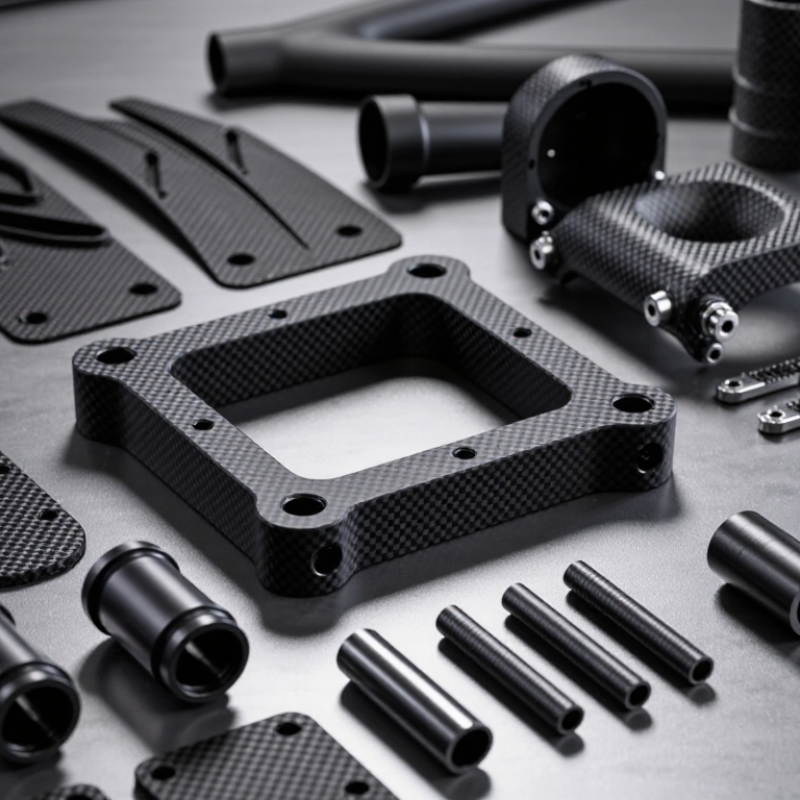
This guide examines 10 Best Carbon Fiber Components for Global Buyers. It considers structural panels, tubes, brackets, shafts, enclosures, bicycle parts, automotive trim, aerospace-grade assemblies, and custom molded pieces. Each category deserves careful comparison. Weight reduction alone is not enough. Buyers should review fiber grade, resin system, layup schedule, surface finish, dimensional tolerance, and documented testing. ISO 9001 certification can support confidence, but it does not replace part-specific inspection.
Dr. Stephen W. Tsai, a respected composite-materials researcher, offers a practical reminder: “Design with composites, not just of composites.” His point remains important for international purchasing teams. A component must match its load path, environment, joining method, and service temperature. Salt spray, ultraviolet exposure, vibration, and repeated impacts can change real-world performance. Supplier photographs cannot prove durability.
No ranking is perfect. Some buyers may value price more than peak stiffness. Others may need traceability, repair guidance, or shorter lead times. That difference can change the best choice. We therefore compare practical strengths and limitations, not only advertised specifications. The strongest Carbon Fiber Components are not always the lightest. They are the ones that perform consistently after installation, shipping, and years of use.
What Makes Carbon Fiber Components Valuable for Global Buyers
10 Best Carbon Fiber Components for Global Buyers
Carbon fiber components are valuable because they combine low weight with strong structural performance. Global buyers often select bicycle frames, automotive body panels, aircraft interior panels, and marine masts. These parts can reduce mass while maintaining stiffness in demanding environments.
The remaining high-value options include robotic arms, camera supports, racing seats, industrial covers, wind turbine blades, and custom brackets. Each component serves a different purpose. A bicycle frame needs controlled flex. A camera support needs vibration stability. A marine mast requires dependable fatigue resistance and moisture protection.
Material quality matters.
Experienced buyers review fiber direction, resin type, surface finish, and production records before ordering. They also request dimensional reports, load testing, and batch traceability. These details help compare suppliers across different regions and technical standards. A smooth surface alone proves little. Internal voids may remain invisible without suitable inspection.
Carbon fiber is not magic. It can crack after sharp impact, and repairs may require specialized knowledge. A cheaper component may hide inconsistent curing or weak joints. I have seen attractive samples fail when mounting holes were poorly reinforced. Buyers should confirm tolerances, packaging protection, documentation, and expected service conditions. The best component is not always the lightest one. It is the one that performs reliably in its actual application.
10 Best Carbon Fiber Components for Global Buyers? - What Makes Carbon Fiber Components Valuable for Global Buyers
| Rank | Carbon Fiber Component | Typical Global Applications | Typical Manufacturing Method | Approx. Density
(g/cm³) | Typical Tensile Strength
(MPa) | Typical Tensile Modulus
(GPa) | Main Buyer Value |
| 1 | Carbon Fiber Structural Panels | Vehicle body panels, equipment covers, machine enclosures, lightweight structures | Autoclave or compression molding | 1.45–1.60 | 600–1,200 | 50–120 | High stiffness-to-weight ratio and corrosion resistance |
| 2 | Carbon Fiber Tubes | Robotics, drones, medical equipment, automation frames and sports equipment | Pultrusion or filament winding | 1.45–1.60 | 500–1,000 | 40–100 | Excellent bending stiffness with low rotational inertia |
| 3 | Carbon Fiber Shafts | Drive systems, industrial rollers, marine equipment and sporting goods | Filament winding | 1.45–1.60 | 500–1,000 | 45–110 | Low mass, low vibration and strong fatigue performance |
| 4 | Carbon Fiber Brackets and Mounts | Aerospace interiors, automotive systems, electronics and industrial assemblies | CNC machining or molded composite forming | 1.45–1.65 | 400–900 | 40–100 | Weight reduction in complex load-bearing assemblies |
| 5 | Carbon Fiber Automotive Components | Aerodynamic parts, interior trim, battery enclosures and suspension components | Resin transfer molding or prepreg molding | 1.45–1.65 | 500–1,100 | 45–120 | Lower vehicle mass, high design flexibility and premium appearance |
| 6 | Carbon Fiber Robotic Arms | Factory automation, laboratory systems, inspection equipment and collaborative robots | Autoclave, compression molding or pultrusion | 1.45–1.60 | 600–1,200 | 50–130 | Higher operating speed and reduced actuator energy demand |
| 7 | Carbon Fiber Drone Frames | Unmanned aerial vehicles, aerial imaging, surveying and inspection platforms | Compression molding or CNC machining | 1.45–1.60 | 500–1,000 | 45–100 | High payload efficiency, dimensional stability and vibration control |
| 8 | Carbon Fiber Pressure Vessels | Compressed gas storage, hydrogen systems and industrial fluid applications | Filament winding over a liner | 1.45–1.65 | 600–1,500 | 50–150 | High pressure-to-weight efficiency and corrosion resistance |
| 9 | Carbon Fiber Wind Turbine Components | Longer wind-turbine blades, spar caps and lightweight reinforcement structures | Pultrusion or resin infusion | 1.45–1.65 | 500–1,200 | 45–120 | Higher blade stiffness and potential for longer blade designs |
| 10 | Carbon Fiber Prosthetic and Orthotic Components | Running blades, braces, mobility devices and customized medical supports | Prepreg molding or resin infusion | 1.45–1.60 | 500–1,100 | 45–120 | Lightweight support, energy return and user-specific geometry |
Note: Values are typical engineering ranges for carbon-fiber-reinforced polymer components. Actual performance depends on fiber grade, fiber orientation, resin system, laminate design, manufacturing process, testing standard and component geometry.
Global Sourcing Factors: Suppliers, Certification, Shipping, and Support
When sourcing carbon fiber components globally, buyers should evaluate more than surface finish and quoted price. Useful options include structural panels, tubes, brackets, enclosures, shafts, bicycle parts, drone frames, and custom molded covers. Each requires different fiber orientation, resin selection, and tolerance control. Ask for evidence.
A reliable supplier should provide material certificates, batch traceability, dimensional reports, and clear inspection records. Certifications may include ISO 9001, while market-specific requirements can involve REACH, RoHS, ASTM, or EN standards. Certification alone is not proof of product quality. Request recent test data that matches your component, not a generic brochure. Sample approval should include weight, laminate thickness, hole position, and surface defects. I have seen polished samples hide inconsistent inner layers. That risk deserves attention.
Shipping requires practical planning. Components need edge protection, moisture control, strong cartons, and accurate customs documents. Confirm the HS code, Incoterms, lead time, and responsibility for damaged goods before payment. International freight can change quickly. Support matters after delivery. A capable technical team should review drawings, tolerances, installation loads, and revision changes. Ask how quickly they answer problems and whether replacement parts are available. Do not assume every supplier can support small repeat orders. Some can produce an impressive first batch but struggle with consistency later. A written quality agreement helps, although it cannot replace independent inspection.
