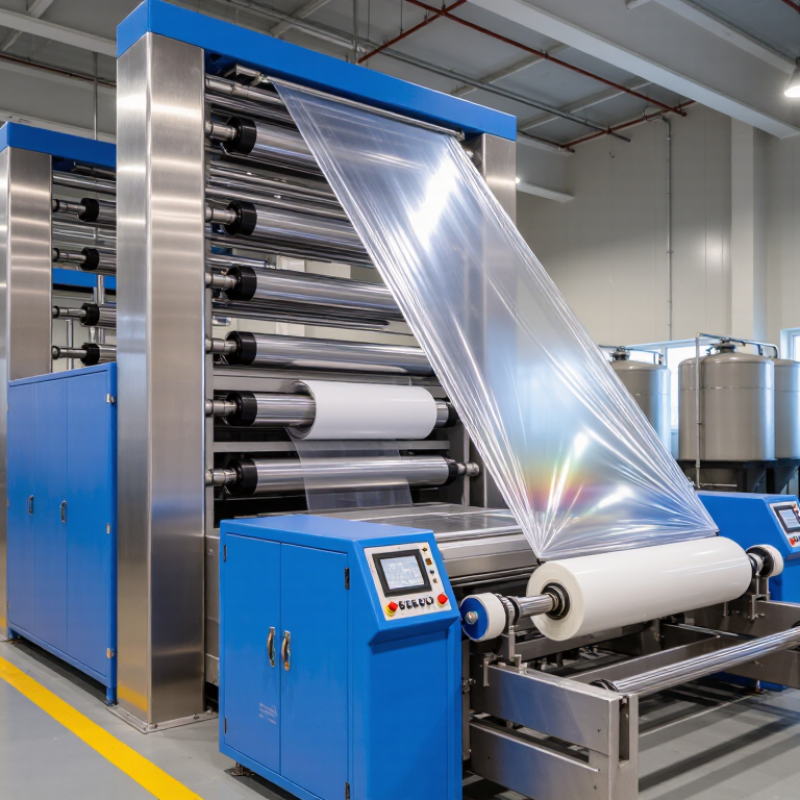
| Net output | Stable production rate in kg/h, measured as usable film wound or collected over a defined period. | Use the same resin grade, layer structure, film width, target thickness, and product-quality limits. State whether start-up scrap and edge trim are excluded. | A timed production record showing the operating conditions, weighing method, duration, and scrap quantity. |
| Film thickness (gauge) | Nominal thickness in μm; minimum, maximum, average, and measurement positions across the web and along the roll. | Compare samples taken at the same locations and after the process has stabilized. Report the measurement instrument and sampling plan. | A thickness profile or mapped measurement sheet from a full-width sample, plus instrument calibration information. |
| Gauge variation | Range = maximum thickness − minimum thickness. Relative deviation from target = (measured thickness − target thickness) ÷ target thickness × 100%. | Agree on the sampling locations and report both the absolute range and percentage deviation; an average alone can hide local thin or thick areas. | Raw measurement data, not only a stated “gauge control accuracy” figure. |
| Illustrative gauge calculation | For a 50 μm target, readings of 48 μm and 52 μm give a 4 μm range and deviations of −4% and +4%. | This is a calculation example only; it is not a machine test result or an acceptance limit. | Use actual readings from the agreed trial to calculate the result. |
| ASTM D882 tensile properties | For thin plastic sheeting, report tensile strength, elongation, specimen direction, thickness, and test conditions as applicable. | Test specimens cut in both machine direction (MD) and transverse direction (TD). Compare results only when specimen preparation and test conditions are equivalent. | A laboratory report identifying the ASTM D882 edition, specimen details, number of specimens, conditioning, test speed, and individual results. |
| ASTM D1709 dart impact | Report the dart impact result in grams and identify the test method used. ASTM D1709 evaluates the energy needed to cause failure under specified falling-dart conditions. | Use the same film thickness, specimen conditioning, method, and test procedure. A result from one D1709 method should not be treated as directly interchangeable with the other. | A laboratory report naming ASTM D1709 and the method, with thickness, conditioning, test details, and reported result. |
| Trial acceptance criteria | Buyer-defined minimum output, thickness tolerance, and mechanical-property limits for the intended film application. | Set limits before the trial. ASTM test methods describe how properties are measured; they do not establish a universal pass/fail specification for every product. | A signed trial protocol and complete production and laboratory records. |