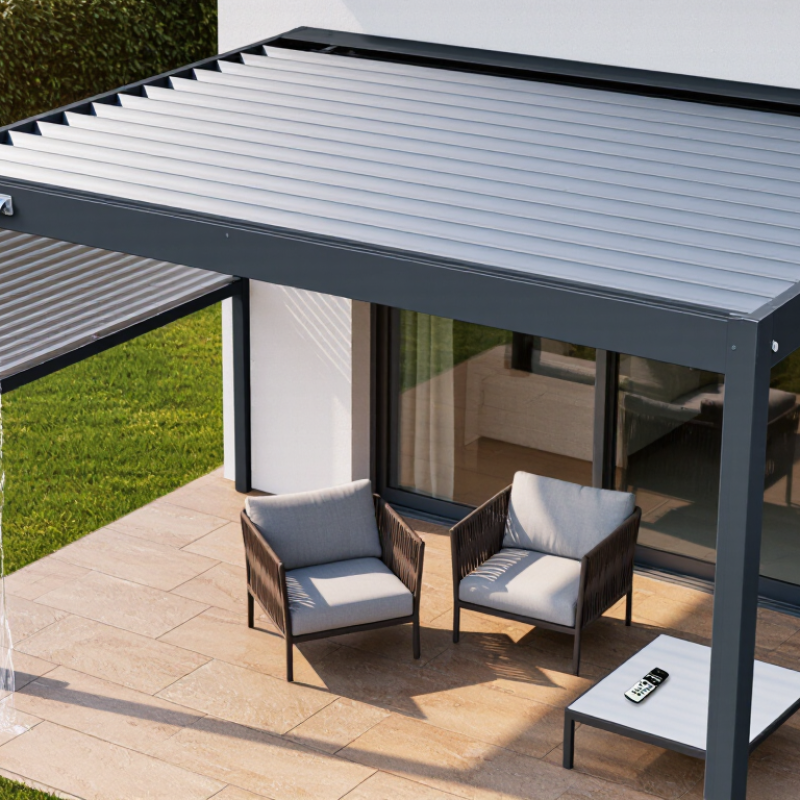
| Motorized louvered roof | Roof slats rotate to adjust shade and airflow; some designs also retract. | Remote control, wall switch, or smart-home control; rain and wind sensors may be available. | Adjustable slats provide more control over sunlight and ventilation than a fixed roof. | Patios used in changing sun and light-rain conditions. | Confirm drainage, closed-roof weather limits, and the structure’s rated wind conditions. |
| Retractable fabric-roof system | A motor extends or gathers a tensioned fabric canopy along tracks. | Remote or wall control; compatible systems may support sensors or scheduled operation. | Opens the overhead area fully when the canopy is retracted. | Spaces where users want both open sky and retractable shade. | Fabric performance depends on its specification; check care requirements and wind limits. |
| Motorized sliding-panel roof | Rigid roof panels slide along guides to open or cover the space. | Motorized open-and-close control; automation features depend on the system. | Uses solid panels rather than a fabric canopy. | Projects that prioritize a more substantial overhead covering. | Review panel storage space, drainage details, and the manufacturer’s operating limits. |
| Automatic roof with rain sensing | Typically uses motorized louvers or a retractable canopy. | A compatible rain sensor can trigger a preset response, such as closing the roof. | Can respond to detected rainfall without waiting for a manual command. | Owners who want weather-responsive operation. | A sensor does not make every system waterproof; verify the roof’s design and rain-management provisions. |
| Wind-aware motorized system | May use rotating louvers or a retractable canopy. | A compatible wind sensor can trigger a configured safe position or alert. | Automation can help respond to changing wind conditions. | Exposed sites where wind management is a key design concern. | Sensor behavior and operating thresholds vary; follow the system’s wind ratings and instructions. |
| Pergola with motorized side screens | The roof may be fixed or motorized; vertical screens lower or raise by motor. | Separate controls for screens and roof; some setups allow grouped or smart-home control. | Adjustable side screening helps manage low-angle sun and visual exposure. | Patios that need flexible side shade or added privacy. | Screen fabrics differ in visibility, airflow, and shade; screens may need to be raised in strong winds. |
| Integrated lighting and roof system | Motorized louvers or a retractable roof, paired with built-in lighting. | Roof and lights may use coordinated remote, wall, or smart controls. | Combines overhead adjustment with task or ambient lighting. | Outdoor dining and entertaining areas used after dark. | Check lighting dimming options, wiring access, and electrical suitability for outdoor use. |
| Smart-home compatible pergola | Roof movement depends on the selected louver or canopy design. | May integrate with a compatible hub or platform; functions vary by controller. | Can bring pergola controls into a broader home-automation setup. | Homes where users want centralized control or automation routines. | Confirm platform compatibility, connectivity requirements, and manual operation options. |
| Freestanding automatic pergola | Motorized louvers or a retractable canopy on an independently supported frame. | Remote or wall control; optional sensors depend on the chosen configuration. | Can be positioned away from the house rather than attached to its exterior. | Gardens, poolside areas, or detached outdoor seating zones. | Foundation design, site drainage, and local wind and snow requirements need careful review. |
| Wall-attached automatic pergola | Motorized louvers or a retractable canopy connected to the building. | May use remote, wall, sensor, or compatible smart controls. | Creates a covered transition between an indoor room and an outdoor patio. | Patios directly beside a house or another suitable structure. | Check attachment details, water management at the wall, and any required permits. |