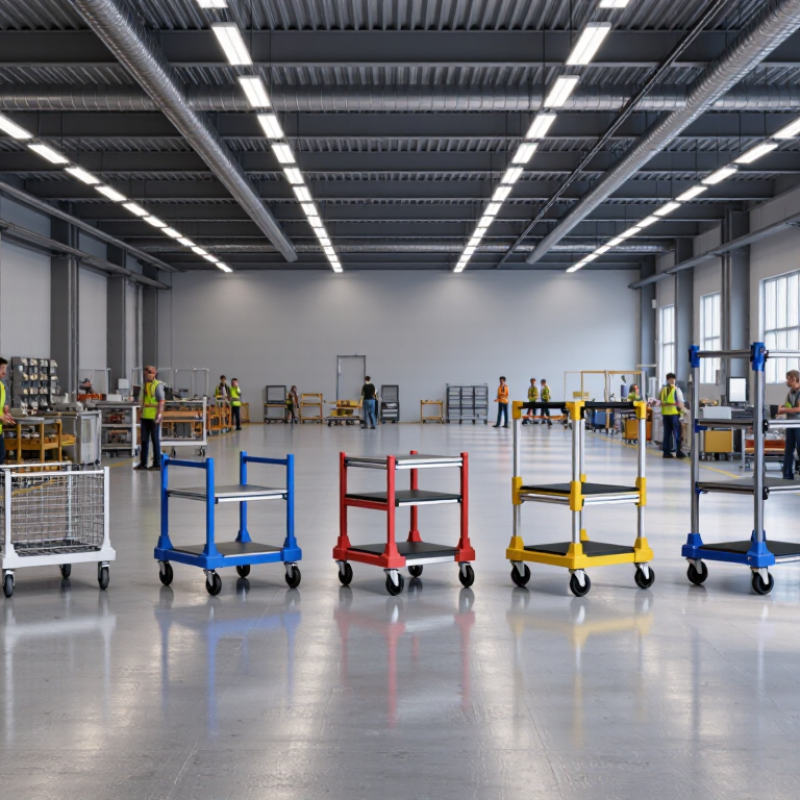
| Multi-shelf assembly trolley | Moving components, tools, and work-in-progress between nearby workstations | Steel frame with steel or polymer shelves | About 150–500 kg total | Two to four shelves; fixed or adjustable shelf spacing | Check the safe working load per shelf as well as the trolley’s total capacity. |
| Picking and kitting trolley | Delivering grouped parts to an assembly operator in a planned sequence | Steel or aluminum frame with bins, trays, or divided shelves | About 100–300 kg total | Multiple small-part bins, label positions, and compartmented trays | Choose bin sizes and layout to match the parts and picking sequence. |
| Heavy-duty platform trolley | Transporting bulky assemblies, tooling, or packed goods | Welded steel frame with a steel or non-slip deck | About 300–1,000 kg | Flat platform, often with a push handle; optional side rails | Confirm floor condition, ramp gradients, and load stability before selecting capacity. |
| Enclosed cabinet trolley | Keeping tools, instruments, or valuable components contained during internal transport | Steel cabinet body with lockable doors and a wheeled base | About 100–300 kg total | Lockable compartments, shelves, and optional drawers | Account for the cabinet’s own weight and verify that doors stay secure while moving. |
| Tool trolley | Bringing hand tools and maintenance supplies to assembly or service stations | Steel or aluminum frame with drawers and a worktop | About 100–300 kg total | Several drawers, a top tray, and often a locking mechanism | Look for drawer retention and a stable layout that limits tipping when drawers are open. |
| Roll-cage trolley | Moving cartons, reusable containers, or light-to-medium goods through production areas | Steel base with mesh or tubular sides | About 250–500 kg | Three or four sides, sometimes with a hinged access side | Check the internal dimensions, access opening, and suitability for the facility’s aisles. |
| ESD-safe trolley | Handling electrostatic-sensitive electronic parts and assemblies | Conductive or static-dissipative materials with compatible wheels | About 100–300 kg total | Shelves or bins with provisions for grounding where required | Verify electrical resistance and grounding arrangements against the site’s ESD control program. |
| Stainless-steel trolley | Production spaces that require frequent washdown or corrosion-resistant equipment | Stainless-steel frame and shelves | About 100–300 kg total | Two or three shelves, with smooth or raised-edge surfaces | Match the steel grade, weld finish, and wheel materials to cleaning chemicals and hygiene needs. |
| Ergonomic height-adjustable trolley | Bringing workpieces or tools to a more suitable handling height | Steel frame with a manual or powered lift mechanism | About 100–500 kg, depending on the lift design | Adjustable platform or shelf with a defined lift range | Check the rated load throughout the lift range and use the trolley according to its operating instructions. |
| Towable line-side trolley | Scheduled delivery of components along a production route | Reinforced steel frame with tow hitch and industrial wheels | About 300–1,000 kg, depending on design and train setup | Flat deck, shelves, or bins; some designs can be linked into a train | Confirm hitch compatibility, turning clearance, braking needs, and the approved towing load. |