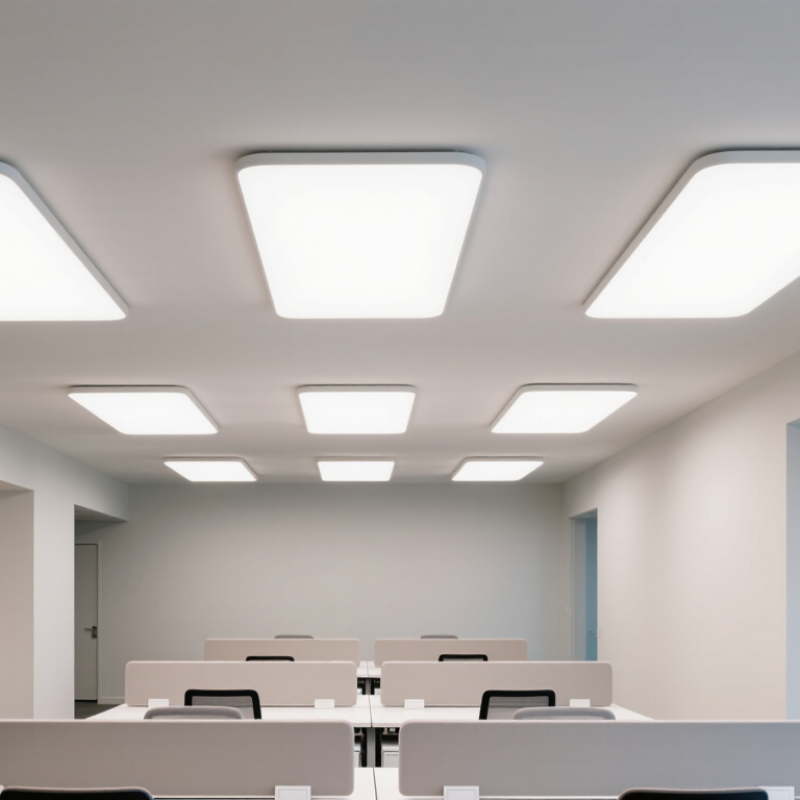
| What they are | Flat, rectangular or square light fixtures that use light-emitting diodes (LEDs) to illuminate a broad diffuser or light-guiding surface. | The wide, even-looking lit area is suited to general room illumination. | Panels are commonly designed for suspended ceilings, surface mounting, or recessed installation. |
| Common formats | Popular nominal sizes include 600 × 600 mm and 600 × 1,200 mm; exact dimensions vary by market and ceiling system. | Choosing a format that fits the ceiling layout can simplify installation and create a consistent appearance. | Check the fixture’s actual dimensions and mounting requirements before ordering. |
| Light output and power | Commercial models often provide roughly 3,000–6,000 lumens for a 600 × 600 mm panel and 4,500–9,000 lumens for a 600 × 1,200 mm panel. Power commonly varies by model and output. | Comparing lumens helps determine whether a panel can provide the required brightness; wattage alone does not show light output. | These are indicative ranges, not specifications for every product. |
| Energy efficiency | Many current commercial LED panels are rated around 100–140 lumens per watt, depending on the fixture and operating conditions. | Higher lumens per watt means more light output for each watt consumed. | Compare rated efficacy alongside light output, glare control, and other performance requirements. |
| Color temperature | Common choices include warm white (about 3,000 K), neutral white (about 4,000 K), and cool white (about 5,000–6,500 K). | Color temperature affects the perceived warmth or coolness of the light and the overall feel of a space. | Select according to the room’s use and the desired visual environment. |
| Color rendering | Color Rendering Index (CRI) is specified by the manufacturer; CRI 80 or higher is common for general commercial lighting. | A higher CRI can help colors appear more natural under the light. | Spaces where accurate color evaluation matters may require a higher specified CRI. |
| Service life | Many panels are rated for approximately 30,000–50,000 hours, with the rating and test conditions varying by model. | A long rated life can reduce how often a fixture needs replacement compared with many older lighting technologies. | Check the published lifetime rating and warranty; actual life depends on operating conditions and component quality. |
| Light distribution | Panels typically use a diffuser or optical plate to spread light across the visible face. Distribution and glare performance differ between designs. | Broad, even illumination can be helpful in offices, classrooms, and other spaces with ceiling-grid lighting. | Review photometric data and glare ratings where visual comfort is important. |
| Controls and dimming | Dimming and control options are available on some models, but compatibility depends on the driver and control system. | Compatible controls can support adjustable light levels and help match lighting to different tasks. | Confirm that the panel, driver, and dimmer or control protocol are compatible. |
| Typical applications | Offices, classrooms, healthcare facilities, retail areas, corridors, and other indoor spaces with suitable ceiling layouts. | The flat profile and broad light output make panels a practical option for many functional interiors. | Choose a model with the appropriate installation method and environmental rating for the location. |