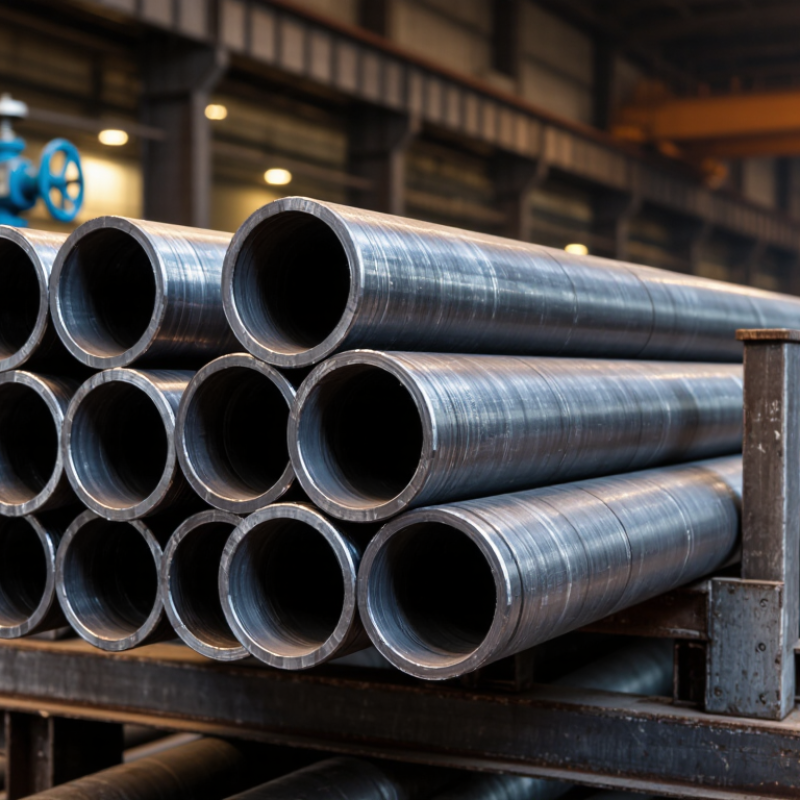
| Global Standard | Primary material specification | ASTM A106/A106M covers seamless carbon steel pipe for high-temperature service. The specification includes Grades A, B, and C. | Suitable for engineered piping systems where seamless carbon steel pipe is required for elevated-temperature fluid transport. |
| International Compatibility | Comparable design and procurement references | ASTM A106 is commonly referenced alongside ASME B36.10M for dimensions and ASME B16.5 or ASME B16.47 for compatible flanges, where applicable. | Using a recognized specification and compatible dimensional standards can simplify documentation, supplier qualification, and cross-border procurement. |
| Manufacturing Method | Pipe construction | Seamless pipe is manufactured without a welded longitudinal seam. ASTM A106 pipe is generally supplied in seamless construction. | Useful for high-temperature and pressure service where the project specification favors seamless construction and consistent pressure-boundary integrity. |
| Material Grades | Strength and service selection | Grade B is widely used for general industrial piping. Grade A provides lower minimum strength, while Grade C provides higher minimum tensile and yield strength than Grades A and B. | Select the grade according to design pressure, temperature, code calculations, weldability requirements, and procurement availability—not by grade name alone. |
| Mechanical Performance | Minimum specified properties | Typical ASTM A106 minimum values include: Grade A tensile strength 330 MPa and yield strength 205 MPa; Grade B tensile strength 415 MPa and yield strength 240 MPa; Grade C tensile strength 485 MPa and yield strength 275 MPa. | Design engineers should verify the exact edition of the specification, grade, wall thickness, design code, and allowable stresses before final material approval. |
| Temperature Capability | High-temperature suitability | The specification is intended for high-temperature service, but allowable pressure and temperature are governed by the applicable design code and material allowable stresses. | Commonly considered for steam, hot oil, boiler-related piping, refinery process lines, and high-temperature utility systems. |
| Chemical Control | Composition and weldability | ASTM A106 places limits on elements such as carbon, manganese, phosphorus, sulfur, and silicon. Carbon-equivalent and welding procedure requirements should be checked separately. | Review mill test certificates and welding qualifications when the project includes field welding, preheating, post-weld heat treatment, or sour-service restrictions. |
| Dimensional Selection | Outside diameter and wall thickness | Nominal pipe size and schedule are commonly selected using ASME B36.10M dimensions. Actual outside diameter and wall thickness must match the approved piping class. | Confirm design pressure, corrosion allowance, mechanical loads, allowable stress, internal diameter, and connection requirements before choosing the schedule. |
| Pressure Design | Wall-thickness verification | Pipe suitability cannot be determined from nominal size alone. Required wall thickness depends on design pressure, design temperature, material stress, weld factors where applicable, and corrosion allowance. | Use the governing piping or pressure-vessel code for calculations. Do not substitute nominal schedule selection for a complete engineering review. |
| Common Applications | Industrial fluid transport | Typical applications include steam lines, process piping, boiler systems, heat-exchanger connections, petroleum refining, power generation, and high-temperature water service. | Confirm whether the service contains chlorides, hydrogen sulfide, oxygen, acids, or other aggressive media that may require a different alloy or additional controls. |
| Corrosion Consideration | Environmental resistance | ASTM A106 is carbon steel and does not provide stainless-steel-level resistance to general corrosion, pitting, or specialized chemical environments. | Consider corrosion allowance, internal lining, external coating, cathodic protection, insulation design, chemical control, or an alternative alloy when required by the service environment. |
| Inspection and Testing | Quality verification | Typical requirements include chemical analysis, tensile testing, hydrostatic testing, dimensional inspection, and visual examination. Additional nondestructive examination may be specified by the purchase order or project code. | Define inspection scope, test pressure, acceptance criteria, traceability, and documentation requirements before placing the order. |
| Traceability | Documentation package | Project records commonly include material test certificates, heat or batch identification, dimensional reports, hydrostatic test results, inspection records, and compliance statements. | Strong traceability supports customs clearance, third-party inspection, construction turnover, maintenance records, and future replacement planning. |
| Welding and Fabrication | Installation requirements | Carbon steel pipe can generally be welded using qualified procedures, but preheat, interpass temperature, consumable control, and post-weld heat treatment depend on thickness, grade, service, and governing code. | Coordinate pipe material, fittings, flanges, welding procedures, welder qualifications, and heat-treatment requirements before fabrication begins. |
| Project Economics | Lifecycle value | Carbon steel is often selected for its broad availability, established fabrication practices, and compatibility with common industrial piping systems. | Compare purchase price with coating, insulation, corrosion management, inspection, maintenance, replacement, and downtime costs over the project lifecycle. |
| Procurement Risk | Supplier and delivery qualification | International projects should verify specification edition, grade, size range, schedule, end preparation, quantity, testing requirements, and delivery condition before award. | Use approved technical submittals, inspection hold points, packaging requirements, and clear Incoterms to reduce cross-border delivery and conformity risks. |
| Final Selection Rule | Engineering approval | ASTM A106 is appropriate when the service, design code, temperature, pressure, corrosion environment, dimensions, fabrication method, and documentation requirements are compatible. | Make the final selection through the project piping class and engineering review rather than relying solely on the ASTM designation. |