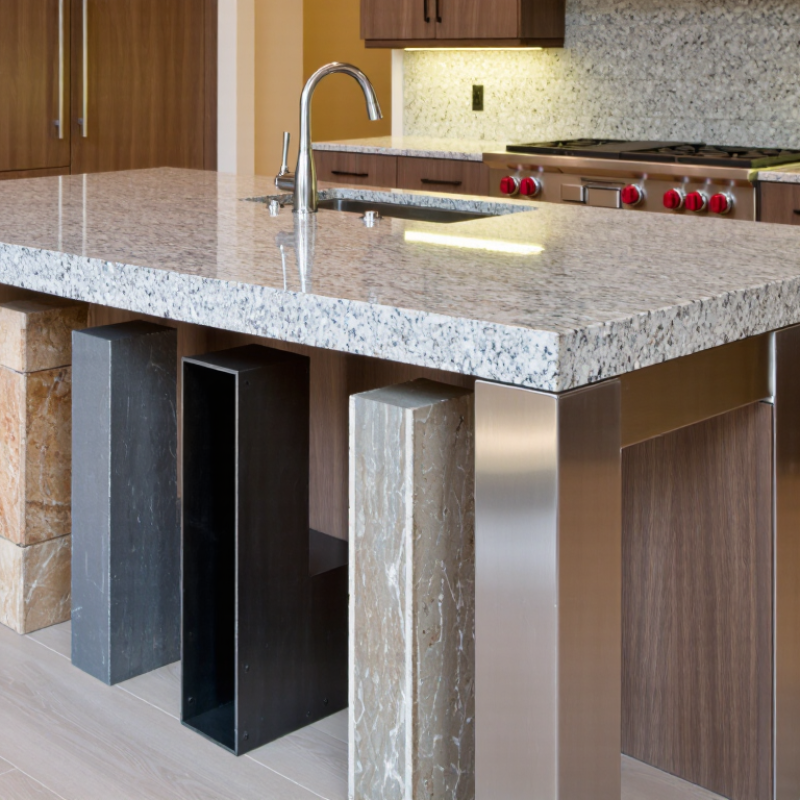
| Solid Stone Support Block | Matching granite, marble, or engineered stone | Approximately 75–150 mm wide, 75–150 mm deep, and 20–40 mm thick | Supporting short countertop overhangs, raised sections, and visible stone details | Excellent visual integration and high compressive strength | Must be installed on a level, fully supported surface with compatible stone adhesive | Best when appearance and material matching are priorities |
| Hardwood Support Block | Seasoned hardwood, such as oak or maple | Typically 75–100 mm wide, 75–150 mm deep, and 20–40 mm thick | Cabinet-top reinforcement and localized support beneath countertop joints | Easy to cut, drill, and fasten to wood cabinetry | Protect from moisture and leave sufficient clearance for stone movement and adhesive | Best for wood cabinets and projects requiring simple on-site fabrication |
| Steel Angle Support Block | Powder-coated or galvanized carbon steel | Commonly 40–75 mm legs with 3–6 mm steel thickness | Reinforcing corners, cabinet edges, and moderate countertop overhangs | High strength with a relatively compact profile | Use corrosion-resistant finishes and fasten into structural cabinet members | Best where strong support is needed without a large visible support piece |
| Stainless-Steel Support Block | 304 or 316 stainless steel | Usually 40–75 mm legs with approximately 3–6 mm thickness | Kitchens, utility areas, outdoor counters, and humid environments | Strong, corrosion-resistant, and easy to clean | Use compatible fasteners and avoid direct contact with dissimilar metals that may promote corrosion | Best for moisture resistance and long-term durability |
| Aluminum Support Block | Structural aluminum alloy | Commonly 40–75 mm legs with approximately 3–6 mm thickness | Lightweight cabinetry, removable panels, and areas where installation weight matters | Lightweight, corrosion-resistant, and easy to machine | Use a sufficiently thick section and suitable fasteners because aluminum is softer than steel | Best when low weight and corrosion resistance are important |
| Masonry or Concrete Support Block | Concrete, dense concrete block, or solid masonry | Commonly 100–200 mm wide, 100–200 mm deep, and 75–200 mm high | Peninsulas, freestanding counters, outdoor kitchens, and heavy fixed installations | Very high compressive capacity and excellent stability | Requires a flat bearing surface; isolate the stone from uneven masonry and provide moisture control | Best for permanent, heavy-duty support with a substantial base |
| Adjustable Cabinet Support Block | Steel or reinforced polymer with an adjustable threaded mechanism | Typical adjustment range of approximately 100–180 mm in height | Uneven floors, retrofit cabinetry, island bases, and height-sensitive installations | Allows precise leveling before the countertop is installed | Lock the adjustment mechanism and distribute the load through a stable top plate | Best when leveling and installation flexibility are required |