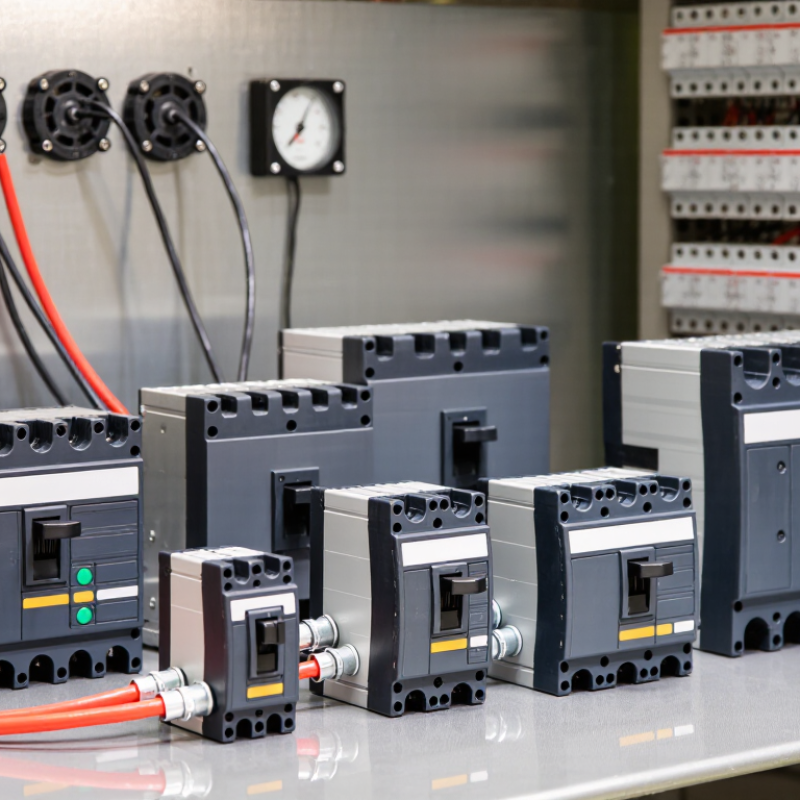
| Compact Fixed-Thermal-Magnetic MCCB | 15–250 A | Up to 600/690 V AC, depending on the product design | Typically 18–50 kA at the applicable voltage | Thermal overload protection and instantaneous magnetic short-circuit protection | Small commercial buildings, distribution boards, HVAC feeders, pumps and general motor feeders | Confirm conductor ampacity, available fault current, terminal capacity, ambient-temperature derating and coordination with upstream devices. |
| General-Purpose Adjustable MCCB | 100–800 A | Up to 600/690 V AC | Typically 25–65 kA at the applicable voltage | Adjustable long-time and instantaneous settings; some configurations also include adjustable short-time protection | Main distribution panels, commercial facilities, industrial feeders and generator output circuits | Adjustable settings can improve selectivity, but the trip-unit range must match the system load, cable rating and protection study. |
| High-Interrupting-Capacity MCCB | 100–1,600 A | Up to 600/690 V AC | Commonly 50–100 kA at the applicable voltage; verify the exact rating | Thermal-magnetic or electronic trip units, with optional short-time and ground-fault functions on selected models | Industrial plants, utility rooms, data-center distribution and systems with high prospective short-circuit current | The interrupting rating must be equal to or greater than the calculated available fault current at the installation point. |
| Electronic-Trip MCCB | 250–2,500 A | Up to 600/690 V AC | Typically 35–100 kA, depending on frame size and voltage | Long-time, short-time, instantaneous and optional ground-fault protection; digital metering may be available | Large commercial buildings, process plants, critical power systems and low-voltage switchboards | Evaluate trip-unit accuracy, sensor rating, adjustable protection bands, power requirements, event logging and communication options. |
| Motor-Protection MCCB | 15–800 A | Commonly up to 600/690 V AC | Often 25–65 kA, subject to the selected frame and voltage | Adjustable overload and instantaneous protection; normally coordinated with a contactor and overload or motor-management system | Pumps, compressors, fans, conveyors and other low-voltage motor circuits | Check motor full-load current, starting current, locked-rotor behavior, coordination type, enclosure temperature and switching duty. |
| DC-Rated MCCB | 15–1,600 A | Commonly 125–1,000 V DC, depending on pole configuration and tested application | DC interrupting ratings are application-specific and may be substantially different from AC ratings | Thermal-magnetic or electronic protection; some versions are designed for battery, solar or energy-storage circuits | Battery systems, photovoltaic combiner outputs, electric-vehicle infrastructure and industrial DC distribution | Never use the AC interrupting rating as a substitute for the DC rating. Verify polarity, pole wiring, time constant, voltage and tested configuration. |
| Four-Pole MCCB | 63–1,600 A | Up to 600/690 V AC | Typically comparable to the equivalent three-pole family, subject to product certification | Switching and protection of three-phase conductors with a neutral pole; neutral protection or switching options vary | Three-phase four-wire systems, transfer equipment, healthcare facilities and installations requiring neutral isolation | Determine whether the neutral must be switched, protected or solidly connected. Confirm neutral-pole make/break timing and local code requirements. |
| Current-Limiting MCCB | 100–1,200 A | Up to 600/690 V AC | High interrupting ratings, with reduced let-through current compared with standard designs | Fast current-limiting interruption, often combined with electronic or high-performance thermal-magnetic protection | Facilities where arc energy, equipment damage or available fault current is a major concern | Review let-through energy, peak let-through current, fuse or breaker coordination, replacement parts and the required short-circuit study. |
| Communication-Enabled MCCB | 250–2,500 A | Up to 600/690 V AC | Typically 35–100 kA, depending on the specific configuration | Electronic trip unit with optional Modbus or other communication interface, metering and remote status monitoring | Smart buildings, energy-management systems, industrial automation and condition-monitoring projects | Check protocol compatibility, auxiliary power requirements, cybersecurity practices, data accuracy, commissioning support and service continuity. |