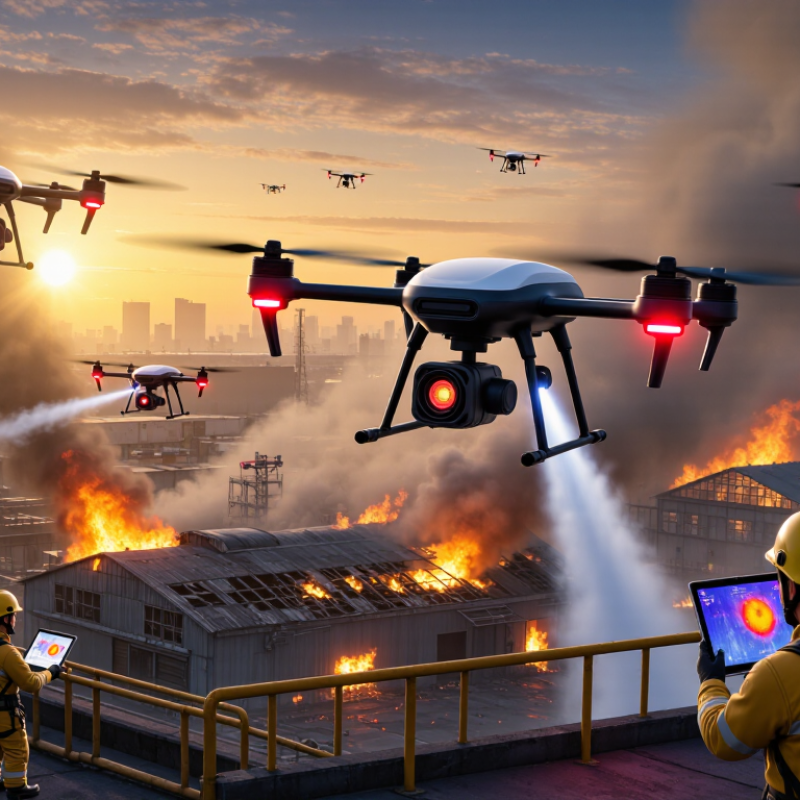
| Thermal Imaging Multirotor | Hot-spot detection, victim location, roof inspection, perimeter monitoring, and post-fire assessment. | Approximately 25–45 minutes per battery, depending on aircraft mass, weather, payload, and flight profile. | Radiometric thermal camera, visible-light camera, spotlight, loudspeaker, and positioning system. | Usually within 1–5 km of the launch point when operated under visual-line-of-sight procedures. | Can provide rapid situational awareness without immediately exposing personnel to smoke, heat, unstable structures, or hazardous materials. | Thermal cameras may be affected by reflective surfaces, hot smoke, steam, water spray, and heavy rain. Battery endurance decreases in cold or windy conditions. | Operators generally need remote-pilot authorization, aircraft registration where required, pre-flight risk assessment, airspace approval, and visual-line-of-sight operation unless an exemption or specific authorization applies. | Municipal fire services, industrial emergency teams, utility operators, and search-and-rescue organizations. |
| Heavy-Lift Multirotor | Transporting small emergency supplies, communication equipment, lighting, rescue items, or specialized sensors to difficult-to-access areas. | Approximately 15–35 minutes, strongly dependent on payload weight and battery configuration. | Payload capacity commonly ranges from about 2–20 kg in this operational class; exact capacity must be verified from the aircraft’s approved documentation. | Normally short to medium range because payload weight reduces endurance and reserve capacity. | Can reduce the need for personnel to enter unstable terrain, contaminated areas, floodwater, or elevated structures. | High mass and rotor energy increase the consequences of a loss of control. Payload release, suspended loads, and operation near people require additional risk controls. | Many jurisdictions require additional operational approval for heavier aircraft, flights over people, payload dropping, or operations near emergency response zones. The aircraft must remain within its approved weight and balance limits. | Specialized fire departments, disaster-response agencies, mines, ports, energy facilities, and large industrial sites. |
| Tethered Observation Drone | Persistent overwatch of wildfire lines, industrial incidents, evacuation routes, hazardous-material zones, and large public-safety scenes. | Several hours or longer when supplied continuously by a ground tether system; flight duration depends on generator or power-source capacity. | Thermal camera, optical zoom camera, spotlight, communications relay, and scene-recording equipment. | Commonly positioned within several hundred metres of the ground station, subject to tether length, terrain, and local authorization. | Continuous power can reduce battery-change risk and maintain a stable observation point for incident commanders. | The tether can create a snagging or entanglement hazard and may be affected by strong wind, cranes, trees, wires, or firefighting aircraft. | Requires a controlled launch and recovery area, tether-management procedure, obstacle assessment, aviation deconfliction, and authorization for the intended airspace and operating height. | Incident command teams, refineries, airports, power stations, ports, and fixed emergency-control locations. |
| Long-Endurance VTOL or Fixed-Wing System | Wildfire mapping, smoke-front monitoring, broad-area damage assessment, and detection of changing fire boundaries. | Approximately 60–180 minutes for many systems in this category; actual endurance varies with aircraft configuration and payload. | Thermal and multispectral cameras, mapping camera, automatic identification receiver where lawful, and navigation sensors. | Several kilometres to tens of kilometres, subject to communications coverage, approved operating area, and regulatory restrictions. | Covers larger areas with fewer battery changes and can support mapping of remote or inaccessible terrain. | Requires more space, training, and planning for launch and recovery. Fixed-wing aircraft generally cannot hover and may not be suitable for confined urban scenes. | Beyond-visual-line-of-sight operations normally require specific approval, documented detect-and-avoid procedures, reliable command-and-control links, and coordination with other airspace users. | Wildland agencies, national emergency organizations, forestry services, and large infrastructure operators. |
| Indoor or Confined-Space Microdrone | Inspection of warehouses, tunnels, stairwells, damaged buildings, basements, and other GPS-denied or restricted environments. | Approximately 8–20 minutes per battery for many compact systems. | Low-light camera, thermal sensor, obstacle-protection frame, gas sensor, or two-way audio module, depending on configuration. | Typically a few hundred metres to approximately 1 km, depending on building structure and radio interference. | Small size and protective guards can reduce collision damage and support inspection before entry by firefighters. | Limited endurance, radio-shadowing, dust, water, heat, smoke, and loss of positioning signals can affect control and image quality. | Indoor flight may still be subject to workplace safety, privacy, radio-frequency, and fire-scene rules. Operators should establish geofenced indoor procedures and emergency recovery methods. | Urban fire services, structural-inspection teams, industrial plants, warehouses, tunnels, and confined-space rescue units. |
| Water-Resistant Emergency-Scene Multirotor | Operations in rain, near water spray, flood zones, coastal areas, and wet industrial environments. | Approximately 20–40 minutes, depending on weather, payload, and aircraft protection rating. | Thermal camera, zoom camera, searchlight, loudspeaker, and optional water-resistant environmental sensors. | Usually 1–5 km for routine visual-line-of-sight missions. | Improved resistance to rain and spray can extend operational availability during severe-weather response. | Water resistance is not the same as waterproofing. High-pressure jets, saltwater, condensation, and contaminated water can damage motors, sensors, batteries, or connectors. | Operators must follow the manufacturer’s environmental limits, maintain safe separation from people and energized equipment, and comply with local aviation and emergency-scene restrictions. | Flood-response teams, coastal authorities, utilities, fire departments, and industrial emergency-response units. |