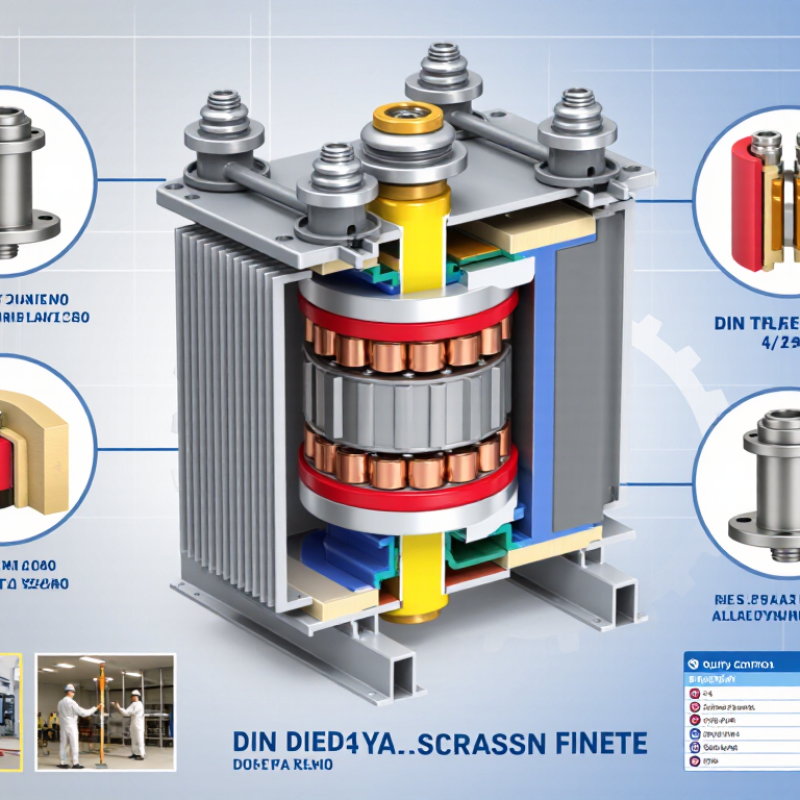
| Product definition | Transformer bushing designed to provide an insulated current path through the transformer tank or cover. | Porcelain-insulated bushing for oil-immersed distribution and power transformers. | Confirms that the product is intended for tank-wall electrical connection rather than for cable termination or switchgear use. |
| Applicable standard | Dimensional and application requirements should be checked against the latest applicable edition of DIN 42530 and the project specification. | DIN 42530 series; verify edition, drawing, and any customer-specific deviations before order approval. | Standard-number matching alone does not confirm interchangeability; mounting dimensions and conductor details must also match. |
| Rated voltage | Maximum system voltage for which the bushing is selected. | 1 kV class, commonly expressed as 1/250 in the product designation. | Prevents insulation coordination errors and ensures suitability for the transformer winding and network voltage. |
| Rated current | Continuous current capability under the applicable service and temperature conditions. | 250 A nominal continuous current. | The current rating must cover transformer full-load current, permissible overload conditions, and terminal temperature limits. |
| Insulating body | High-strength electrical porcelain with a glazed external surface. | Glazed ceramic insulation suitable for outdoor and oil-side transformer service. | Porcelain provides mechanical strength, weather resistance, and stable insulation performance over a long service life. |
| Conductor material | Current-carrying rod or terminal arrangement compatible with the transformer connection. | Typically copper or copper-alloy current path; confirm material, plating, and terminal form on the approved drawing. | Material compatibility affects contact resistance, thermal performance, corrosion resistance, and connection reliability. |
| Core function | Electrically isolate the energized conductor from the grounded transformer tank while transferring current through the tank wall. | Insulated feed-through between the transformer internal winding connection and the external busbar or cable connection. | This is the primary safety and operating function of the bushing. |
| Mounting arrangement | Tank-mounted construction with a flange, gasket, fixing hardware, and an internal oil-side connection. | Use the manufacturer’s certified dimensional drawing for flange diameter, hole pattern, projection, and terminal geometry. | Correct mounting dimensions are essential for oil tightness, electrical clearances, and replacement compatibility. |
| Sealing system | Oil-resistant gasket and sealing surfaces suitable for transformer insulating oil. | Elastomeric gasket selected for transformer oil, temperature range, and flange design. | Reliable sealing prevents oil leakage and the ingress of moisture that can reduce insulation performance. |
| Installation environment | Outdoor air-side exposure with the internal portion immersed in transformer oil. | Suitable for oil-immersed transformer applications; verify altitude, pollution level, humidity, and ambient temperature. | Environmental conditions influence creepage, insulation aging, gasket life, and corrosion protection. |
| Electrical clearance | Air and oil clearances must be maintained according to the approved transformer design. | Confirm clearances from the bushing drawing and transformer tank layout; do not infer them from the designation alone. | Adequate clearance reduces the risk of flashover, internal discharge, and accidental contact. |
| Mechanical requirements | Resistance to tightening loads, conductor forces, vibration, transport shock, and thermal expansion. | Supplier should provide mechanical drawings, tightening torque guidance, and transport protection details. | Mechanical failure or cracked porcelain can lead to oil leakage and electrical breakdown. |
| Routine quality checks | Inspection of dimensions, visual condition, terminal integrity, sealing surfaces, and insulation performance. | 100% visual and dimensional inspection recommended; electrical routine tests should follow the applicable standard and purchase specification. | Routine checks identify manufacturing defects before shipment and support traceability. |
| Recommended supplier capability | Ability to manufacture standard-compliant porcelain bushings and provide controlled drawings and test documentation. | Qualified ceramic forming, glazing, metalwork, sealing, inspection, and final assembly processes. | A complete process capability is more important than price alone for a safety-critical transformer component. |
| Supplier profile A | High-volume standard-component manufacturer. | Best suited to repeat orders requiring stable dimensions, short replenishment cycles, and standard documentation. | Evaluate production capacity, batch consistency, quality records, and availability of replacement parts. |
| Supplier profile B | Custom transformer-component manufacturer. | Best suited to projects requiring modified terminals, special flange geometry, or non-standard connection details. | Evaluate engineering support, drawing approval workflow, prototype capability, and change-control procedures. |
| Supplier profile C | Regional service and replacement supplier. | Best suited to urgent maintenance, retrofit, and small-batch replacement requirements. | Evaluate stock availability, dimensional verification, delivery response, and field technical support. |
| Documentation to request | Technical drawing, material information, inspection report, test certificate, installation instructions, and packing specification. | Documentation should identify the 1 kV / 250 A rating, applicable standard, revision level, and product traceability. | Complete documentation simplifies design approval, incoming inspection, installation, and future maintenance. |
| Procurement verification | Compare the approved drawing with the transformer tank interface before purchase. | Verify voltage, current, flange, hole pattern, terminal size, projection, gasket, polarity or phase marking, and packing method. | These checks reduce the risk of receiving a technically similar but mechanically incompatible bushing. |