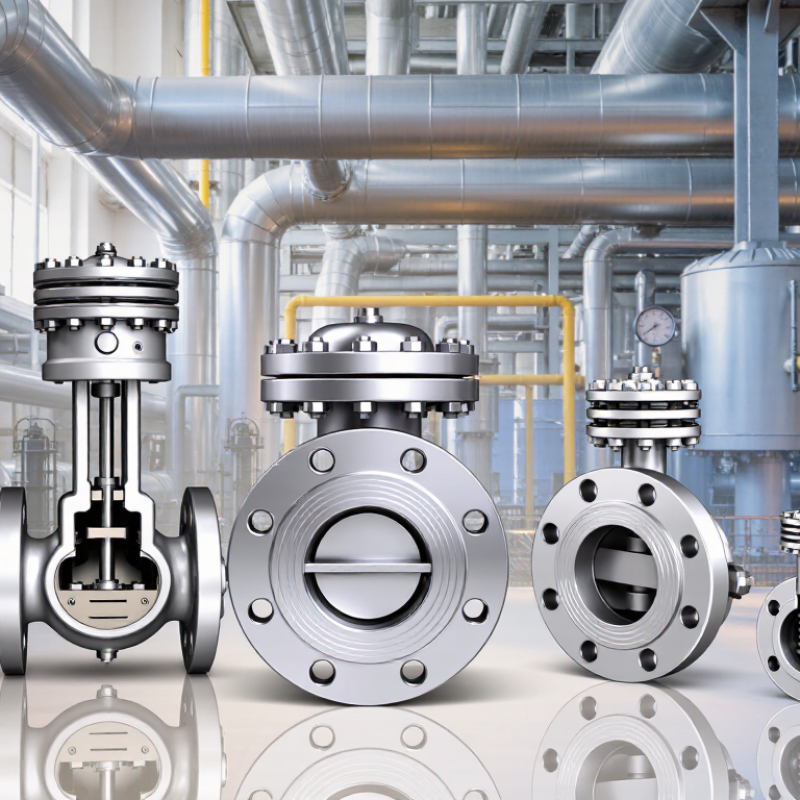
| Swing Check Valve | Prevents reverse flow in pipelines where steady, mostly horizontal flow is expected. | A hinged disc swings open with forward flow and returns toward the seat when flow stops or reverses. | Body, hinge, disc, hinge pin, seat, cover, and optional lever-and-weight or dashpot. | Generally low pressure loss at suitable flow velocity; may slam if reverse flow develops before the disc closes. | Simple construction, broad size range, and good capacity for water and clean liquids. | Can be sensitive to pulsating flow, installation orientation, and excessive flow velocity. | Water transmission, wastewater, fire-protection piping, cooling-water systems, and general process lines. |
| Lift Check Valve | Controls backflow in clean liquid, steam, gas, and process piping, particularly where reliable guided closure is required. | A piston or disc moves vertically from the seat when inlet pressure exceeds outlet pressure and closes when the pressure differential reverses. | Body, guided disc or piston, seat, spring in spring-loaded designs, cover, and guide arrangement. | Usually higher pressure drop than a swing design because flow changes direction inside the body; fast closure is possible with a spring. | Good shutoff control, compact travel, and suitability for higher-pressure services. | Normally requires a suitable flow direction and is less tolerant of dirty or heavily contaminated media. | Steam systems, compressed air, gas processing, boiler piping, and high-pressure process lines. |
| Wafer Dual-Plate Check Valve | Provides non-return protection where low weight, short face-to-face length, and space efficiency are important. | Two spring-loaded plates pivot on a central hinge or shaft and open under forward flow. | Wafer body, two plates, hinge pins, central shaft, springs, seat, and sealing elements. | Lower inertia and generally quicker closure than a large swing disc; pressure loss depends on plate design and flow velocity. | Lightweight, compact, economical in large sizes, and suitable for installation between flanges. | Requires correct flange alignment; spring and plate mechanisms may be unsuitable for abrasive or highly fouling media. | Water, HVAC, seawater, fire-protection systems, chemical piping, and utility services. |
| Tilting-Disc Check Valve | Reduces flow disturbance and closure shock in large-diameter, high-capacity pipeline systems. | An eccentrically mounted disc tilts around a pivot, requiring less travel than a conventional swing disc. | Body, pivot shaft, tilting disc, seat ring, bearings, cover, and optional hydraulic or counterweight closing device. | High flow capacity with relatively low pressure loss; closure behavior can be controlled to reduce water hammer. | Fast response, reduced slam potential, and good performance in large pipelines. | More complex and costly than basic swing designs; requires correct sizing and maintenance of pivot components. | Large water pipelines, pump discharge lines, power stations, and industrial circulation systems. |
| Piston Check Valve | Offers guided non-return control and improved damping for high-pressure liquid, steam, and process services. | A piston or plug moves axially inside a chamber; pressure differential opens it and reverse pressure closes it against the seat. | Body, piston, guide, seat, damping chamber, spring where fitted, cover, and sealing rings. | Stable closure and effective damping; pressure drop can be relatively high because of the guided internal passage. | Good resistance to rapid cycling and reduced tendency to chatter when properly sized. | Not ideal for dirty media; internal clearances and seals require suitable material selection and maintenance. | Refineries, petrochemical plants, steam systems, compressor discharge lines, and high-pressure process piping. |
| Diaphragm Check Valve | Prevents reverse flow while isolating the operating mechanism from corrosive, sterile, or contamination-sensitive media. | A flexible diaphragm deflects under forward pressure and returns to the seat when pressure falls or reverses. | Body, flexible diaphragm, seat, retainer, bonnet or cover, and optional support components. | Moderate flow capacity; pressure loss and cracking pressure vary significantly with diaphragm material and design. | No exposed stem packing, low contamination risk, and strong corrosion resistance when compatible materials are used. | Diaphragm fatigue, temperature limits, and material compatibility must be carefully evaluated. | Chemical dosing, pharmaceutical processing, sanitary systems, corrosive fluids, and laboratory equipment. |
| Ball Check Valve | Provides simple backflow prevention in liquid systems, especially where the medium may contain suspended solids. | A ball lifts away from the seat during forward flow and settles onto the seat when flow reverses. | Body, spherical ball, seat, cover, and optional guide or cage. | Typically moderate pressure loss; full-port designs can reduce clogging and improve solids handling. | Compact, self-cleaning in many services, and available with resilient or metal seating. | May require a minimum flow velocity to open fully; ball wear can occur in abrasive or high-cycle service. | Wastewater, slurry handling, pump systems, drainage, sewage, and low-to-medium pressure liquid lines. |
| Foot Valve | Maintains pump priming by preventing liquid from draining back through the suction line; often includes a strainer. | The valve opens when the pump creates suction and closes when the pump stops or flow reverses. | Valve body, disc, ball or poppet, seat, spring where fitted, inlet strainer, and connection assembly. | Adds suction-side pressure loss; the strainer must be sized to avoid excessive restriction and cavitation risk. | Combines non-return protection and debris screening at the suction pipe inlet. | Strainer blockage can reduce pump inlet pressure; access for cleaning should be considered during installation. | Well pumps, irrigation, water-transfer systems, tanks, chemical feed systems, and suction-lift installations. |