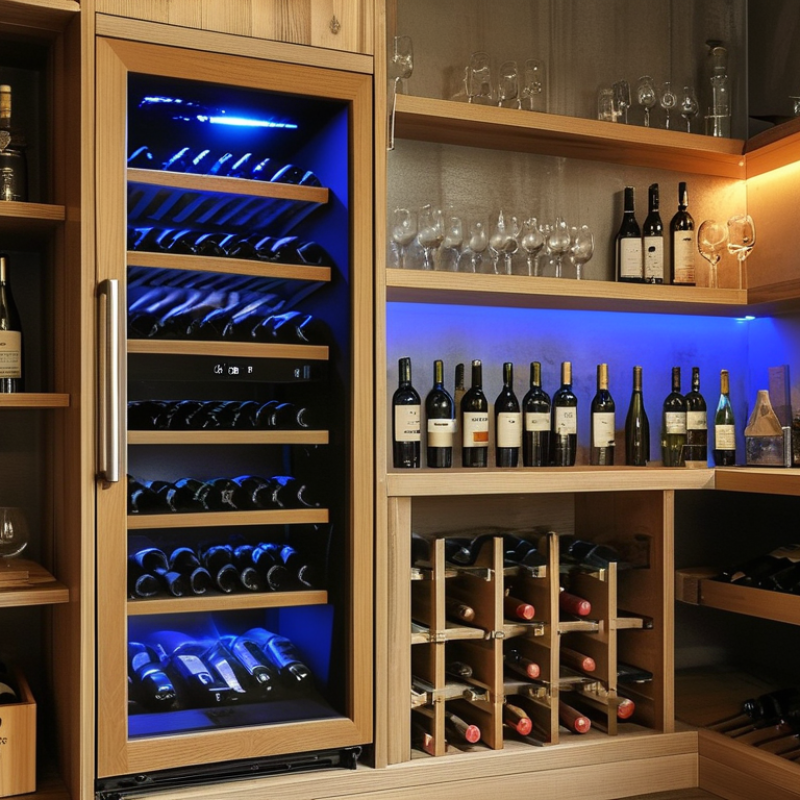
| Small household or apartment | 12–30 standard 750 ml bottles | One zone, approximately 10–14°C for mixed long-term storage | Compact footprint, adjustable shelves, interior light, reversible door if available | Leave ventilation clearance around the cabinet; avoid direct sunlight and heat-producing appliances | Exterior dimensions, noise level, door swing, plug type, voltage, and usable rather than advertised capacity |
| Mixed collection of red and white wines | 30–80 bottles | Dual zone; commonly about 8–12°C for whites and 12–18°C for reds, depending on serving preference | Independent digital controls, stable airflow, removable shelves, low-vibration operation | Freestanding models are easier to place; built-in models require specified front ventilation | Actual temperature range in each zone, zone separation, shelf spacing, and recovery time after door opening |
| Long-term aging collection | 50–150 bottles | Stable single zone around 12–14°C is generally suitable for aging most wines | Consistent temperature, humidity management, UV-resistant glass, charcoal or odor filtration, vibration reduction | Place in a temperature-stable indoor room away from radiators, ovens, windows, and strong vibration | Temperature stability, alarm functions, replacement filter availability, door seal quality, and shelf load rating |
| Frequent entertaining and serving | 40–100 bottles | Two zones or a dedicated serving zone; whites are usually served cooler than reds | Pull-out shelves, clear labeling, bright but low-heat lighting, wide door opening, quick-access layout | Allow enough front clearance for shelves and door movement; keep the unit level | Shelf ergonomics, bottle visibility, door lock, noise rating, and ease of cleaning spills |
| Large private cellar or hospitality use | 100–300+ bottles | Single-zone aging storage or multiple independently controlled zones | High-capacity compressor system, strong insulation, commercial-grade hinges, lockable door, serviceable components | Confirm floor loading, dedicated electrical requirements, ventilation, delivery access, and service support | Rated energy consumption, warranty coverage, spare parts, compressor type, temperature alarms, and maintenance access |
| Built-in kitchen installation | 24–80 bottles | One or two zones according to the collection and serving plan | Front ventilation, flush-fitting design, adjustable feet, integrated handle, concealed controls | Follow the installation manual exactly; do not block front or rear ventilation openings | Cutout dimensions, ventilation path, hinge configuration, electrical outlet position, and installation certification |
| Hot or humid climate | 30–150 bottles | Stable storage setting around 12–14°C; confirm the appliance’s rated ambient operating range | Efficient insulation, reliable compressor cooling, door-open alarm, anti-condensation design, moisture-resistant materials | Keep away from outdoor heat, damp walls, and direct solar radiation; provide adequate airflow | Climate class, ambient-temperature limit, energy use in local conditions, condensation control, and voltage compatibility |
| Energy-conscious buyer | 20–120 bottles | Use the narrowest practical temperature range and avoid unnecessary zone separation | Thick insulation, efficient compressor, low-emissivity glass, automatic lighting, sleep or eco mode | Place in a cool indoor location with sufficient ventilation to reduce cooling workload | Regional energy label, annual kWh rating, standby consumption, refrigerant information, and repairability |