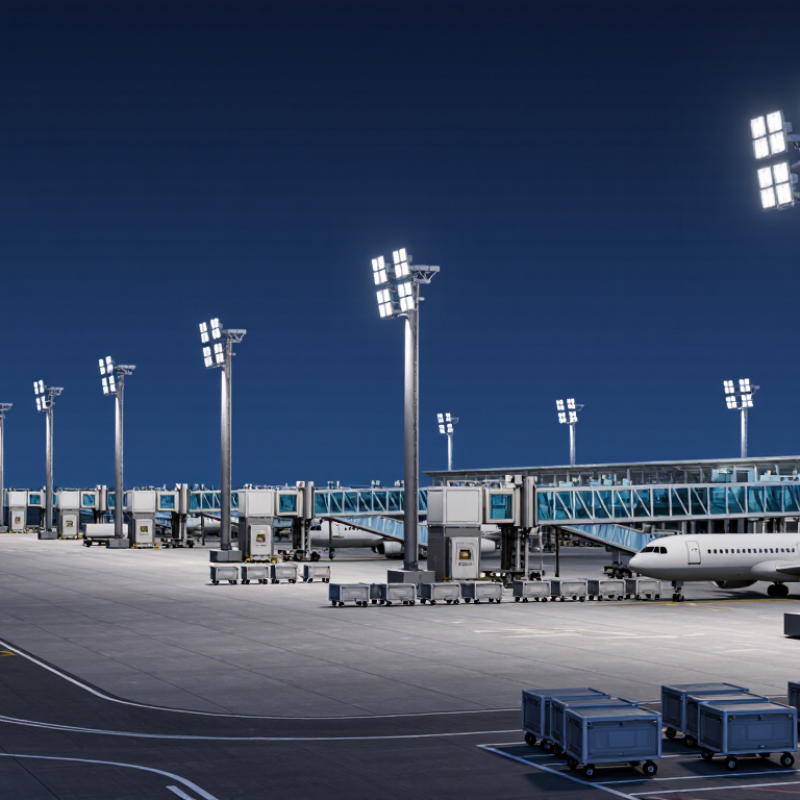
| Apron average horizontal illuminance | 20 lux minimum benchmark for aircraft stand areas | Supports aircraft servicing, ground handling, loading, inspection, and safe vehicle movement during night operations. | ICAO Annex 14, Volume I, apron floodlighting provisions; verify the current edition and the applicable national aviation rules. |
| 20-lux unit conversion | Approximately 1.86 foot-candles | Useful when comparing tender documents that use SI units and imperial units. | 1 foot-candle = 10.764 lux; 20 lux ÷ 10.764 = 1.86 foot-candles. |
| Average-to-minimum uniformity | Maximum ratio of 4:1 for aircraft stand areas | Limits dark patches and excessive contrast that can affect personnel visibility and ground operations. | ICAO apron floodlighting recommendation; the project lighting calculation should demonstrate compliance. |
| Illuminance measurement plane | Horizontal plane at the apron or aircraft stand surface | Provides a consistent basis for photometric calculations, acceptance testing, and maintenance checks. | Use a defined measurement grid and calibrated lux meter during commissioning. |
| Light source technology | LED floodlight with photometric files for project calculation | LED systems can provide directional optics, instant switching, dimming, and lower maintenance than many legacy discharge systems. | Performance must be verified from LM-79 or equivalent photometric test data and the submitted IES/LDT file. |
| Typical correlated color temperature | 3,000–5,000 K, selected by the airport lighting designer | Affects visual comfort, color recognition, glare perception, and compatibility with surrounding airport lighting. | CCT is a project choice, not a universal ICAO apron requirement; evaluate glare, wildlife, and local environmental rules. |
| Color rendering | CRI typically ≥70 for general outdoor industrial lighting; higher values may be specified | Improves recognition of equipment, safety markings, cables, fluid leaks, and aircraft surface conditions. | Confirm the required CRI in the airport’s technical specification; it is not a substitute for illuminance and uniformity compliance. |
| Glare and stray-light control | Use asymmetric optics, shielding, aiming limits, and controlled tilt | Reduces discomfort glare and unwanted light toward pilots, control towers, adjacent roads, and neighboring properties. | Confirm compatibility with aerodrome safeguarding, obstacle limitation, and local light-pollution requirements. |
| Ingress protection | IP66 minimum is commonly specified for exposed airport floodlight housings | Protects the enclosure against dust and powerful water jets in demanding outdoor environments. | Verify the rating through an independent test report; IP ratings do not define impact, corrosion, or wind resistance. |
| Impact protection | IK08 or IK10 where the risk assessment requires enhanced mechanical protection | Helps protect luminaires from accidental contact, maintenance activity, and airport service-vehicle exposure. | Select the IK level according to site risk and confirm compliance with IEC 62262 test classifications. |
| Operating temperature | Specify the actual site range; many outdoor products are rated around −40°C to +50°C | Ensures reliable starting, thermal management, and driver performance in cold, hot, or desert climates. | The stated range is a common procurement target, not a universal requirement; check the product data sheet. |
| Surge protection | Specify a site-appropriate combination of internal and external surge protection | Reduces damage from switching events and lightning-related surges on long outdoor cable runs. | The required test level depends on the electrical design, earthing system, exposure, and local standards. |
| Commissioning evidence | Provide lux-grid measurements, aiming records, as-built drawings, and maintenance instructions | Creates an auditable record that the installed floodlighting achieves the approved design values. | Acceptance criteria should be agreed before installation and checked against the current airport authority requirements. |