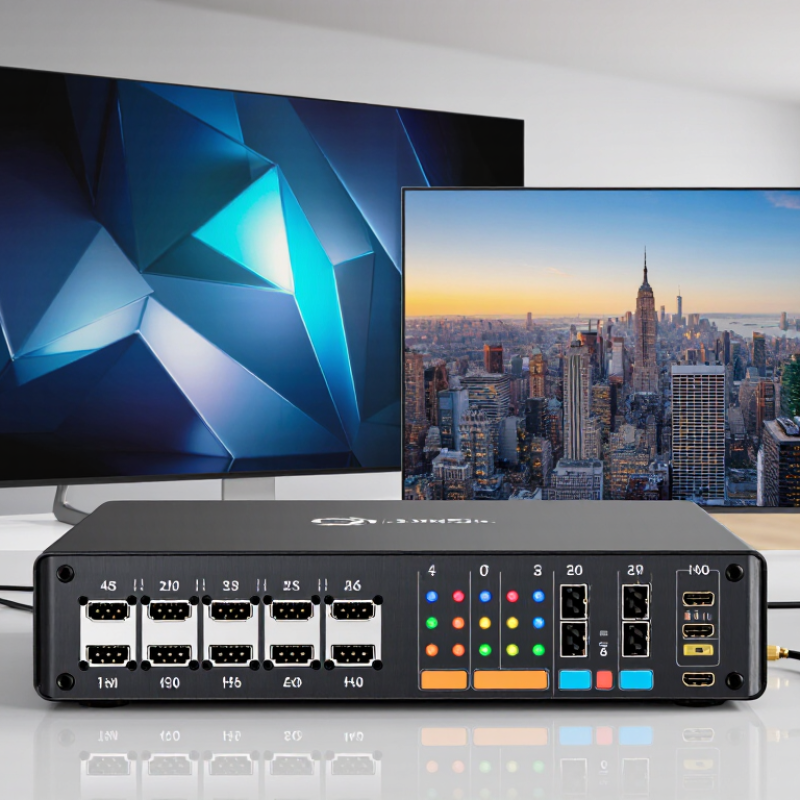
| Port Configuration | 4 HDMI inputs / 2 HDMI outputs | Allows four source devices to share two displays or zones while preserving the intended 4x2 routing function. | Confirm that all four inputs and both outputs are HDMI ports, not a combination of HDMI, DisplayPort, or inactive service ports. |
| Switching Flexibility | Independent output selection, with each output able to select any connected input | Independent routing is more useful than mirrored-only operation for conference rooms, classrooms, retail displays, and home entertainment systems. | Check the routing diagram and confirm combinations such as Output 1 = Input 1 and Output 2 = Input 3. |
| HDMI Bandwidth | Up to 18 Gbps for HDMI 2.0-class operation | 18 Gbps is the bandwidth commonly associated with 4K at 60 Hz using 4:4:4 chroma at 8-bit color depth, subject to the source and display. | Look for a stated bandwidth figure and a clear test specification rather than relying only on a “4K” label. |
| Supported Resolution | Up to 3840 × 2160 at 60 Hz; support for 1920 × 1080 at 60 Hz | 4K60 is suitable for most current presentation, streaming, signage, and consumer video applications, while 1080p compatibility improves system flexibility. | Verify the exact resolution and refresh-rate combinations for both simultaneous outputs. |
| Color and Chroma | 4:4:4 and 4:2:2 support at compatible resolutions; 8-bit support as a minimum | Higher chroma fidelity improves text clarity and desktop graphics, while reduced chroma formats may be used for bandwidth-heavy video signals. | Review the supported color format, color depth, and maximum resolution together; these specifications are interdependent. |
| HDR Compatibility | HDR10 pass-through; additional HDR formats only when explicitly documented | HDR10 is an open HDR format widely used by televisions, streaming devices, game consoles, and Ultra HD Blu-ray equipment. | Confirm HDR pass-through with the chosen source, display, cable length, and output configuration. |
| HDCP Compliance | HDCP 2.2 pass-through, with backward compatibility for HDCP 1.4 where specified | HDCP compatibility helps prevent blank screens when protected content is routed from modern sources to 4K displays. | Check the exact HDCP versions supported on the inputs and outputs, not just a general “HDCP compliant” statement. |
| EDID Management | Automatic EDID plus selectable modes such as copy, fixed 1080p, and fixed 4K | EDID controls how source devices detect display capabilities and can reduce resolution drops, handshake failures, and intermittent blank screens. | Look for an EDID switch, button, software setting, or documented procedure for mixed-display installations. |
| Audio Pass-Through | Support for stereo PCM and multichannel formats up to 7.1 channels when supported by the complete signal chain | Audio pass-through is important when displays, AV receivers, soundbars, and extractors use different audio capabilities. | Verify support for LPCM, Dolby, and DTS formats separately; audio performance depends on the source and destination devices. |
| Audio Extraction | Optional analog stereo or digital audio output, clearly identified if included | Audio extraction allows external speakers or an amplifier to receive sound independently from the display. | Confirm the output connector type, supported audio formats, and whether extracted audio is available from every HDMI input. |
| Control Methods | Front-panel buttons, infrared remote, and at least one professional control option such as RS-232 or IP | Multiple control methods support local operation, concealed installations, automation systems, and remote troubleshooting. | Check whether RS-232 or IP control is actually available and whether command documentation is provided. |
| Automatic Switching | Auto-switching with manual override and a reliable priority rule | Automatic switching is convenient for meeting rooms and shared systems, but manual override is necessary when multiple active sources are connected. | Test source priority, active-signal detection, and recovery behavior after a source is disconnected and reconnected. |
| Signal Reliability | Stable operation with certified high-speed HDMI cables appropriate to the required distance | Many apparent matrix-switch failures are caused by cable loss, marginal connectors, incompatible displays, or excessive cable length. | Review maximum tested cable distances and use appropriately rated cables for the selected resolution and refresh rate. |
| Power and Thermal Design | External power supply with clear input-voltage requirements and ventilation provisions | Continuous commercial use can expose weak power supplies and inadequate cooling, leading to resets or signal interruptions. | Confirm the supported mains input range, power-adapter certifications, operating temperature range, and ventilation guidance. |
| Global Installation Readiness | 100–240 V AC power input or region-appropriate certified adapter, with applicable safety markings | Universal-voltage support simplifies deployment across regions and reduces the need for separate power versions. | Check the adapter label, plug type, frequency range, and safety certifications required in the destination market. |
| Physical Installation | Metal enclosure, labeled ports, non-blocking connectors, and optional mounting hardware | A durable enclosure and accessible labeling improve serviceability in racks, cabinets, meeting rooms, and equipment shelves. | Review enclosure dimensions, mounting-hole locations, connector spacing, and cooling clearance. |
| Firmware and Documentation | Published user manual, EDID/control instructions, firmware procedure, and troubleshooting guide | Clear documentation reduces setup time and makes compatibility problems easier to diagnose across different countries and system designs. | Download the manual before purchase and confirm that control commands, indicators, and update procedures are documented. |
| Testing and Warranty | Documented quality testing, traceable support contact, and a clearly stated warranty and return policy | Support and replacement terms are especially important for international buyers facing shipping, customs, and installation delays. | Review warranty duration, regional service arrangements, return conditions, and response channels before ordering. |