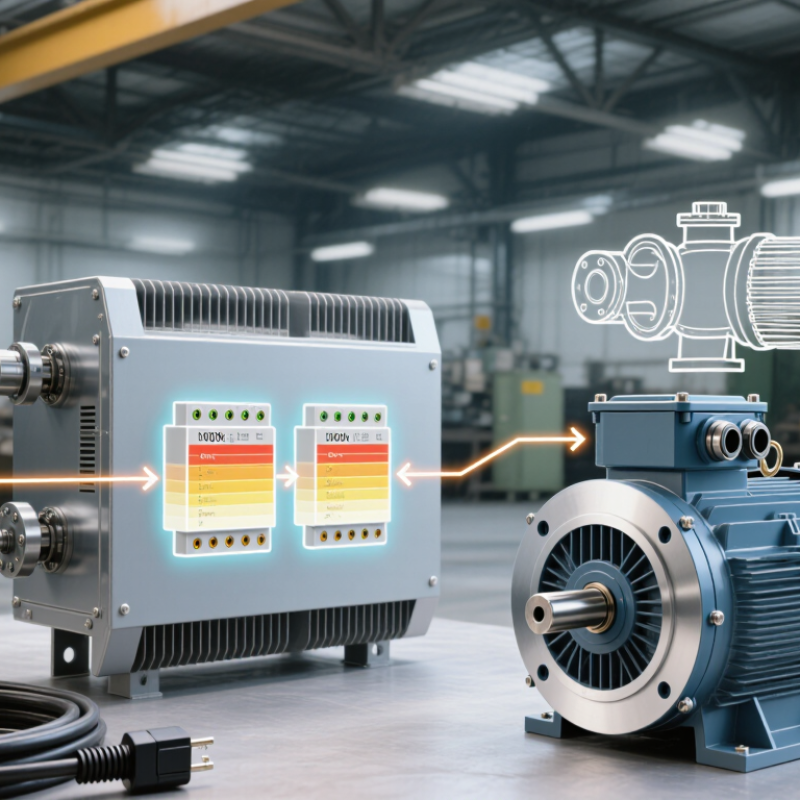
| Definition | A soft starter is an electronic device that gradually increases the voltage supplied to an AC motor during startup. | It helps limit starting current and reduce mechanical shock compared with starting the motor directly across the line. |
| Meaning of “200 kW” | 200 kW usually refers to the motor’s rated mechanical output power, not the soft starter’s current rating. | The starter must be selected using the motor nameplate current, supply voltage, operating duty, and starting requirements. |
| Typical applications | Large pumps, fans, compressors, conveyors, and other three-phase motor-driven equipment. | Soft starting can reduce pressure surges, belt stress, and abrupt torque loads, depending on the application and settings. |
| How voltage is controlled | Power semiconductors, commonly thyristors, control the voltage applied to the motor during the start ramp. | The starter adjusts the ramp and current limit to help the motor accelerate smoothly. |
| Typical starting-current setting | Many applications use a current limit in the approximate range of 2–4 times the motor’s rated current; the suitable value varies. | Load inertia, required acceleration time, motor characteristics, and the supply system all affect the setting. |
| Illustrative full-load current at 400 V | Approximately 358 A, assuming 200 kW output, 0.85 power factor, and 95% motor efficiency. | This is an estimate, not a selection value. Use the motor nameplate current for final sizing. |
| Illustrative full-load current at 415 V | Approximately 345 A, using the same power factor and efficiency assumptions. | Current changes with supply voltage and actual motor operating characteristics. |
| Illustrative full-load current at 690 V | Approximately 207 A, using the same power factor and efficiency assumptions. | A higher voltage generally means lower current for the same three-phase output power. |
| Current estimate formula | I ≈ P ÷ (√3 × V × power factor × efficiency) | For the example, P = 200,000 W. The formula estimates three-phase motor current; nameplate data takes precedence. |
| After the motor starts | Many installations use a bypass contactor to carry motor current after acceleration, if the starter design supports it. | A standard soft starter is primarily for starting and stopping; it does not normally provide continuous variable-speed control. |
| Protection and selection | Check the starter’s rated operational current, voltage, duty class, start frequency, ambient conditions, and required protections. | Confirm coordination with fuses or circuit breakers, overload protection, cabling, and the motor manufacturer’s requirements. |