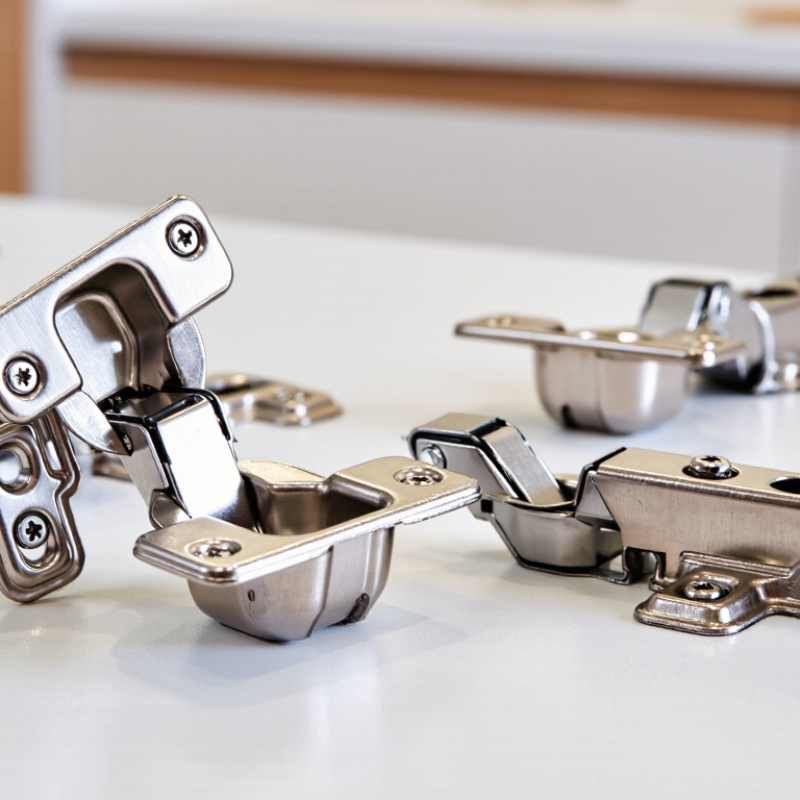
| Opening Angle and Clearance | Confirm the hinge achieves the required opening angle in the intended cabinet or door geometry. “180 degree” performance can depend on the hinge design, mounting plate, door thickness, and surrounding panels. | Install samples on a representative cabinet or test fixture. Measure the usable opening angle and check for interference throughout the opening path. | Dimensioned installation drawing, technical data sheet, and sample-test record showing the mounting conditions. | Result: __________
Score: ____ / 5 |
| Load and Door Compatibility | Assess suitability for the specified door material, dimensions, weight, hinge quantity, and mounting arrangement. Do not rely on a load figure without its test conditions. | Ask the supplier to state the supported door configuration and test setup. Validate the intended configuration using a representative door and the proposed number of hinges. | Load-test report or documented test setup, recommended hinge quantity, and installation limits for the application. | Result: __________
Score: ____ / 5 |
| Durability and Cycle Testing | Check whether opening-and-closing durability has been tested and whether the test reflects the intended use. Cycle life should be compared only when test conditions are comparable. | Request the cycle count, test load, opening angle, speed, sample quantity, and failure criteria. Agree on a project-specific acceptance target before testing. | Test report identifying the sample, test conditions, number of cycles, observations, and final inspection results. | Target: __________
Result: __________
Score: ____ / 5 |
| Corrosion Resistance and Finish | Evaluate the finish for the expected environment, including indoor humidity or other exposure conditions. Salt-spray hours are not a universal measure of service life. | Specify the test method and acceptance criteria in advance. Where appropriate, request testing under ISO 9227 or ASTM B117 and review the reported test conditions and coating defects. | Coating specification, test report, surface-finish samples, and agreed acceptance criteria for corrosion or appearance. | Method / target: __________
Score: ____ / 5 |
| Materials and Component Consistency | Confirm the declared materials for hinge arms, cups, pins, springs, and other critical components, as applicable to the design. | Compare the bill of materials and drawings with production samples. Use suitable material verification, such as certificate review or independent testing, when required by the project. | Material specifications, supplier certificates where applicable, component drawings, and sample inspection records. | Verified items: __________
Score: ____ / 5 |
| Dimensional Accuracy | Check critical dimensions, hole positions, mounting interfaces, and adjustment range against the approved drawing. | Measure samples using calibrated instruments or suitable gauges. Confirm the drawing revision and tolerance requirements used for inspection. | Approved dimensional drawing, inspection report, measurement records, and gauge-calibration records. | Critical dimensions checked: __________
Score: ____ / 5 |
| Customization Capability | Assess the supplier’s ability to adapt dimensions, mounting plates, finishes, damping features, packaging, or other requirements, where the design permits. | Submit a written specification and request a feasibility review, prototype schedule, tooling details, minimum order quantity, and quotation for each requested change. | Written feasibility confirmation, prototype samples, revised drawings, quotation, and agreed tooling ownership or charges. | Requirements met: __________
Score: ____ / 5 |
| Production Quality Control | Review controls for incoming materials, production processes, final inspection, nonconforming products, and batch traceability. | Audit the documented inspection flow. Agree on sampling and acceptance criteria, such as an AQL plan where appropriate, in the purchase specification or quality agreement. | Inspection plan, sample inspection records, nonconformance procedure, traceability example, and relevant quality-system documentation. | Audit findings: __________
Score: ____ / 5 |
| Sample-to-Mass-Production Consistency | Confirm that approved samples, drawings, materials, and finish are controlled and matched during production. | Retain an approved “golden sample.” Compare pre-shipment samples or inspection samples with the approved sample and current drawing revision. | Signed sample approval, revision-controlled drawings, change-notification procedure, and pre-shipment inspection report. | Consistency check: __________
Score: ____ / 5 |
| Commercial and Delivery Readiness | Evaluate quoted lead time, minimum order quantity, packaging, spare-parts availability, and the supplier’s process for communicating delays or changes. | Request a written quotation and production schedule for the specified product, quantity, finish, packaging, and inspection requirements. | Quotation, confirmed lead-time schedule, packaging specification, and written order-change or delay communication process. | Assessment: __________
Score: ____ / 5 |
| Overall Supplier Evaluation | Compare shortlisted suppliers using the same specification, sample conditions, test methods, and scoring rules. | Score each dimension from 1 (insufficient evidence or poor fit) to 5 (requirements met with verifiable evidence). Apply project-specific weightings if needed. | Completed evaluation records, test reports, approved samples, and agreed purchase specifications. | Total: ____ / 50
Decision: __________ |
| Interpretation Note | Use this table as a supplier-evaluation framework, not as a ranking of named manufacturers. Durability targets, corrosion acceptance limits, sampling plans, and load requirements should be defined for the actual application; there is no single universal pass value for every 180-degree concealed hinge. |